
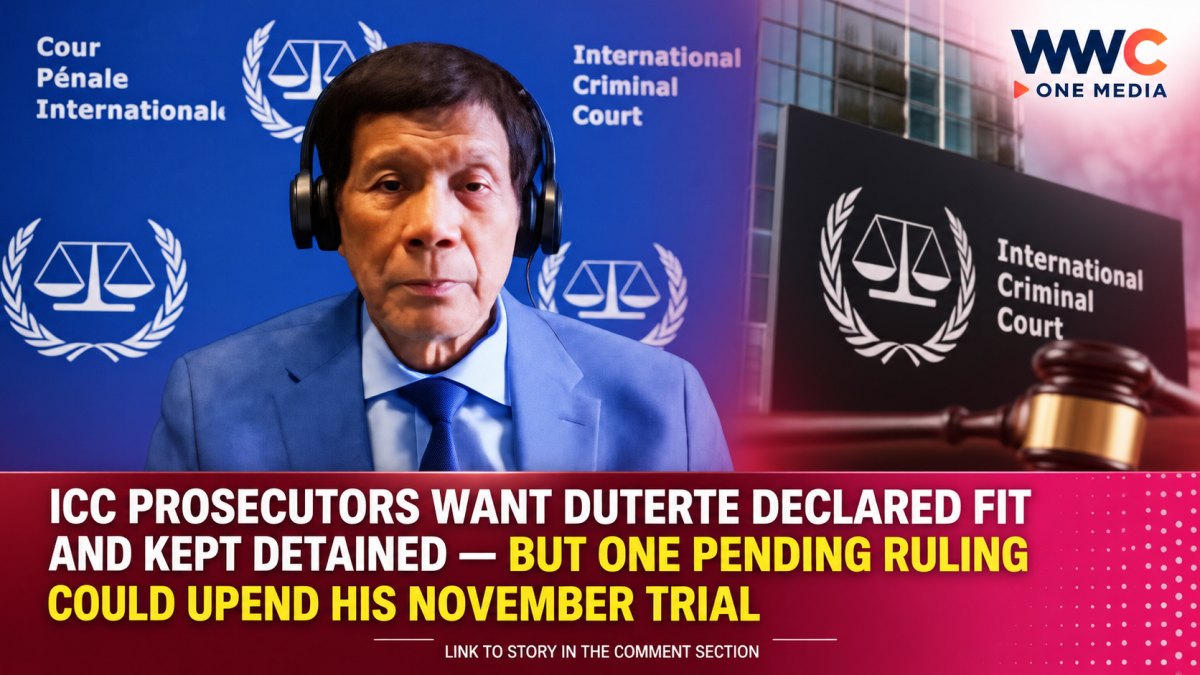
MANILA/THE HAGUE — International Criminal Court prosecutors are pressing judges for two decisions that could determine whether former Philippine President Rodrigo Duterte’s long-awaited crimes-against-humanity trial begins as scheduled on November 30.
First, prosecutors want Trial Chamber III to formally declare the 81-year-old former president fit to stand trial after a new round of medical examinations.
Second, they want him kept in detention in The Hague, arguing that the risks of flight and interference with witnesses have not disappeared—and may actually have increased as the case moves closer to trial.
But neither question has yet been finally decided in this latest round.
And that distinction is crucial.
Duterte was found fit to participate in pre-trial proceedings in January. The judges now handling his full trial deliberately ordered another assessment because the demands of an actual trial are different and potentially much greater.
The result could determine whether the most consequential international criminal case involving a former Philippine president stays on schedule—or faces another major delay.
Prosecutors: Medical reports show Duterte can stand trial
ICC Deputy Prosecutor Mame Mandiaye Niang has asked Trial Chamber III to find Duterte fit for the proceedings after court-appointed medical specialists submitted their latest joint and individual assessments.
In a September 7 filing made public this week, the prosecution argued that the experts’ reports demonstrate that Duterte possesses sufficient capacity to proceed to trial.
Much of the underlying medical information remains redacted from the public record, meaning outsiders cannot independently examine the full clinical evidence on which both sides are relying.
The prosecution’s filing referred to what it characterized as reduced effort and unreliability during portions of Duterte’s assessments, but the detailed medical findings behind those arguments are confidential or redacted.
That makes one point particularly important for responsible reporting:
Prosecutors believe the evidence establishes fitness. The judges have not yet adopted that conclusion.
Under ICC procedure, medical experts provide specialist assessments, but it is ultimately the Trial Chamber—not the doctors and not the prosecution—that decides whether an accused person is legally fit to stand trial.
This is not the same fitness ruling Duterte already lost in January
The health issue can be confusing because the ICC has already ruled once that Duterte was fit.
On January 26, 2026, Pre-Trial Chamber I rejected his defense team’s request for an indefinite adjournment and found him capable of participating effectively in the pre-trial phase.
That decision followed assessments by a three-member panel of independent medical experts.
The chamber concluded that Duterte had sufficient ability to understand the proceedings and exercise his procedural rights at that stage.
Duterte’s lawyers unsuccessfully tried to challenge that decision before the confirmation-of-charges proceedings continued in February.
But after the case moved from the Pre-Trial Chamber to Trial Chamber III, the new judges said they had not themselves resolved Duterte’s fitness for the demands of a full trial.
They therefore ordered a fresh medical examination in June.
“The Chamber is yet to address and resolve” trial fitness, the judges said, noting that the earlier assessment had been confined to the pre-trial stage.
That means the latest prosecution request is not simply asking the ICC to repeat an old decision.
It asks a different chamber to decide whether Duterte can meaningfully participate in the trial itself.
What does “fit to stand trial” actually mean?
Fitness is not the same thing as being in perfect health.
Nor does an accused need the knowledge or mental ability of a trained lawyer.
ICC case law focuses instead on whether the person can meaningfully exercise fair-trial rights.
Relevant abilities include understanding the purpose and consequences of the case, following the proceedings and evidence, communicating with and instructing lawyers, and giving a statement or testimony if the accused chooses to do so.
That is especially important in Duterte’s case because his defense has repeatedly argued that he suffers from serious cognitive impairment.
His previous lawyers told judges in 2025 that memory problems allegedly affected his ability to recall events, places, dates and even people close to him. The defense contended that his condition prevented him from properly assisting counsel.
Those were defense claims, not independent judicial findings.
The January 2026 Pre-Trial Chamber ruling ultimately concluded that the medical evidence did not render him incapable of taking part in those earlier proceedings.
The question now is whether Trial Chamber III reaches the same conclusion for what could be a lengthy and demanding trial.
If the judges find him unfit, the case does not automatically disappear
This may be the most misunderstood part of the fitness dispute.
An unfitness ruling would not amount to an acquittal, nor would it automatically terminate the criminal case.
Rule 135 of the ICC Rules of Procedure and Evidence says that if the Trial Chamber is satisfied an accused is unfit, it must adjourn the trial.
The court can subsequently order further examinations, and the case ordinarily must be reviewed every 120 days unless there are reasons to proceed differently.
If the accused later becomes fit, the proceedings may resume.
So the immediate consequence of an unfitness finding would likely be delay—not a judgment on whether Duterte committed the crimes alleged against him.
That difference matters amid recurring misinformation online suggesting that health disputes could mean Duterte has “won” his ICC case or is automatically entitled to return to the Philippines.
He has not been acquitted, and the charges remain pending.
Prosecutors also want Duterte to stay behind bars
Running alongside the medical dispute is another battle: whether Duterte should continue to be detained at the ICC’s detention facility in Scheveningen, The Hague.
Niang told Trial Chamber III that there had been no material change that justified reversing the court’s previous detention decisions.
Instead, prosecutors argue the risk has increased as the trial approaches.
They point to the existence of a definitive trial date and argue that the prospect of facing the full case could increase the incentive to flee.
Prosecutors have also raised the risk of possible interference with witnesses.
Duterte’s defense was given the prosecution’s witness list on August 31, including names and descriptions of expected testimony.
The prosecution argues that because Duterte now knows the identities of witnesses who could testify against him, continued detention remains necessary to protect the proceedings.
Again, this is the prosecution’s legal position.
Trial Chamber III must decide whether the statutory requirements for continued detention remain satisfied.
Prosecutors say the case has grown since the last detention decision
The prosecution’s latest submission also says its trial case now encompasses additional incidents compared with the circumstances considered during the court’s May detention review.
Niang referred to eight additional incidents contained in the prosecution’s still-confidential trial materials and argued that the number of incidents and victims relevant to the case has increased.
According to the prosecution, that raises the potential seriousness of the sentence Duterte could face if ultimately convicted and therefore strengthens the argument that he could have a greater incentive to abscond.
This should not be confused with a judicial finding that eight new crimes have been proven.
Nor does the filing itself mean Duterte has already been convicted of anything.
The prosecution is laying out the case it intends to prove at trial.
Duterte is presumed innocent unless and until the ICC establishes guilt beyond a reasonable doubt.
Duterte’s lawyers say fitness and detention cannot simply be separated
The defense is taking a different approach.
Lead counsel Peter Haynes KC told the chamber that Duterte’s fitness and continued detention are closely connected.
The defense has indicated it wants the fitness question resolved before deciding whether to seek another full review of his detention.
Its argument is straightforward: if the chamber were to find Duterte unfit and postpone the trial, that could constitute a significant change in circumstances relevant to whether detention remains justified.
Haynes said the defense intends to invoke Duterte’s right to seek another detention review after the fitness ruling if circumstances warrant it.
That sets up a potentially important sequence.
First: Is Duterte capable of being tried?
Then, depending on that answer: Does he still need to remain detained?
Why has the ICC kept Duterte detained until now?
Duterte has repeatedly sought release since being transferred to ICC custody in March 2025.
Judges have consistently rejected those requests.
Trial Chamber III ruled again on May 22, 2026 that there had been no material change warranting his release.
Among the factors previously cited by judges were Duterte’s resources and political connections, his continued influence in the Philippines, his rejection of the ICC’s jurisdiction, and the possibility that associates could assist him in avoiding the court or interfering with proceedings.
Judges also noted his decision not to attend the February confirmation hearing after being permitted to waive his presence.
The ICC has therefore treated health and detention as related factual issues but legally distinct questions.
A person can have health problems and still satisfy the legal test for detention.
Similarly, being detained does not itself establish that someone is fit for trial.
Duterte now faces a full crimes-against-humanity trial
The proceedings reached a critical turning point on April 23, 2026, when ICC Pre-Trial Chamber I unanimously confirmed all charges against Duterte and committed him to trial.
The judges found substantial grounds to believe that he was responsible for crimes against humanity of murder and attempted murder allegedly committed as part of a widespread and systematic attack on civilians in connection with the Philippine anti-drug campaign.
The confirmed case covers alleged conduct between November 1, 2011 and March 16, 2019, encompassing periods when Duterte was mayor of Davao City and later president of the Philippines.
Reuters reported that the confirmed case then linked Duterte to the alleged murders of 76 people and attempted murders of two others.
Prosecutors allege that he participated in a common plan targeting suspected drug offenders and other alleged criminals.
Duterte has rejected accusations that he directed unlawful killings. His lawyers have argued that his public statements about killing criminals were rhetoric and that police were authorized to use lethal force only when necessary in self-defense.
The April confirmation ruling was not a conviction.
At that stage, ICC judges needed only to find “substantial grounds to believe” the crimes occurred and that Duterte was responsible.
The prosecution will face the much higher beyond-a-reasonable-doubt standard if it seeks a conviction at trial.
Why can the ICC still prosecute him after the Philippines withdrew?
Duterte and his allies have repeatedly challenged the ICC’s authority over the Philippines.
The country withdrew from the Rome Statute effective March 17, 2019.
But the ICC maintains that the withdrawal did not erase jurisdiction over alleged crimes committed while the Philippines was still a member of the court.
That is why the confirmed charges stop on March 16, 2019, the final day before the withdrawal took effect.
Appeals judges have already rejected Duterte’s attempt to stop the case on jurisdictional grounds.
The continuing dispute over the ICC’s legitimacy remains politically potent in the Philippines, but it is not currently preventing the trial chamber from moving forward.
November 30 is approaching quickly
Trial Chamber III has scheduled the opening of Duterte’s trial for November 30, 2026.
Presiding Judge Joanna Korner, joined by Judges Keebong Paek and Nicolas Guillou, is overseeing preparations.
The court has already set deadlines for witness lists, evidence, trial briefs and defense responses as it attempts to keep the case moving.
The prosecution has also begun asking judges to admit previously recorded witness testimony—including evidence it says relates to an alleged policy of “neutralising” suspected criminals and to the alleged modus operandi of the so-called Davao Death Squad.
Duterte’s defense, meanwhile, is challenging how the charges are framed and has asked judges for stricter verification requirements covering open-source and user-generated digital evidence.
In other words, the parties are already preparing as though the November trial will proceed.
The unresolved health ruling is the major question hanging over that timetable.
The next status conference could offer important clues
The ICC’s next status conference is scheduled for September 16.
Earlier this year, Judge Korner said she expected Duterte to attend that conference unless a medical issue prevented him from doing so.
The July status conference was canceled because the parties had no matters requiring immediate attention, making the September proceeding potentially much more significant.
The fitness decision, however, belongs exclusively to the judges and should not be presumed before a formal ruling is issued.
As of September 15, Trial Chamber III has not publicly announced its final determination on Duterte’s latest medical assessment.
The case is now approaching its most consequential procedural fork
For almost 18 months, Duterte’s ICC case has repeatedly turned on disputes over jurisdiction, arrest, detention, medical fitness and the scope of the charges.
Now several of those fights are converging.
The prosecution says the medical evidence is sufficient to move forward.
The defense maintains that Duterte’s condition could affect not just his ability to stand trial but the justification for keeping him detained.
And the judges face a November 30 trial date that leaves increasingly little room for unresolved procedural disputes.
If Trial Chamber III declares Duterte fit and keeps him detained, one of the largest remaining obstacles to the November opening would be removed.
If it finds him unfit, Rule 135 requires the trial to be adjourned and his condition revisited later.
And if the fitness outcome triggers a fresh detention challenge, the court could be forced into another round of litigation over whether one of the Philippines’ most consequential former leaders should remain in custody while unable to face trial.
That is why the next ruling is about much more than Duterte’s health.
It could determine whether the ICC finally moves from years of investigation and pre-trial battles into the courtroom phase where prosecutors must actually prove their case.


Leave a Reply