
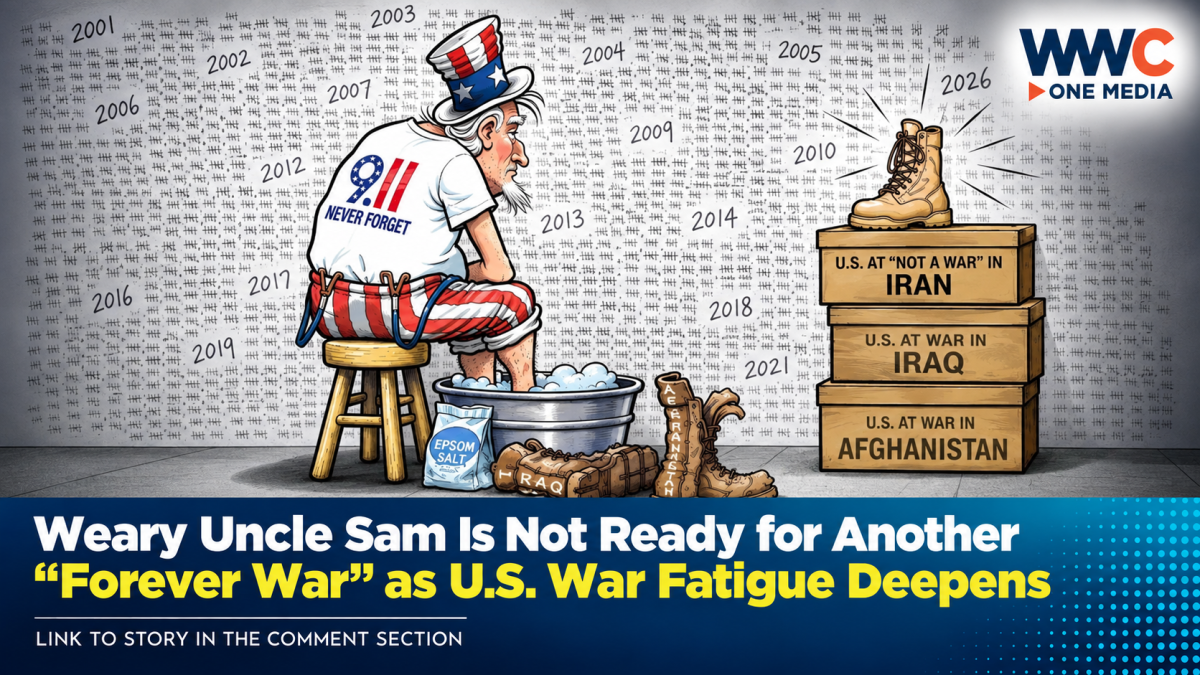
WASHINGTON — The United States may have enormous military power, but a new political cartoon is highlighting a very different limitation: war fatigue.
Published by The Korea Times on September 15, the cartoon, titled “Weary Uncle Sam Is Not Ready for Another Forever War,” reflects growing concerns about the political and public appetite for another prolonged U.S. military commitment in the Middle East. The work is by cartoonist R.J. Matson and draws on the legacy of America’s post-9/11 military campaigns.
The reference to a “forever war” evokes the long conflicts in Afghanistan and Iraq, which consumed enormous American resources and continued for years after their initial military campaigns began. The Afghanistan war became America’s longest war before the U.S. withdrawal in 2021, while the Iraq conflict left a lasting imprint on U.S. foreign policy and public attitudes toward military intervention.
Matson’s cartoon places that history against renewed tensions surrounding Iran and the wider Middle East, suggesting that Washington faces a difficult question: how much additional military involvement can the United States sustain after decades of overseas conflict?
The shadow of Iraq and Afghanistan
The post-9/11 era fundamentally changed America’s approach to national security.
Following the September 11, 2001 attacks, the United States launched military operations in Afghanistan and later invaded Iraq in 2003. Both conflicts lasted far longer than many Americans initially expected.
The human, financial and political costs eventually fueled debate over whether Washington had become too willing to enter conflicts without a clear path to an enduring political settlement.
That history is central to the “forever war” concept referenced by Matson’s cartoon. Cagle’s description of the work specifically connects U.S. fatigue over the Middle East wars with concerns about a potential Iran conflict.
Iran raises a different kind of dilemma
Iran presents Washington with a particularly complicated strategic challenge.
Unlike a conventional conflict involving a single battlefield, any major confrontation with Iran could have consequences stretching across the broader Middle East. The possibility of a conflict becoming prolonged—or expanding beyond its initial objectives—is precisely the concern captured by the cartoon’s “forever war” framing.
That does not mean the United States has ruled out military action or that another prolonged war is inevitable. Rather, the cartoon is expressing a political judgment about the difficulty of asking Americans to accept another open-ended military commitment after the experiences of Iraq and Afghanistan.
Why war fatigue matters
The United States remains one of the world’s most powerful military and economic powers. But military capability and political willingness are not the same thing.
America’s experience since 2001 has demonstrated that winning an initial military campaign does not necessarily mean achieving a stable or lasting political outcome.
That distinction has become one of the defining lessons of the post-9/11 era.
The question now confronting Washington is not simply whether the United States can fight another major conflict. It is whether policymakers can define clear objectives, an achievable end state and a credible exit strategy before committing the country to another potentially lengthy engagement.
A warning wrapped in satire
The cartoon’s message is therefore less about predicting what Washington will do and more about highlighting the political baggage that comes with another Middle East conflict.
For a generation shaped by Iraq, Afghanistan and the broader “war on terror,” the phrase “forever war” carries considerable weight.
Matson’s cartoon turns that accumulated experience into a simple warning: America’s willingness to enter another open-ended conflict cannot be assumed.
And if Washington does face another major military decision in the Middle East, the hardest question may not be how to begin the fight—but how to make sure it does not become another war without a clear ending.



Leave a Reply