
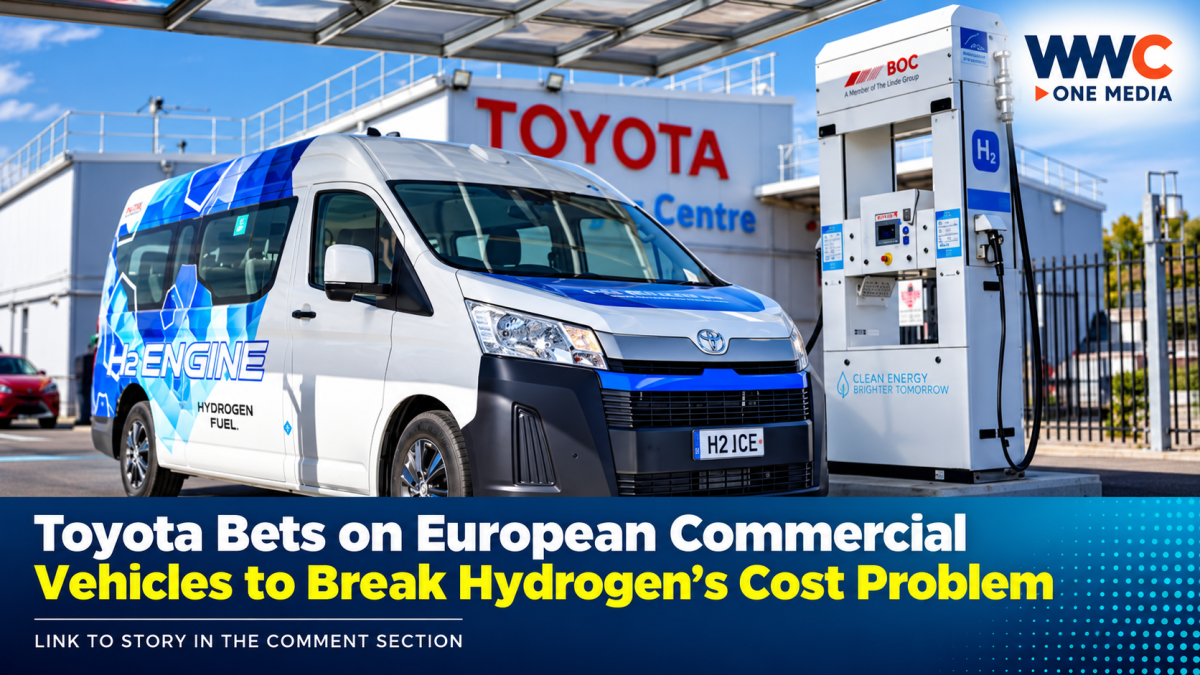
BRUSSELS — Toyota is turning to Europe’s heavy-duty transport sector in an effort to tackle one of hydrogen mobility’s biggest obstacles: cost.
The Japanese automaker is expanding its push into hydrogen fuel-cell trucks, arguing that commercial vehicles could provide the high-volume, high-utilization market needed to build demand for hydrogen and help make the technology more economically viable.
The strategy comes as Toyota strengthens partnerships with major European truck manufacturers, including Scania and IVECO, while working with energy and infrastructure companies to develop a broader hydrogen ecosystem.
Why trucks could be hydrogen’s way forward
Hydrogen-powered passenger cars have struggled to achieve mass-market adoption because of high vehicle and fuel costs, limited refueling infrastructure and relatively small markets.
Heavy-duty trucks present a different proposition.
Long-haul commercial vehicles can operate for many hours a day and travel long distances, potentially making the quick refueling and long-range characteristics of hydrogen fuel cells more attractive in applications where charging large batteries could be difficult.
Toyota says hydrogen is particularly suited to demanding heavy-duty operations where long range, high utilization and operational efficiency are important.
That does not mean hydrogen automatically beats battery-electric trucks. Fuel-cell vehicles still face significant challenges, including the cost of producing low-carbon hydrogen, limited refueling networks and lower overall energy efficiency compared with direct battery-electric use.
The commercial-vehicle market is therefore becoming something of a test case for whether hydrogen can overcome those barriers.
Toyota and Scania put 40 trucks to the test
Toyota and Swedish truckmaker Scania announced a partnership to put Toyota’s latest fuel-cell technology into 40 heavy-duty vehicles under Scania’s Pilot Partner program.
The trucks are expected to begin operating with European customers in the first quarter of 2027, providing real-world data on performance, efficiency, durability and total cost of ownership.
Toyota’s third-generation fuel-cell system produces 300 kW and is designed in a compact package for heavy-duty applications.
The trial is important because laboratory performance alone cannot answer the central commercial question: Can hydrogen trucks make financial sense for fleet operators?
Real-world logistics operations should provide better evidence.
IVECO partnership pushes the strategy further
Toyota is also working with Italian commercial-vehicle manufacturer IVECO on the next generation of fuel-cell trucks.
The companies are integrating Toyota’s fuel-cell technology into IVECO’s heavy-duty vehicle platform, with the goal of developing zero-emission trucks capable of meeting demanding long-distance transport requirements.
Reports indicate that the IVECO fuel-cell concept is being developed with a target range of more than 900 kilometers, illustrating why heavy-duty transport is an attractive market for hydrogen technology.
The idea is straightforward: if commercial fleets can generate predictable hydrogen demand, they could provide the foundation for building more refueling stations and larger hydrogen supply chains.
The infrastructure problem remains
Toyota’s strategy also acknowledges a fundamental problem with hydrogen mobility: vehicles alone cannot create a hydrogen economy.
Truck operators will not invest heavily in fuel-cell vehicles if hydrogen stations are unavailable, while energy companies have little incentive to build extensive infrastructure without enough vehicles to use it.
Toyota and other industry players are therefore pushing an ecosystem approach.
In Germany, Toyota has joined Daimler Truck, Volvo Group, Bosch, Air Liquide, TotalEnergies and other companies in an initiative aimed at scaling hydrogen truck deployment and developing refueling infrastructure along strategic European corridors.
The goal is to coordinate trucks, hydrogen supply, refueling stations and pricing rather than attempting to develop each piece separately.
Hydrogen still has a price problem
Despite the industry’s optimism, hydrogen remains expensive.
Green hydrogen—produced using renewable electricity—is generally the cleanest form but is also among the most expensive to produce. Fuel-cell trucks must compete against rapidly improving battery-electric alternatives, which can benefit from increasingly widespread charging infrastructure and higher overall energy efficiency.
Toyota’s own strategy therefore represents a bet rather than a guaranteed solution.
The company needs commercial fleets to adopt the technology at meaningful scale. That, in turn, could help increase production volumes, improve the economics of fuel-cell systems and justify investment in hydrogen infrastructure.
Europe’s heavy trucks could decide hydrogen’s next chapter
Toyota has spent decades developing hydrogen fuel-cell technology, but the company now appears to be narrowing its commercial focus toward applications where the technology may have a stronger business case.
That makes Europe’s heavy-duty transport industry particularly important.
If the Scania and IVECO programs demonstrate competitive operating costs and reliable performance, hydrogen could gain a stronger foothold in long-distance commercial transport.
If the economics fail to compete with battery-electric trucks and conventional alternatives, however, hydrogen’s path to mass adoption could become even more difficult.
For Toyota, the question is no longer simply whether hydrogen fuel cells work.
The bigger question is whether Europe’s trucks can become the market large enough to finally make hydrogen affordable.




Leave a Reply