
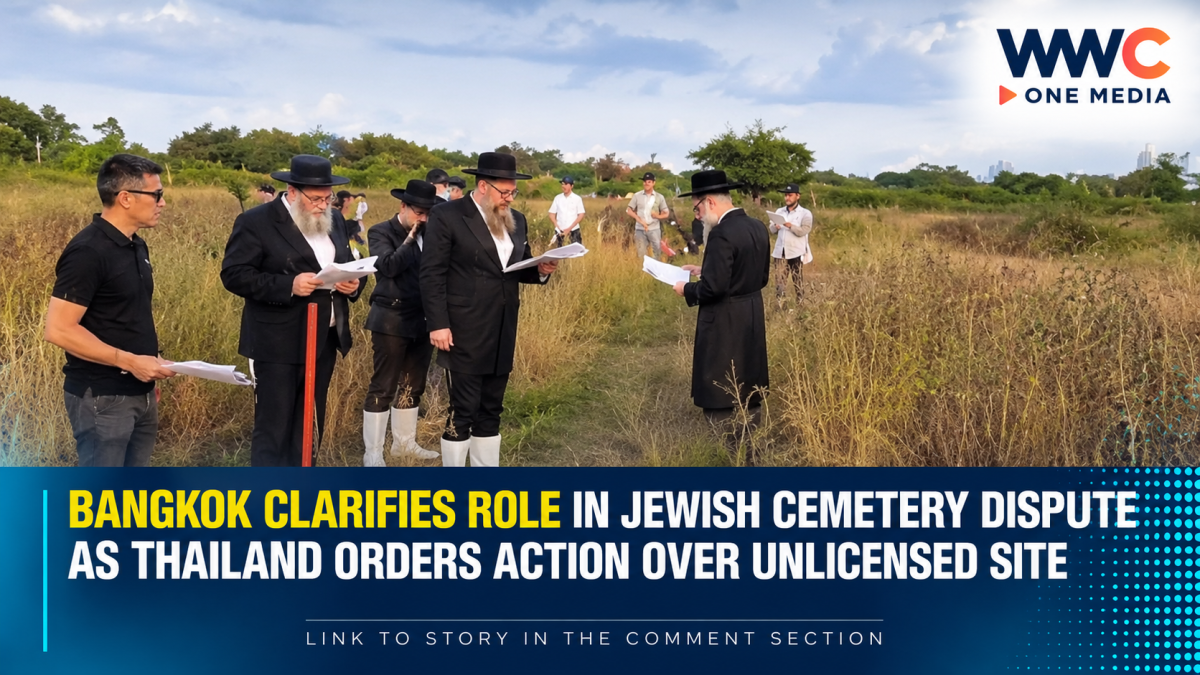
Bangkok authorities have moved to clarify their role in a growing controversy surrounding a Jewish cemetery in Chachoengsao, after questions were raised over the Bangkok Metropolitan Administration’s involvement in a site that authorities say failed to meet Thailand’s legal requirements.
The dispute centres on a Jewish cemetery project in Bang Khla district, Chachoengsao province, east of Bangkok.
The Bangkok Metropolitan Administration has stressed that it is not responsible for approving or operating the cemetery, as the site falls outside Bangkok’s administrative jurisdiction.
The clarification comes as Thai authorities intensify inspections of the property following concerns over its licensing status and the handling of human remains.
Provincial authorities previously rejected an application to renew the cemetery’s operating licence after inspections found that the facility did not comply with relevant regulations.
The controversy escalated after officials inspected the site and discovered four bodies, prompting authorities to investigate whether burials had taken place without the required approvals.
Officials have since ordered measures to address the unauthorised activity and determine the status of the remains found at the property.
The case has attracted national attention because of reports that the proposed cemetery could eventually contain a large number of burial plots.
Local residents had sought clarification after reports of a planned cemetery with up to 1,200 plots raised concerns about the project’s scale and whether all necessary permissions had been obtained.
Officials have stressed that the current controversy is primarily a regulatory and administrative matter, rather than an issue concerning Thailand’s Jewish community or religious practice.
Thailand has a small Jewish population and has historically accommodated Jewish residents and visitors, including through established burial facilities in Bangkok.
The dispute highlights the importance of complying with Thailand’s rules governing cemeteries, burial sites and the handling of human remains.
Authorities must determine whether the site received the correct approvals, whether burials were legally authorised and how the remains already found should be handled.
The case also illustrates the division of responsibilities between Bangkok’s municipal administration and provincial authorities.
While the BMA oversees Bangkok, Chachoengsao is administered separately by provincial and national agencies. The BMA therefore does not have authority to approve a cemetery located in another province.
The clarification is intended to prevent confusion over which government bodies are responsible for the site and its regulatory status.
At the same time, authorities are facing pressure to resolve the issue sensitively because it involves religious burial practices and the remains of deceased people.
Any removal or exhumation of bodies will need to be handled according to Thai law while taking into account appropriate religious considerations.
The wider controversy also comes amid heightened public attention in Thailand over the behaviour and activities of foreign communities and visitors.
Recent tensions involving some foreign nationals have triggered demonstrations and calls for foreigners to respect Thai laws and local customs, although the cemetery dispute itself is fundamentally a separate regulatory matter.
Thai officials have sought to avoid allowing individual disputes involving foreign communities to become broader diplomatic or religious conflicts.
For the Jewish community, the immediate concern is ensuring that any burial arrangements are conducted lawfully and that the remains already at the site are treated with dignity.
For Thai authorities, the priority is determining how the cemetery was established, why its licence was not renewed and whether additional legal violations occurred.
The investigation could ultimately determine whether the site can be brought into compliance with Thai regulations or whether the proposed cemetery will have to be dismantled.
For now, authorities are making clear that religious identity does not exempt a cemetery from Thailand’s licensing, land-use and public-health requirements.
The case is likely to remain under close scrutiny as officials work to reconcile regulatory enforcement with the sensitive religious and humanitarian issues surrounding the site.




Leave a Reply