
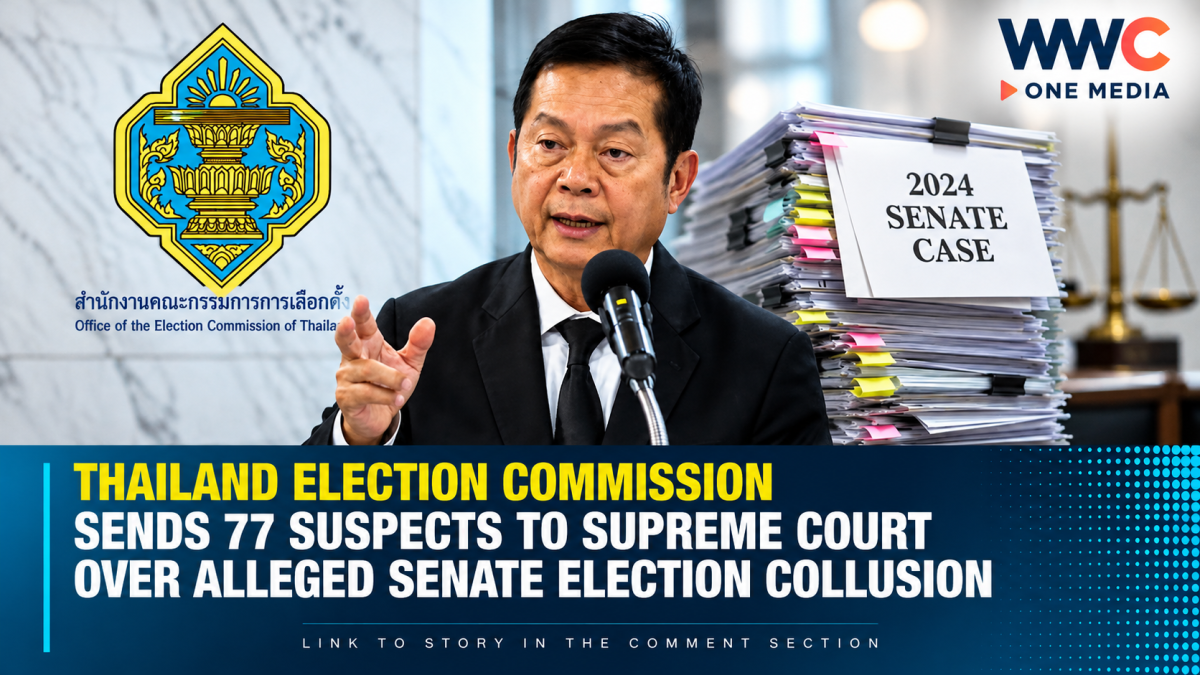
Thailand’s Election Commission has voted to refer 77 people, including 26 sitting senators, to the Supreme Court over allegations of collusion during last year’s controversial Senate election.
The decision marks a major escalation in one of Thailand’s most politically sensitive election cases and could put the positions of serving senators at risk if the court ultimately finds that election laws were violated.
The Election Commission considered allegations involving hundreds of people accused of coordinating or manipulating the Senate selection process.
After reviewing the cases, commissioners decided that 77 suspects should face proceedings before the Supreme Court’s Election Cases Division.
The group includes 26 current senators, making the case particularly significant because the Senate plays an important role in Thailand’s political system and legislative process.
The allegations centre on claims that candidates coordinated their voting strategies or otherwise colluded during the multi-stage Senate selection process.
Thailand’s Senate election system is unusual because candidates were selected through a series of voting rounds involving candidates from different professional and social groups rather than through a conventional nationwide popular vote.
The system was introduced under Thailand’s post-2017 constitutional framework and was intended to produce a chamber representing a broad range of professions and interests.
However, the 2024 Senate election quickly became controversial, with allegations that political networks had organised voting blocs to influence which candidates advanced through the different rounds.
The Election Commission subsequently investigated multiple complaints concerning alleged vote coordination and other irregularities.
The investigation involved 427 people across seven separate allegations, according to reports on the commission’s proceedings.
The EC’s decision does not mean that the 77 individuals have been found guilty.
The Supreme Court will have to examine the allegations and evidence before determining whether any laws were breached.
Those facing proceedings could challenge the allegations and present their own evidence in court.
The case nevertheless creates significant political uncertainty because a court ruling against serving senators could affect the composition and influence of the upper house.
The Senate has considerable power under Thailand’s constitutional system, including a role in legislation, appointments to important independent organisations and other political processes.
The controversy has also intensified scrutiny of how the 2024 Senate election was conducted.
Critics have argued that the selection system was vulnerable to organised voting because candidates could coordinate across professional groups and voting rounds.
Supporters of the process have rejected accusations of widespread manipulation and have argued that political opponents are attempting to undermine senators who were lawfully selected.
The Election Commission has faced pressure from both sides throughout the investigation.
Those demanding tougher action have accused the commission of moving too slowly, while others have questioned whether the evidence is strong enough to justify removing elected or selected representatives from office.
The decision to send the cases to the Supreme Court now shifts the most important stage of the dispute from the election regulator to the judiciary.
The court will determine whether the allegations meet the legal threshold and whether any penalties should be imposed.
The case could take considerable time, meaning the 77 suspects may continue carrying out their duties while the proceedings move forward unless separate legal measures affect their status.
For Thailand, the outcome could have consequences well beyond the individual suspects.
A ruling confirming widespread collusion could trigger further questions about the legitimacy of the 2024 Senate election and potentially lead to additional legal challenges.
A ruling in favour of the accused, meanwhile, could strengthen the position of the current Senate and undermine criticism of the election process.
The case therefore represents another major test for Thailand’s political institutions as the country continues to grapple with disputes over electoral rules, political influence and the independence of its oversight bodies.
For now, the Election Commission has made its decision.
The next major battle will take place in court, where the evidence surrounding the alleged Senate election collusion will be tested — and where the future of dozens of Thailand’s current senators could ultimately be decided.



Leave a Reply