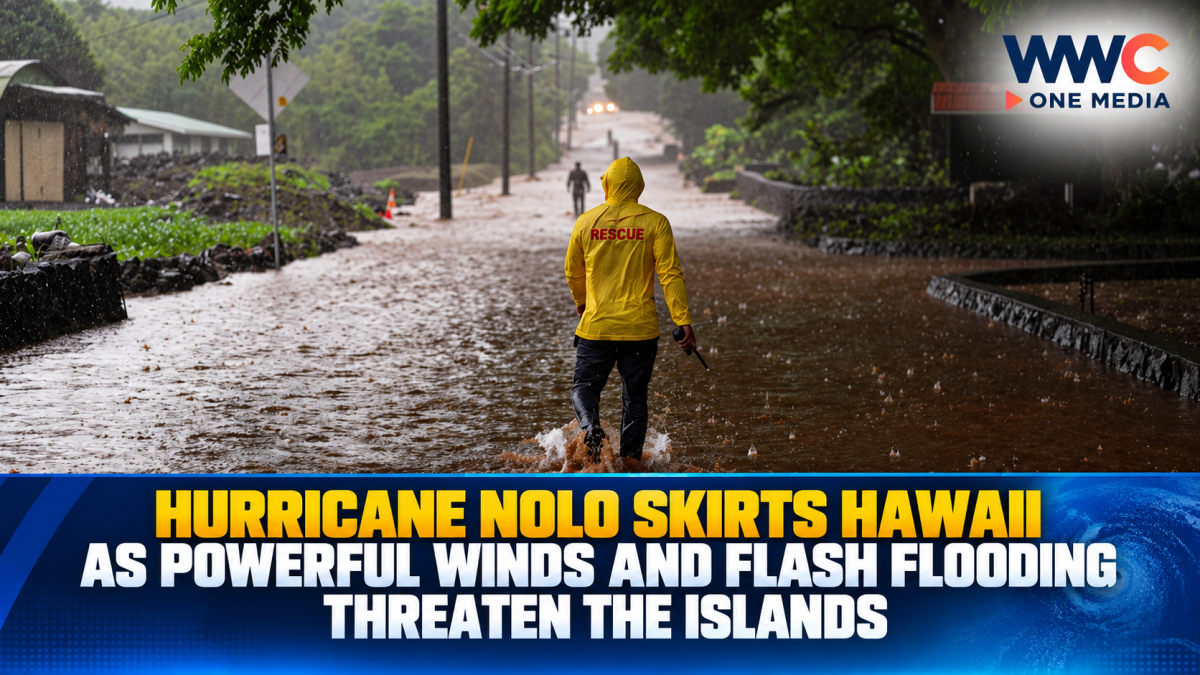
Hurricane Nolo skirted the Hawaiian Islands without making a direct landfall, but its powerful outer bands still brought heavy rain, strong winds and dangerous surf to communities already recovering from earlier storms.
The hurricane passed south of Hawaii’s Big Island on Sept. 26 and continued moving westward. At one point, Nolo had maximum sustained winds of about 150 km/h, while forecasters warned that its outer bands could still produce life-threatening flooding and mudslides.
The threat was particularly serious on the Big Island, where some areas were forecast to receive as much as 20 inches (51 centimetres) of rain. Heavy rainfall also affected other Hawaiian islands, increasing the risk of flash flooding and landslides in vulnerable areas.
Nolo’s center remained well offshore, meaning Hawaii avoided the direct impact of the hurricane’s strongest core. However, officials warned residents not to underestimate the storm because powerful winds, falling trees, downed power lines and rapidly rising water remained possible.
Heavy rain caused partial closures along one of the main highways connecting Kailua-Kona and Hilo. Near Naalehu on the southern part of the Big Island, floodwaters covered sections of Mamalahoa Highway as emergency personnel helped residents navigate affected areas.
Authorities also prepared for possible evacuations and widespread power disruptions. More than 120 National Guard members were activated on the Big Island, forming part of roughly 400 personnel activated statewide after Hawaii’s governor issued an emergency proclamation.
The storm arrived as Hawaii was still dealing with damage from Hurricane Lala, which had previously produced destructive winds and heavy rainfall on the Big Island. About 100 homes were reportedly swept from their foundations during that earlier storm, leaving some communities particularly vulnerable to another round of severe weather.
Businesses boarded up their premises and some events were cancelled as residents prepared for the possibility of worsening conditions. Hawaiian Electric also repositioned crews to help respond to potential outages across the islands.
The storm also affected Maui, where a brush fire broke out on the island’s west side during the weekend. Mandatory evacuations were ordered for some residents, while portions of a major highway were closed.
By Sunday, Nolo was moving farther away from Hawaii, although damaging winds, heavy rain and dangerous surf remained possible. The National Hurricane Center said the storm’s center was expected to remain south of the main Hawaiian Islands as it continued westward.
Nolo was part of an unusually active period in the Pacific during the peak of hurricane season. Weather officials said tropical activity had been running above average, a pattern they associated with El Niño conditions.
For Hawaii, the immediate concern shifted from a potential direct hurricane strike to managing flooding, mudslides, high surf and wind damage while communities continued recovering from previous storms.
The latest storm has underscored how quickly Hawaii’s recovery efforts can be complicated by another major weather system, particularly when saturated ground, damaged infrastructure and vulnerable communities remain in place.