
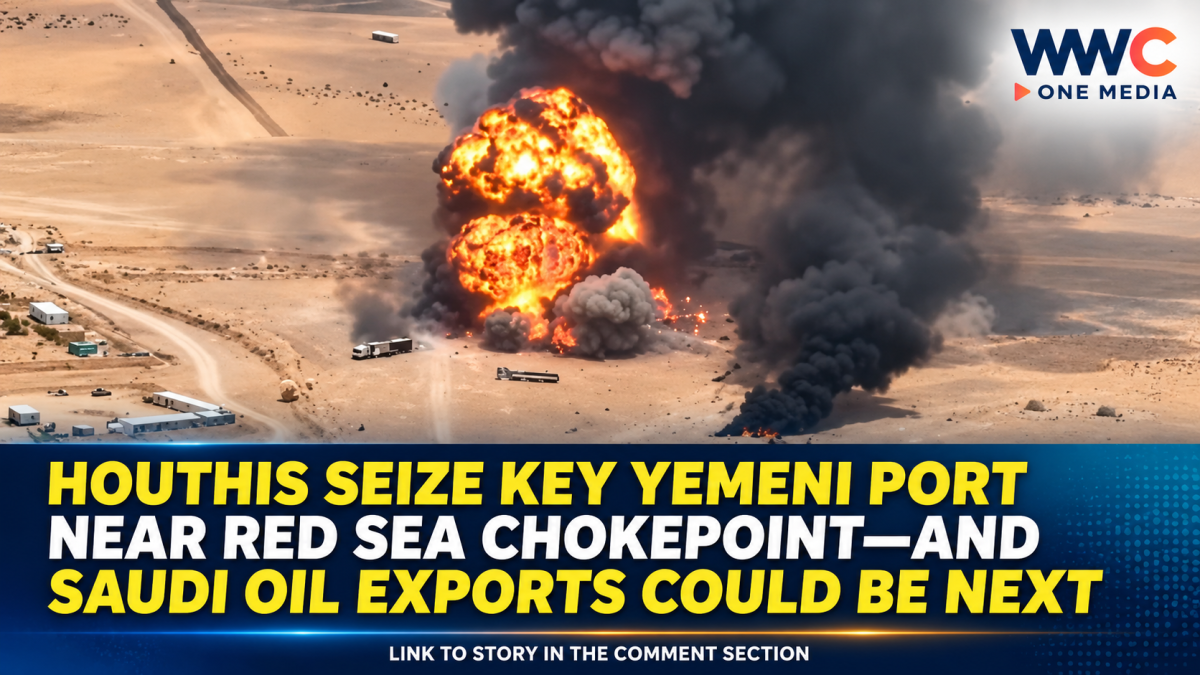
The rapid Houthi advance along Yemen’s western coast has placed renewed pressure on Saudi Arabia and its allied Yemeni forces, while bringing the rebels closer to the Bab el-Mandeb Strait—the narrow waterway connecting the Red Sea to the Gulf of Aden and the Indian Ocean.
Reuters reported that Houthi forces seized Mocha and advanced toward strategic positions along the Red Sea coast, including the Hanish Islands, as government forces withdrew toward Dhubab near the Bab el-Mandeb. The developments represent one of the most significant shifts in Yemen’s battlefield in years.
Why Mocha Matters—and Why the World Is Watching
Mocha is far more than a symbolic battlefield victory.
The port city sits on Yemen’s western coastline, close to the Bab el-Mandeb Strait, one of the world’s most strategically important shipping routes. Control or disruption of territory near the strait could threaten commercial vessels moving between the Mediterranean, the Suez Canal, the Red Sea and the Indian Ocean.
The Associated Press said the Houthi capture of Mocha could signal a broader return to conflict in Yemen while placing a critical oil shipping corridor under greater pressure. The advance comes at a particularly dangerous moment for global energy markets, with other regional shipping routes already facing disruption.
The Wall Street Journal similarly described the Houthi advance toward Bab al-Mandeb as a major strategic development, with the rebels expanding their position near a chokepoint vital to international energy exports.
Saudi Oil Exports Now Face a Growing Red Sea Threat
The biggest international concern is the potential impact on Saudi Arabia’s oil exports.
Saudi Arabia has increasingly relied on Red Sea routes as wider Middle East tensions complicate traditional export pathways. But the Houthi advance toward Bab el-Mandeb now threatens to put another major energy corridor at risk.
According to the Financial Times, Saudi oil production fell sharply in August as threats and attacks disrupted the kingdom’s export operations and maritime logistics. Saudi crude exports reportedly dropped to their lowest levels in years, highlighting how vulnerable the country’s energy infrastructure and shipping routes have become.
A Reuters survey also found that OPEC output declined significantly in August, driven in part by disruptions affecting Saudi oil exports amid the broader Middle East conflict.
The concern is now clear: if Saudi oil faces pressure in both eastern and western export corridors, the consequences could extend far beyond Yemen and the Gulf.
Oil Prices Jump as Energy Markets Brace for Another Shock
Energy markets have already reacted to the escalating crisis.
Reuters reported that oil prices climbed sharply as investors assessed growing risks to Middle East supply routes, while other reports showed Brent crude moving above the psychologically important $100-per-barrel level.
The Financial Times also reported that Brent crude rose above $100 as Saudi production and export concerns intensified.
The potential danger is not simply the loss of oil production.
Even the threat of disruption can drive prices higher.
Shipping companies may reroute vessels, insurers may raise premiums and traders may price in the possibility of supply shortages. A serious disruption near Bab el-Mandeb could also affect container shipping and other goods moving through the Red Sea-Suez Canal corridor.
Houthi Attacks on Saudi Arabia Deepen the Crisis
The capture of Mocha follows a broader escalation between the Houthis and Saudi Arabia.
The Associated Press reported this week that Houthi missile and drone attacks struck targets in southern Saudi Arabia, wounding dozens of people and causing fires at oil and economic facilities. The attacks included strikes targeting areas associated with Saudi energy infrastructure.
Another AP report said the renewed fighting and airstrikes have killed hundreds and displaced tens of thousands, increasing fears that Yemen’s long-running conflict could spiral back into a full-scale war.
The Guardian reported that the fighting around Yemen’s western coast has become the most intense since the collapse of the relative calm that followed the 2022 UN-brokered truce. It also described significant territorial gains by the Houthis and growing disarray among forces opposing them.
The Hanish Islands Could Be the Next Strategic Flashpoint
Military sources cited by Reuters said the Houthis have also advanced toward the Hanish Islands, a strategically located island group in the Red Sea.
That development is particularly concerning because islands and coastal positions can provide military forces with greater influence over surrounding maritime traffic.
While controlling territory near a shipping lane does not automatically mean a group can shut down international navigation, it can significantly increase the threat posed by drones, missiles, boats and other asymmetric weapons.
The Indian Express reported that the Houthi advance toward coastal positions and islands near Bab el-Mandeb has intensified concerns about the security of global shipping and oil flows through the Red Sea.
Is Yemen Heading Back to Full-Scale War?
Perhaps the most alarming question is whether the latest fighting marks the effective end of Yemen’s fragile period of relative calm.
The Houthis have controlled much of northern Yemen, including the capital Sanaa, while Saudi-backed and internationally recognized government forces control other parts of the country.
The 2022 truce reduced large-scale fighting, but the underlying political and military conflict was never fully resolved.
Now, the seizure of Mocha, renewed Saudi-Houthi attacks and growing international tensions appear to be pushing Yemen toward another dangerous phase.
The Associated Press warned that the latest escalation threatens to pull Yemen back into broader civil war while creating a new crisis around one of the world’s most important maritime routes.
Iran’s Role Under Renewed Scrutiny
The Houthis are widely described by Western and Saudi officials as being aligned with and supported by Iran.
Reuters reported that sources believe Iranian arms, guidance and support have played a role in the Houthis’ growing capabilities and recent operations, although the exact nature and extent of Iranian involvement remains a major geopolitical dispute.
The broader regional picture has made the situation even more volatile.
The Houthis’ position near the Bab el-Mandeb raises concerns about simultaneous pressure on multiple Middle East maritime chokepoints. Any sustained disruption to major oil shipping routes could create a powerful shock to global energy markets.
What Happens Next?
The next few days could determine whether the capture of Mocha becomes a temporary battlefield victory—or the beginning of a much larger regional escalation.
Three developments will be critical:
- Whether the Houthis continue advancing toward Bab el-Mandeb
- Whether Saudi Arabia launches a larger military response
- Whether commercial shipping and oil exports face direct disruption
For Saudi Arabia, the stakes are particularly high. The kingdom remains one of the world’s most important oil producers, and its ability to move crude safely to international markets is central to global energy stability.
For Yemen, meanwhile, the latest escalation threatens to reopen a devastating war that millions of civilians are still struggling to recover from.
And for the rest of the world, a battle over one Yemeni port could quickly become something much bigger.
Because if the fighting reaches deeper into the Bab el-Mandeb corridor, the next shock may not stay in Yemen—or even in the Middle East.


Leave a Reply