
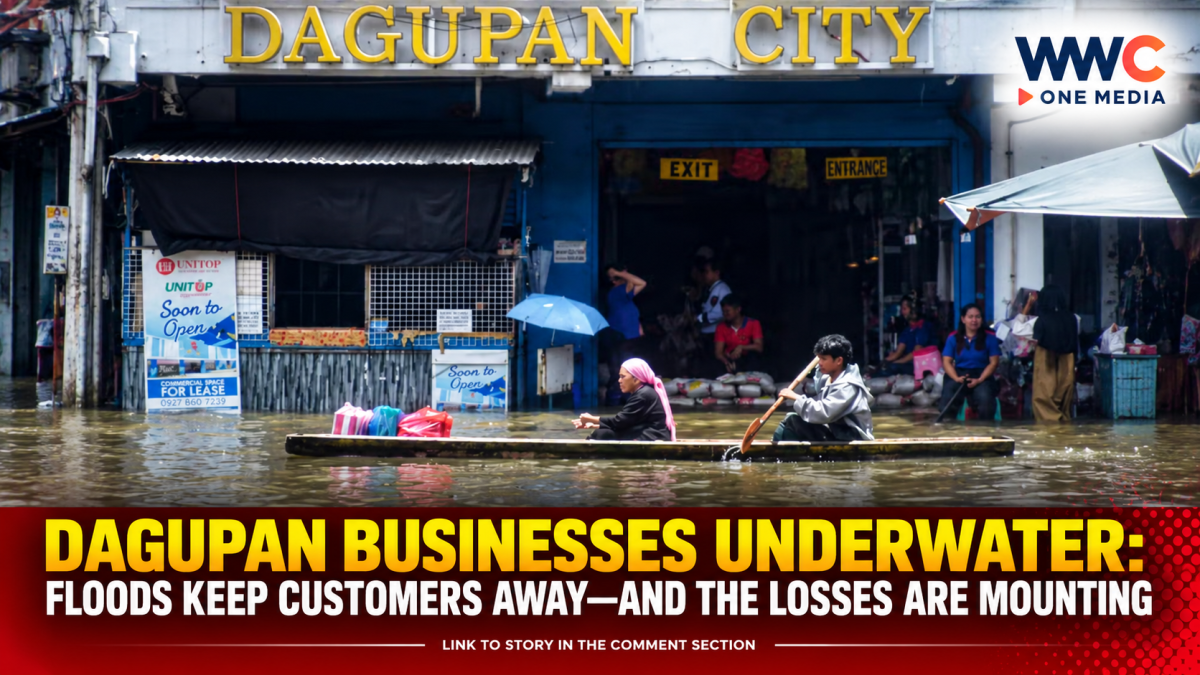
DAGUPAN CITY, Pangasinan — For businesses in Dagupan, the flooding is no longer just a temporary inconvenience. Repeated inundation has become a growing threat to daily sales, inventory, operations and the livelihoods of small entrepreneurs who are struggling to keep their establishments open.
The problem has persisted across several parts of the city as heavy rains, the southwest monsoon or habagat, high tides and backflow from waterways repeatedly push floodwaters into commercial areas.
In recent weeks, business owners and their workers have been forced to pump out water, clean their establishments and protect merchandise—sometimes only to face another round of flooding when rain intensifies.
Reports from local media indicate that some businesses have continued operating despite the difficult conditions, while others have been forced to close temporarily when floodwater reaches their establishments.
GMA News previously reported that flooding affected businesses in downtown Dagupan, with establishments closing or opening later than usual as owners tried to protect their goods. Business owners and residents used water pumps and sandbags to keep floodwater from entering their properties.
Sales fall as customers stay away
For small businesses, the economic damage goes beyond water entering a store.
When roads become difficult to pass and customers avoid flooded areas, daily sales can quickly disappear.
The latest reports from iFM News Dagupan indicate that micro, small and medium enterprises across Pangasinan have been feeling the impact of prolonged rain and flooding, with food businesses such as carinderias seeing fewer customers and lower daily income.
Manufacturing businesses are also being affected because flooded roads can delay the delivery of raw materials and supplies, disrupting production and operations.
The situation has been particularly difficult for vendors at Dagupan’s Malimgas Public Market.
According to a September 10 report by iFM News Dagupan, vendors and stallholders said they had been dealing with flooding for almost two months. The prolonged situation reportedly resulted in fewer customers and declining income throughout August.
Some vendors have even asked authorities to cancel their stall rentals for August because of the disruption. Their concerns were raised during a committee hearing on September 9.
Floodwater is becoming an everyday business expense
For some entrepreneurs, keeping the doors open now means repeatedly paying in time, labor and resources simply to remove floodwater.
Local reports said some business owners and employees have been manually scooping out water, while others have resorted to water pumps to clear their establishments.
Despite the added work, some businesses are still attempting to remain open so they can continue earning and serving customers.
But repeated flooding also raises the possibility of damage to equipment, merchandise and business premises.
In downtown Dagupan, vendors and shoppers have also complained about dirty, foul-smelling floodwater, with algae and garbage accumulating in some flooded areas. Cleanup operations have been undertaken to prevent waste from blocking drainage channels and other waterways.
Why does the flooding keep coming back?
The city’s geography and drainage challenges make Dagupan particularly vulnerable.
The city is low-lying, while its waterways are affected by rainfall, river flow and tides. During prolonged weather disturbances, water can remain in some communities instead of draining quickly.
Dagupan Mayor Belen Fernandez has pointed to the need for additional flood-control measures in frequently affected areas.
Bombo Radyo Dagupan reported that the city government is looking at creeks as part of a recovery program intended to improve water flow. Fernandez said a floodgate and pumping station in one area were not enough because water could still enter from A.B. Fernandez Avenue in the absence of a protective dike.
She also said water entering from Rizal Street and river backflow behind establishments contribute to flooding around the public market.
The provincial government, meanwhile, is pursuing river dredging as part of a longer-term strategy.
Pangasinan Gov. Ramon Guico III said major rivers have become heavily silted and need systematic dredging. He also called for comprehensive studies of major rivers and tributaries before implementing long-term river protection and restoration projects.
The crisis extends beyond Dagupan’s storefronts
The flooding is also affecting the wider economy of Pangasinan.
The province declared a state of calamity after weeks of monsoon rains and other weather disturbances affected hundreds of thousands of families. In an earlier assessment, damage estimates included hundreds of millions of pesos in infrastructure and agricultural losses.
Pangasinan’s fisheries sector has also suffered.
Inquirer reported that prolonged flooding caused fishponds to overflow, allowing fish stocks to escape. One fishpond operator in Binmaley estimated losses of around P5 million in fingerlings and feeds, while another producer in Labrador reported losing approximately 500,000 fingerlings.
The economic consequences therefore extend well beyond flooded storefronts—from retailers and market vendors to food businesses, manufacturers, fishpond operators and workers whose incomes depend on uninterrupted economic activity.
A problem that refuses to disappear
The scale and duration of the flooding have already forced Dagupan to confront the possibility that temporary measures may not be enough.
The city declared a state of calamity in August after widespread flooding affected 22,047 families or 90,015 people across 31 barangays, according to GMA News and the Philippine Information Agency.
And the effects have continued.
As of September 8, the Philippine News Agency reported that 906 families, or 2,885 people, remained in evacuation centers across Pangasinan, including residents from Dagupan City.
For businesses, every additional day of flooding means another day of reduced foot traffic, disrupted deliveries, damaged goods, cleanup work and lost income.
That is why the growing concern among Dagupan entrepreneurs is no longer simply when the next flood will arrive.
It is whether they can continue absorbing the cost of the flooding if the water keeps coming back.
For a city whose economy depends heavily on daily commerce, markets and small enterprises, the answer could determine how quickly Dagupan recovers—and how much its business community will have to sacrifice before the water finally stays away.

Leave a Reply