
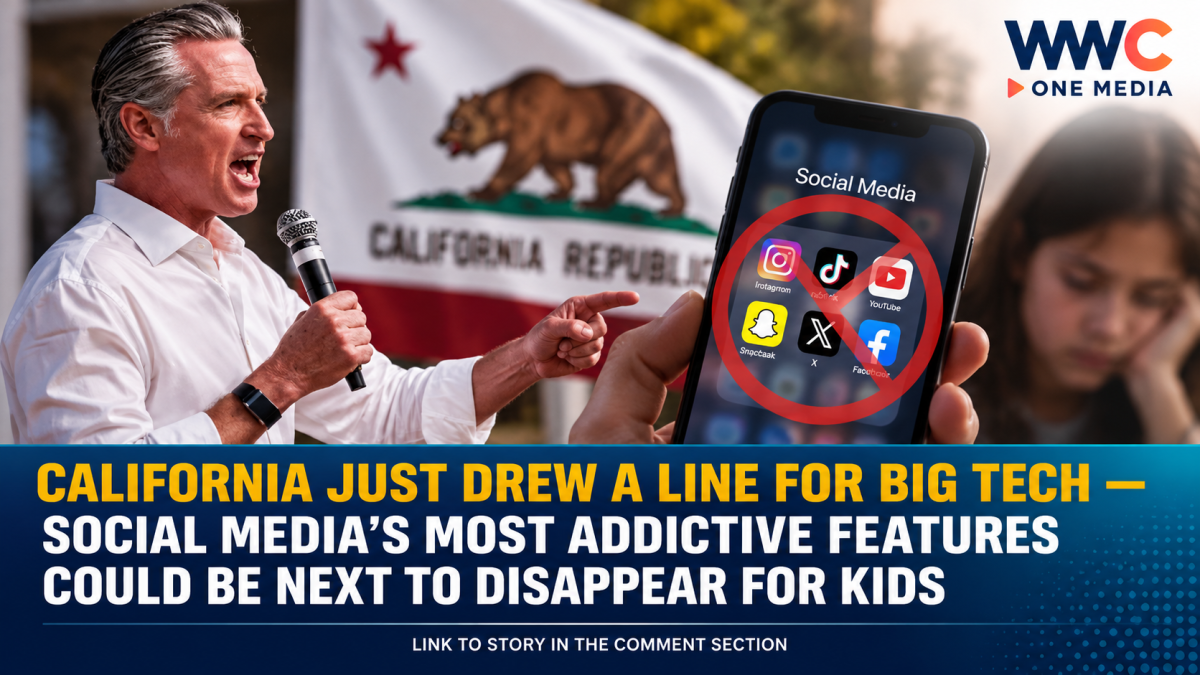
SACRAMENTO, California — California has launched one of its most aggressive efforts yet to protect children online, signing a sweeping package of new laws that takes aim at addictive social media features, AI chatbots, digitally manipulated child sexual abuse material and other technology risks facing young people.
Governor Gavin Newsom signed 13 bills designed to strengthen protections for minors as concerns grow over the impact of social media algorithms and artificial intelligence on children’s mental health, privacy and safety.
The most closely watched measure restricts social media companies from exposing users under the age of 16 to features considered behaviorally addictive, including tools such as algorithm-driven feeds, autoplay and infinite scrolling. The move could force major platforms to rethink how young users experience social media in California — home to some of the world’s biggest technology companies.
No More Infinite Scroll for Young Users?
The new restrictions target features designed to keep users engaged for longer periods, a business model that has increasingly come under political and legal scrutiny.
Infinite scrolling, autoplay and personalized recommendation systems have become central to platforms such as social media and video-sharing services. Supporters of the California measures argue that these tools can encourage compulsive use among children and teenagers.
The legislation is part of a broader effort to push technology companies away from engagement-driven design when dealing with minors. California has already been building a legal framework around youth online safety, including earlier rules addressing personalized recommendation algorithms, age assurance and other protections for young users.
However, the new rules could also intensify the debate over how technology companies determine a user’s age without collecting excessive personal information.
AI Chatbots and Companion Toys Also Targeted
California’s latest package goes beyond social media.
One of the new measures temporarily bans, for four years, the manufacture and sale of toys that incorporate AI companion chatbots. Other legislation requires stronger parental controls, safety measures and risk assessments for chatbot programs.
Among the most significant measures is legislation known as Adam’s Law, named in memory of 16-year-old Adam Raine. The law is aimed at strengthening safeguards around AI chatbot interactions and comes amid growing concerns about how vulnerable users — particularly minors — may interact with increasingly sophisticated conversational AI systems.
The broader regulatory push reflects a major shift: lawmakers are no longer focusing only on harmful content. They are increasingly targeting the design of technology itself — including how algorithms recommend content, how platforms encourage users to stay online and how AI systems interact emotionally with young people.
Tougher Rules on AI-Generated Child Sexual Abuse Material
Another new California measure expands criminal sanctions involving child sexual abuse material to cover digitally altered or AI-generated content depicting a person under 18 engaged in sexual conduct.
The move comes as governments worldwide face growing concerns over the misuse of generative AI to create realistic fake images and other forms of exploitative material.
Big Tech Faces Growing Pressure
California’s action comes at a time when technology companies are facing mounting legal and political pressure over the impact of their products on children.
Major social media platforms have faced lawsuits and investigations over allegations that their products were designed to maximize engagement while exposing younger users to potential mental health and privacy risks.
In August, Meta agreed to a major settlement with U.S. states that included new teen safety measures such as usage limits, overnight restrictions, age verification efforts and changes to how young users experience its platforms. Meta has denied wrongdoing.
The California legislation could add further pressure on the wider technology industry to redesign services for younger audiences.
Supporters See Protection — Critics See Privacy Risks
The laws have received broad political support, but they are not without controversy.
Digital rights advocates, including the Electronic Frontier Foundation, have raised concerns that some youth online safety measures could create privacy and free speech problems, particularly if platforms are required to conduct extensive age verification.
Critics argue that aggressive age-assurance systems could require users to provide more personal information and could potentially limit access to online communities and information.
California’s own regulatory documents show how complicated the issue could become. Proposed age-assurance rules contemplate methods that are measurable and testable while also requiring companies to prevent fraud and misuse and establish appeal processes.
That means the next major battle may not simply be over whether children should be protected online.
It could be over how far technology companies should go to verify who their users actually are.
A Global Shift in How Governments Regulate Social Media
California is not acting alone.
Governments around the world are increasingly considering tougher restrictions on social media and algorithmic recommendations for children. Australia, for example, has continued advancing proposals aimed at giving users more control over algorithm-driven feeds and strengthening protections against harmful digital design.
The growing international movement signals a major change in how governments view social media regulation.
For years, policymakers focused primarily on removing harmful posts.
Now, attention is increasingly shifting toward the algorithms, notifications, autoplay systems and design features that determine what users see — and how long they stay online.
What Happens Next?
California’s new legislation could become a critical test case for the global technology industry.
The state is home to many of the world’s most influential technology companies, meaning rules introduced in California often have consequences far beyond its borders.
Governor Newsom said the goal is to ensure children grow up in a world where technology supports their well-being rather than exploits their vulnerabilities.
But as the laws move toward implementation, Big Tech, parents, privacy advocates and regulators are likely to clash over a difficult question:
Can governments make social media and AI safer for children without turning the internet into an age-verified system for everyone?
The answer could reshape the future of social media — not just in California, but around the world.




Leave a Reply