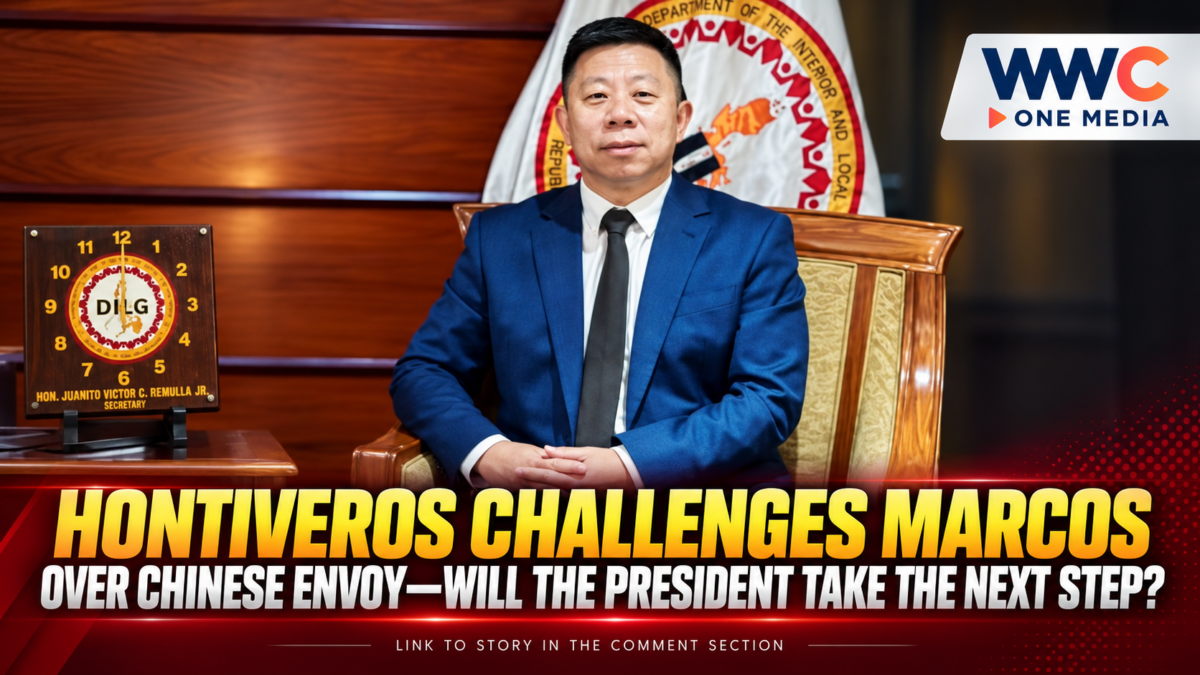
MANILA, Philippines — Senator Risa Hontiveros is urging President Ferdinand Marcos Jr. to take a tougher diplomatic stance against China by demanding a formal retraction and apology over controversial remarks by Chinese Ambassador Jing Quan, warning that the envoy should be declared persona non grata if Beijing refuses to comply.
The controversy has intensified tensions between Manila and Beijing following Jing’s remarks suggesting that China could easily win if it chose to use military force, although he maintained that his country preferred peace.
Hontiveros argued that simply summoning the ambassador was not enough to address what she viewed as an attempt to intimidate the Philippines amid continuing disputes in the West Philippine Sea.
“An ambassador who threatens his host country has crossed a line. Summoning him is not enough,” Hontiveros said, according to a report by Bilyonaryo News Channel on October 16.
She called on the Philippine government to demand a formal retraction and apology from Beijing, adding that the envoy should be declared persona non grata if China failed to provide them.
The senator also urged the government to raise the matter before the Association of Southeast Asian Nations and the United Nations General Assembly, arguing that the issue concerns respect for international law and the sovereignty of nations.
Chinese envoy’s remarks trigger diplomatic backlash
The dispute erupted after Jing responded to Philippine Defense Secretary Gilberto Teodoro Jr.’s characterization of China as a regional troublemaker.
During a media interaction on the sidelines of a forum in Quezon City, Jing rejected that description and said the Philippines should feel fortunate to have China as its neighbor.
He then remarked that China could easily win if it wanted to use force, while insisting that Beijing would not choose that option because it favored peace.
The comments drew criticism from Philippine officials, who viewed the reference to military force as inappropriate and potentially threatening, particularly amid longstanding tensions over disputed maritime areas.
The Department of Foreign Affairs (DFA) subsequently expressed strong objections to the remarks, describing them as provocative and unacceptable.
The controversy has since expanded beyond the ambassador’s original statements, with Chinese diplomatic officials and Philippine lawmakers exchanging increasingly sharp public criticism.
Chinese Embassy challenges Philippine lawmakers
The diplomatic dispute escalated further after the Chinese Embassy publicly challenged Filipino lawmakers who had called for Jing’s removal.
In social media posts reported by Philippine Canadian Inquirer on October 18, the embassy questioned whether the proposed action constituted a threat or coercion and challenged Philippine officials to proceed rather than continue making public statements.
The challenge prompted additional reactions from Philippine legislators, several of whom maintained that the ambassador should leave the country if the controversy remained unresolved.
Senators Francis Pangilinan and JV Ejercito were among those who separately called for Jing to return to China, according to reports by the Philippine Daily Inquirer and Cebu Daily News.
The exchange has placed additional pressure on the Marcos administration to determine how far it is willing to go in responding to the Chinese envoy’s statements.
Marcos administration faces a diplomatic decision
Despite growing calls for Jing’s expulsion, Malacañang indicated on October 19 that Marcos was not inclined to declare the Chinese ambassador persona non grata.
According to Philstar.com, Palace Press Officer Claire Castro said the President did not want to pursue such a declaration against a foreign representative at that time.
The development highlights a difference between the position advocated by some lawmakers and the administration’s apparent preference for handling the dispute through diplomatic channels.
On October 19, Foreign Affairs Secretary Ma. Theresa Lazaro formally summoned Jing and conveyed the government’s serious objections to his remarks. The DFA also criticized the Chinese Embassy’s public attacks on Philippine legislators and reserved the government’s right to take further diplomatic action.
The government’s response leaves open the possibility of further diplomatic measures without confirming that the Philippines intends to expel the ambassador.
What does persona non grata mean?
Under the Vienna Convention on Diplomatic Relations, a host country may declare a foreign diplomat persona non grata, meaning the individual is no longer acceptable to the receiving state.
The sending country is then expected to recall the diplomat or terminate the person’s diplomatic functions. If it fails to do so within a reasonable period, the receiving state may refuse to recognize the individual as a member of the diplomatic mission.
In this case, calls by Hontiveros and other legislators do not automatically result in Jing’s expulsion. The proposal would require appropriate action by the Philippine government.
Such a move would also carry diplomatic consequences for relations between Manila and Beijing, which maintain significant economic ties despite persistent disagreements over maritime claims and security.
West Philippine Sea tensions remain at the center
The controversy comes against the backdrop of continuing disputes over the South China Sea, including waters within the Philippines’ exclusive economic zone that Manila refers to as the West Philippine Sea.
China maintains expansive claims over the waterway, while the Philippines and other regional states assert their own maritime rights. The 2016 arbitral ruling under the United Nations Convention on the Law of the Sea rejected the legal basis for China’s expansive historic-rights claims within the scope addressed by the tribunal.
The latest diplomatic dispute underscores how statements by senior foreign representatives can complicate already sensitive relations, particularly when they involve the possible use of military force.
For Hontiveros, the issue is not limited to the ambassador’s choice of words. Her demand for a retraction and apology reflects a broader call for the Philippines to defend its sovereignty and insist on respect in its dealings with Beijing.
However, with Malacañang signaling reluctance to pursue a persona non grata declaration, the immediate question is whether the administration will adopt additional diplomatic measures or continue seeking a resolution through formal engagement.
As the dispute unfolds, the government’s next move could determine whether the controversy remains a diplomatic protest or escalates into a more serious confrontation between Manila and Beijing.










