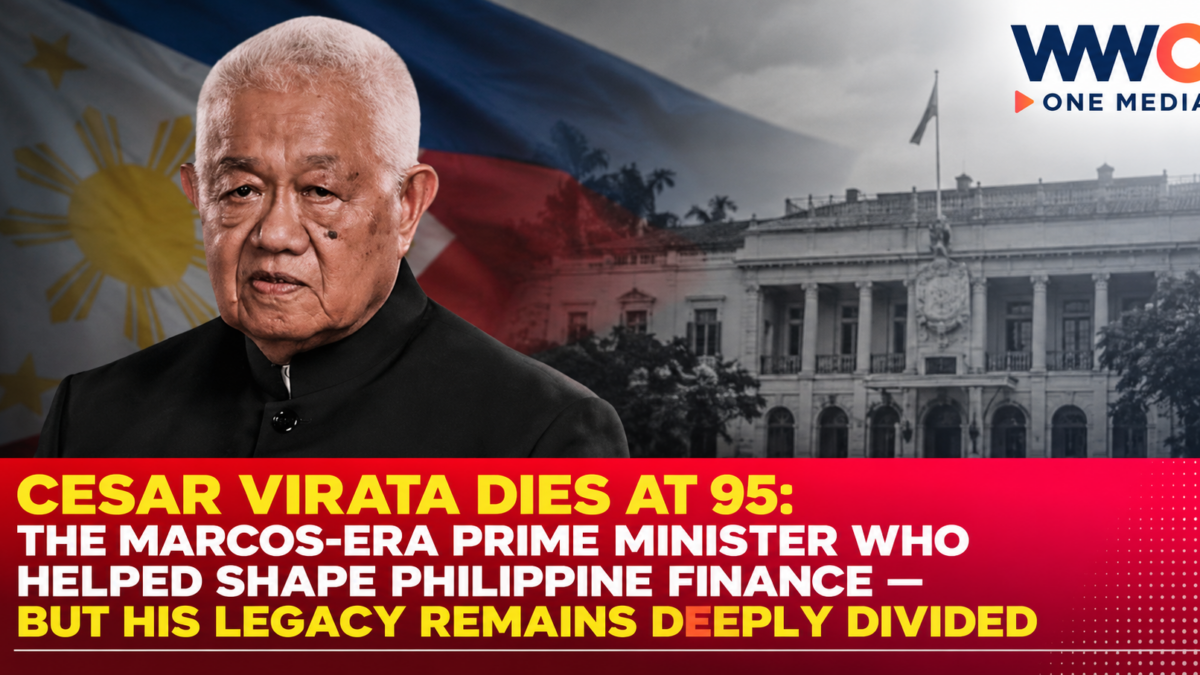
MANILA, Philippines — Cesar Enrique Aguinaldo Virata, the former Philippine prime minister and the country’s longest-serving finance chief, has died at 95, leaving behind a remarkable yet controversial legacy shaped by economic reform, financial crises and nearly two decades at the highest levels of government under Ferdinand Marcos Sr.
Virata died on October 2, 2026, according to Rizal Commercial Banking Corporation (RCBC), where he had served as a director since 1995 and corporate vice chairperson for 26 years.
His passing marks the end of a career spanning academia, public finance, international economic negotiations and corporate leadership.
To admirers, Virata was a disciplined technocrat who helped build important financial institutions and sought to preserve economic stability during one of the Philippines’ most turbulent periods.
To critics, he was a powerful official who remained inside an authoritarian government despite mounting political repression, corruption and an economic collapse that devastated Filipino households.
His story raises a question that remains relevant today: Can a public official’s technical achievements be separated from the political system that enabled them?
From Cavite Scholar to the Highest Levels of Government
Born on December 12, 1930, in Kawit, Cavite, Virata came from a family with deep connections to Philippine education and history.
His maternal grandfather, Baldomero Aguinaldo, was the brother of revolutionary leader Emilio Aguinaldo.
His father, Enrique Virata, was an academic who held senior positions at the University of the Philippines.
Growing up in an intellectually oriented household, Cesar developed a strong interest in engineering, mathematics and business.
He graduated cum laude from the University of the Philippines in 1952 with a background in engineering and business administration.
He subsequently earned a Master of Business Administration degree from the University of Pennsylvania’s Wharton School in 1953.
Virata joined the UP College of Business as a professor and later served as its dean from 1960 to 1967.
His early career also included management consulting work at SGV, where he helped develop the firm’s management services division.
These experiences established his reputation as a specialist in financial management, industrial productivity and corporate organization.
Marcos Appointed Virata Finance Chief at Just 39
Virata entered government service in 1967 during the administration of Ferdinand Marcos Sr.
He held senior positions involving economic planning, investment promotion and industry development before becoming the first chairman of the Board of Investments.
In 1970, Marcos appointed him finance secretary at the age of 39.
Virata would remain the country’s finance chief until 1986, serving as finance secretary from 1970 to 1978 and finance minister from 1978 to 1986.
His unusually long tenure placed him at the center of Philippine fiscal policy during the years before martial law, the expansion of government borrowing and the debt crisis of the 1980s.
He also represented the Philippines in international financial institutions, including the World Bank and Asian Development Bank.
His technical expertise helped him gain credibility among foreign creditors and economic policymakers.
Yet his government career was inseparable from a period in which political power became increasingly concentrated under Marcos.
Why Marcos Chose Virata as Prime Minister
In 1981, Marcos appointed Virata prime minister following a political struggle involving influential members of the ruling Kilusang Bagong Lipunan.
Virata was known for his reserved personality, technical expertise and reluctance to engage in conventional political maneuvering.
Historical accounts describe tensions between Virata and powerful figures within the Marcos administration, including First Lady Imelda Marcos.
According to economic historian Gerardo Sicat’s account, Virata developed a reputation for resisting spending requests that he believed lacked sufficient financial justification.
Imelda reportedly nicknamed him “Dr. No” because of his resistance to certain demands.
But despite holding the title of prime minister, Virata did not exercise authority equivalent to the head of government in a typical parliamentary system.
Marcos retained decisive executive powers, including control over key appointments and major policy decisions.
This arrangement would later become central to debates over how much responsibility Virata personally bore for the regime’s failures.
In 1983, Marcos even described Virata as a likely successor if he became unable to govern, underscoring the technocrat’s importance within the administration.
The 1983–1985 Economic Crisis That Defined His Career
Virata’s most difficult years came as the Philippine economy entered a severe debt and confidence crisis.
The assassination of opposition leader Benigno “Ninoy” Aquino Jr. in August 1983 intensified political uncertainty and contributed to capital flight and declining investor confidence.
But the economy’s structural weaknesses had been building for years, including growing foreign debt, weak financial institutions and distortions associated with politically connected businesses.
By the mid-1980s, the Philippines was experiencing one of its deepest postwar economic downturns.
The economy contracted sharply in 1984 and 1985, while inflation, financial stress and unemployment placed enormous pressure on households and businesses.
Virata became a central figure in negotiations with the International Monetary Fund, World Bank and foreign creditor banks.
In October 1984, a Philippine negotiating team led by Virata reached an agreement on an IMF-supported stabilization program that would help open the way for debt restructuring and additional financing.
The negotiations were intended to prevent a disorderly financial breakdown and restore some international confidence.
However, stabilization policies also involved painful adjustments.
For many Filipinos, the period is remembered not for financial negotiations but for lost livelihoods, falling economic output and the consequences of the country’s debt crisis.
Did Virata Protect the Economy — or Help Sustain the Marcos Regime?
This remains the most difficult question surrounding his legacy.
Supporters argue that Virata’s knowledge of fiscal management and international finance helped prevent an even worse economic collapse.
They point to his disagreements with influential figures in the administration and his attempts to impose financial discipline.
Former Central Bank Governor Jose “Jobo” Fernandez Jr., who worked with Virata during the debt crisis, reportedly credited his efforts as important to the country’s eventual economic recovery.
Critics offer a fundamentally different assessment.
They argue that remaining in government gave the Marcos administration an appearance of economic competence and international credibility while serious abuses, crony capitalism and political repression continued.
The issue was explored in an October 12 reflection by writer Jose Dalisay in The Philippine Star, which described sharply contrasting interpretations of Virata’s career.
One portrays him as a hardworking public servant operating under severe constraints.
The other sees a senior technocrat whose continued service helped sustain an authoritarian political order.
Both perspectives are essential to understanding why Virata’s death has prompted not only tributes but also renewed scrutiny.
Professional competence does not automatically resolve questions of political responsibility.
Equally, membership in a government does not by itself establish personal involvement in every abuse associated with that administration.
The historical challenge is to assess what Virata controlled, what he opposed and what he chose not to challenge.
February 1986: The End of a 16-Year Finance Career
Virata remained finance minister during the final years of the Marcos administration.
He resigned from the finance portfolio on February 16, 1986, days before Marcos was removed from power during the EDSA People Power Revolution.
The political transition ended Virata’s time at the center of the Philippine government.
After leaving office, he faced civil litigation involving the Presidential Commission on Good Government, which had been established to recover alleged ill-gotten wealth associated with the Marcos regime.
The existence of those legal proceedings should not be confused with proof of personal criminal wrongdoing.
Virata subsequently returned to professional and corporate work while continuing to comment on economic policy.
He defended the importance of honoring international financial obligations and warned against policies that could undermine the country’s access to foreign financing.
From Government to RCBC: Another Three Decades in Finance
After the Marcos era, Virata remained influential in Philippine banking and corporate governance.
He joined the board of RCBC in 1995 and served as corporate vice chairperson beginning in 2000.
His work with the Yuchengco-led banking group continued for more than three decades.
In 2001, he helped manage a leadership transition following the resignation of senior executives.
He also participated in a management committee overseeing RCBC operations during the bank’s 2016 leadership difficulties following the Bangladesh Bank cyber-heist controversy.
His corporate responsibilities extended beyond banking into insurance, property, education and other industries.
These positions illustrate how Virata’s reputation for financial management endured long after his departure from government.
However, his continued prominence also raises a broader question about the long-term influence of former senior officials within Philippine financial institutions.
SEC Honors Virata’s Contributions to Philippine Capital Markets
Following Virata’s death, Securities and Exchange Commission Chairman Francis Ed. Lim recognized his role in helping develop the country’s modern capital market infrastructure.
Lim highlighted Virata’s contributions as an incorporator of the Philippine Stock Exchange and a supporter of the development of fixed-income trading infrastructure.
The SEC chairman described Virata’s institutional contributions as an important part of the country’s financial modernization.
These achievements help explain why Virata continued to command respect within business and finance circles despite the controversies surrounding his government service.
But recognizing his contributions to market development does not erase the economic and political failures of the period in which he held public office.
A comprehensive assessment must consider both.
Marcos Jr. Pays Tribute to His Father’s Former Prime Minister
President Ferdinand Marcos Jr. paid his respects to Virata during a visit to his wake at Heritage Memorial Park in Taguig City on October 7, 2026.
The Presidential Communications Office confirmed the visit in an October 8 statement.
Marcos Jr. praised Virata’s years of public service and recalled his long working relationship with the late president.
The tribute underscored Virata’s enduring place in the political history of the Marcos family.
Other institutions, including the Department of Finance and RCBC, also expressed condolences and recognized his professional contributions.
These tributes reflect the respect Virata retained among former colleagues and business institutions.
However, public remembrance also presents an opportunity to examine historical accountability, including the legacy of martial law and the economic crisis of the 1980s.
A Private Life Beyond Politics and Banking
Outside government and corporate affairs, Virata maintained a longstanding commitment to education and history.
He was associated with the Cavite Historical Society and remained interested in preserving the province’s heritage.
He was married to Phylita Joy Gamboa-Virata, a theater personality associated with Repertory Philippines.
The couple married in December 1956 and had three children: Steven Cesar, Gillian Joyce and Michael Dean.
Friends and professional associates frequently described Virata as disciplined, reserved and modest in his personal habits.
Those personal qualities form part of the recollections of his life, although they do not settle debates about his public career.
Cesar Virata’s Legacy: A Technocrat History Will Continue to Debate
Cesar Virata occupied a distinctive place in Philippine history.
He was an engineer and educator who rose to become one of the country’s most powerful economic officials.
He played a central role in international financial negotiations, helped develop market institutions and later remained active in corporate leadership.
But he also served for many years under a dictatorship marked by political repression, crony capitalism and a severe economic crisis.
For supporters, his career shows how professional expertise and disciplined public service can contribute to institution-building even under difficult conditions.
For critics, it raises the danger of technical expertise being used to legitimize or sustain a government that is failing its people.
The debate cannot be resolved by overlooking either side of the historical record.
Virata’s achievements deserve examination, but so do the limits of his authority, the choices he made and the political system he served.
Cesar Virata died at 95, leaving behind a lifetime of work in Philippine finance and public administration. But perhaps his most enduring legacy is the question his career poses to every generation of public officials: How far should loyalty to government go when professional duty and political accountability collide?