
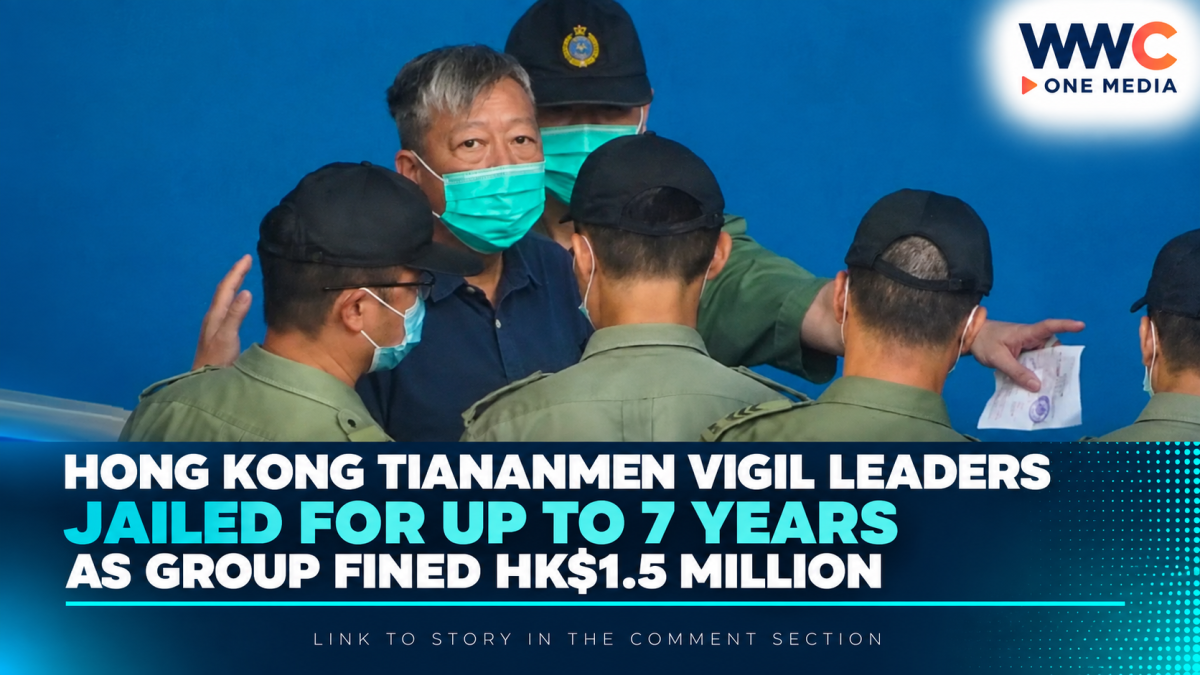
HONG KONG — Two prominent Hong Kong democracy activists who once led the organisation behind the city’s massive annual Tiananmen Square vigils have been sentenced to prison for up to seven years, marking another major national security ruling against the city’s once-powerful pro-democracy movement.
Former Hong Kong Alliance chairman Lee Cheuk-yan, 69, was sentenced to seven years in prison, while former vice-chairwoman Chow Hang-tung, 41, received seven years and three months. Former alliance vice-chairman Albert Ho, 74, who pleaded guilty, was sentenced to five years and two months.
The now-disbanded Hong Kong Alliance itself was fined HK$1.5 million (about US$191,000).
From Candlelight Vigils to National Security Convictions
For decades, the Hong Kong Alliance organised the city’s annual candlelight vigil commemorating the victims of the 1989 Tiananmen Square crackdown.
The gatherings at Victoria Park were once among the largest public commemorations of the events of June 4 anywhere in the world, attracting huge crowds and becoming one of the most visible symbols of Hong Kong’s civil society and political freedoms.
But the political landscape changed dramatically after Beijing imposed Hong Kong’s National Security Law in 2020.
Authorities later accused the alliance and its leaders of inciting subversion through their long-running advocacy for ending what they described as “one-party dictatorship” in China.
Court Says Call to End One-Party Rule Crossed the Line
The case centred heavily on the alliance’s political platform and its repeated calls to end one-party rule.
Prosecutors argued that advocating an end to the Chinese Communist Party’s leadership amounted to inciting subversion under Hong Kong’s National Security Law.
The defendants argued that their activities involved peaceful advocacy for democracy and political change.
However, the court rejected that argument and convicted Lee and Chow. Judges concluded that the alliance’s political activities and messaging crossed into incitement against state power.
The sentences mean the three former leaders will collectively spend years behind bars for activities connected to an organisation that once openly held some of Hong Kong’s largest annual public gatherings.
Albert Ho Received a Shorter Sentence After Guilty Plea
Albert Ho, a former chairman of both the alliance and Hong Kong’s Democratic Party, received a shorter sentence of five years and two months after pleading guilty.
Lee and Chow both contested the charges.
Chow represented herself in the proceedings and continued to defend her belief in democracy and the right to political advocacy.
The difference in sentencing reflects Ho’s guilty plea and cooperation with the judicial process compared with the two other defendants, who maintained their innocence.
A Symbol of Hong Kong’s Changing Political Landscape
The case carries enormous symbolic importance because the Tiananmen vigil was once considered one of Hong Kong’s most distinctive political traditions.
For years, thousands — and in some years tens of thousands — gathered with candles to remember those killed in Beijing’s 1989 crackdown.
The vigils continued for decades under the principle of “one country, two systems,” which was designed to preserve Hong Kong’s separate legal system and certain freedoms after the city’s 1997 handover from British to Chinese rule.
But the annual gatherings effectively disappeared after the introduction of the National Security Law in 2020.
Rights Groups Condemn the Sentences
The sentencing has drawn criticism from international rights groups and democracy advocates, who argue that the case criminalises peaceful political expression and public remembrance.
Human Rights Watch criticised the ruling as a violation of freedom of expression and peaceful assembly.
Critics say the case demonstrates how dramatically Hong Kong’s political environment has changed since the 2019 pro-democracy protests.
Hong Kong authorities, however, have consistently defended the National Security Law and rejected accusations that prosecutions are politically motivated.
The government maintains that the law is necessary to restore stability and that Hong Kong’s courts continue to operate according to the rule of law.
Why This Case Matters
The sentencing sends a powerful message to Hong Kong’s remaining political and civil society groups.
The Hong Kong Alliance was not a newly formed underground organisation. It had operated openly for decades and organised some of the city’s most recognisable public events.
Its leaders included veteran politicians, lawyers and activists who had been prominent figures in Hong Kong’s public life.
Now, the organisation has been disbanded, its leaders imprisoned and the group itself financially penalised.
The transformation illustrates just how quickly Hong Kong’s political boundaries have changed.
The Bottom Line
Former Hong Kong Tiananmen vigil leaders Lee Cheuk-yan and Chow Hang-tung have been jailed for seven years and seven years and three months respectively, while Albert Ho received five years and two months after pleading guilty.
The Hong Kong Alliance behind the city’s historic annual Tiananmen vigils was also fined HK$1.5 million after being convicted in the national security case.
For decades, Hong Kong’s June 4 candlelight vigil stood as one of the world’s most visible annual memorials to the Tiananmen Square crackdown.
Now its organisers are behind bars, its organisation has been dissolved and one of Hong Kong’s most enduring symbols of political remembrance has effectively disappeared — underscoring the dramatic transformation of the city’s political landscape.

Leave a Reply