
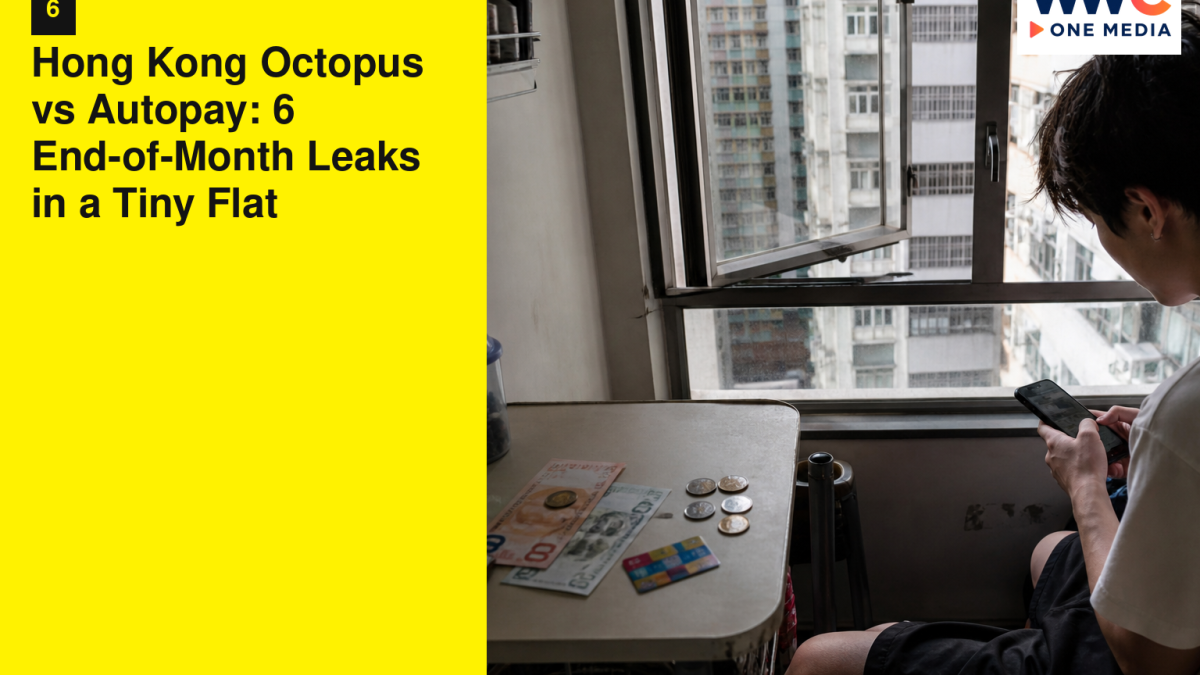
HONG KONG — The tiny flat is already doing maths. Mong Kok, Tai Kok Tsui, Sham Shui Po, a subdivided room in Fortress Hill that looked bigger on a lunch viewing. End of month is not a personality here. It is a stack: rent, management, electric, water, broadband, a phone plan, MTR, the 7-Eleven taps that did not feel like groceries, and the Octopus auto-add that thought it was being helpful at 11.40pm. Hong Kong Octopus vs Autopay is the wrong fight if you treat it as a brand war. It is six leaks in the same week, in a space where a receipt on the fridge is already furniture.
This is not a product ranking. It is not a fee table. No invented percentages, no official tariffs quoted as gospel, no named bank sources, no fake quotes from a landlord in a tank top. Your statements are your statements. Open them. The habits below are about seeing taps and autopay as two pipes into the same tiny flat, then shutting the ones that are only a mood.
Do the sitting on a Sunday when the MTR is a different country. Do not do it on the last Friday while a 7-Eleven microwave is spinning something that was supposed to be dinner.
1. Octopus vs Autopay starts with a week of 7-Eleven taps that never felt like a bill
The first leak is convenience that refuses to look like rent. You tap Octopus at the 7-Eleven under the Mong Kok apartment because you need water, a bun, a charger cable that will die, a paid bag, an umbrella in the rain on Argyle Street. Each tap is small in the wrist. The week is not small. End of month, the Octopus history is a second grocery bill that did not pass through the kitchen because there is no kitchen, only a kettle.
Open the Octopus app or the card history you actually have. Filter a week. Count the 7-Eleven, Circle K, the stall at the MTR entrance that is technically not 7-Eleven and still a tap. Write a number. This article will not invent yours. The number is the leak. People fight Octopus vs Autopay as if one were adult and one were childish. A tap that happens fourteen times is a habit. Autopay is a different habit. Both hit the same HSBC or Hang Seng or Bank of China week.
What not to do. Do not top up in a hurry at the MTR gate with a “just in case” amount that then becomes 7-Eleven because it is sitting there. Sitting there is not a budget. Do not use Octopus for a thing you already have on a card autopay — some people double-pay a transport add-on and a tap and then call Hong Kong expensive, which it is, without needing the double.
City logistics. Mong Kok 7-Eleven at 1am is a community centre with fluorescent lighting. Tai Kok Tsui after a walk from Olympic is a smaller version. Sham Shui Po taps include hardware you did not plan. If the tiny flat has no fridge worth the name, the tap is your fridge. Name it: this is groceries, not “snacks.” Groceries belong in the same sitting as the Wellcome run you keep postponing because the aisle is a crowd.
A script at the door of 7-Eleven: “Is this the kettle, or is this a mood.” Kettle is milk, water, instant, medicine. Mood is a second packaged cake because the room is 120 square feet and the cake is a wall. Mood can happen. Mood should not be unnamed in the Octopus history.
If you share the tiny flat, taps are a couple problem. Two cards. One shelf. Decide whose Octopus buys the shared water. Split in FPS the same night, not in a speech on the last weekend.
2. MTR season vs the taps that are not MTR
The second leak is transport wearing a disguise. MTR is the honest Octopus. You know you rode. Kwun Tong line, Tsuen Wan line, Island line, a change at Mong Kok or Prince Edward that you could walk if the rain were a rumour. Then there are taps that are also movement: minibus, bus, a Star Ferry you took because the harbour was a feeling, a taxi you did not take because Octopus made the MTR feel free-ish after you already auto-added.
End of month, people remember rent and forget the rides that were “just one more stop” to a mall in Kowloon Tong, a dinner in Tsim Sha Tsui, a night market walk that became a tap at every exit shop. Octopus vs Autopay here is simple: MTR should be a known band. The extra taps should be a list. If the extras are larger than the band, you did not have a commute. You had a hobby.
What not to do. Do not buy a transport product you will not use because a poster in the station made it look like adulting. Read your own last month of rides first. Do not tap in and out with a second card “as backup” and then wonder why history looks drunk. One card for the month you are studying.
City logistics. A tiny flat in Fortress Hill means Island line as a default. A tiny flat in Sham Shui Po means a walk that could replace two stops if you left six minutes earlier. The leak is often those two stops plus a 7-Eleven at the destination because you are now late and hungry. Walk once on a Sunday with a timer. If the walk is possible, put it in Notes as the default before 10pm. After 10pm the walk is a different city, and a tap is allowed without a speech.
A script: “Commute band versus extra taps.” Circle extras that were social. Social is fine. Social is not invisible. If a friend in Causeway Bay always makes you the person who taps for both of you at a stall, FPS before the next station. Friendship that waits until payday is how tiny flats go quiet.
3. Autopay stacking: the bills that land in the same three days
The third leak is not Octopus at all, which is why Octopus vs Autopay is a useful title and a bad mental model if you only watch the card. Autopay is rent if the landlord takes it, management fees, CLP or the electric name on your bill, water, Towngas if the tiny flat has gas that is not a lie, broadband, mobile, a streaming thing you forgot, a gym you have not entered since a humid Tuesday in July.
They stack. Hong Kong likes a due-date cluster near month-end because the city enjoys a queue. The tiny flat feels poorer on the 28th than on the 8th, not because you changed as a person, because pipes opened together.
Open the bank app. Filter last month. Tag every autopay. Write the day it left. If three left on the same morning, that is a calendar fact. You cannot always move a utility date. You can move the streaming. You can move the day you FPS the landlord if they take FPS. You can keep a buffer that exists before the cluster, not after.
What not to do. Do not turn off a utility autopay in a mood and then miss a due date because the letter went to a mailbox you do not check in a building where mail is a sport. Do not add a new autopay for a “small” membership the same week as the cluster. Small is how stacks work.
City logistics. Management offices in old Mong Kok buildings want cash, FPS, or a cheque situation that does not belong in 2026 and still exists. If your building is cash, autopay is not the leak — the walk with cash is the leak, plus the extra 7-Eleven because you already left the room. Put the management walk on a calendar day that is not the electric day.
A script to a flatmate: “Cluster days are [dates]. No new subscriptions in that window. Shared bills leave from [account]. Screenshot the same night.” If they hate screenshots, they still owe you one. Tiny flats do not have space for folklore about who paid PCCW.
4. Auto-add on Octopus is not a buffer, it is a surprise top-up
The fourth leak is the feature that feels like care. Auto-add, automatic add-value, the moment the card is low and a bank account quietly refills it so you can still tap the gate at Prince Edward. Useful. Also a way to never see the month. If the tiny flat is already on a knife, a refill at 11.40pm after a 7-Eleven second dinner is a second dinner plus a top-up plus the feeling that Octopus vs Autopay “just happens.”
Look at whether auto-add is on. Look at the amount it adds, as a field, not as a vibe. Look at how many times it fired last month. If it fired because you lived, fine. If it fired because 7-Eleven was a personality, you have a number. Turn it off for one month as an experiment only if you can still get through a gate — keep a manual top-up habit at a machine when you are calm, not at the yellow line with a crowd behind you.
What not to do. Do not disable auto-add the same morning you have a job interview in Central and a card at $3. Do not enable two auto-adds on two cards and a phone Octopus and then lose the thread. One card, one setting, one month of history.
City logistics. The machine at Mong Kok station is a queue. The 7-Eleven add-value is convenient and also puts you in the shop. If you are trying to cut taps, adding value in the shop is a fox guarding a microwave. Use the station machine on a weekday midday if your job allows, or a quieter station one stop over. Olympic, Shek Kip Mei, a walk. Five minutes of boredom is cheaper than a second umbrella.
A script: “Auto-add on or off for this month, and I will read history on Sunday.” Reading is the adult part. The setting is just a tap.
If you use a phone wallet Octopus and a physical card, pick one for the experiment. Dual cards are how leaks fork.
5. Tiny-flat bills that look too small to autopay and then arrive as cash
The fifth leak is the bill you thought was too humble for a system: bottled water delivered, a laundry machine in the building that wants coins or a tap, a window-unit electric personality that is not in the landlord’s “inclusive” sentence, a wifi splitter you pay a neighbour for in an envelope. End of month these crawl out. Octopus vs Autopay does not capture an envelope.
Write every monthly outgo that is not in the bank autopay list and not in Octopus history. If it exists, it is a third pipe. Put it in Notes. If you can move it to FPS on a known day, move it. If you cannot, put cash aside on payday in an envelope that is not also the 7-Eleven envelope.
What not to do. Do not let a neighbour’s wifi remain a handshake. Handshake is how you fund a router and still get blamed when Zoom dies. Name the amount and the day. Do not ignore a management circular about a water tank because the English is tiny. Tiny English still takes money.
City logistics. Subdivided flats in Sham Shui Po and Mong Kok often share meters the way they share air. If electric is a formula, photograph the reading when you move in and once a month. Photograph is a habit from a different adulting piece and still true here. A formula without a photo becomes a fight in a corridor that already has too many shoes.
A script to the landlord: “Which bills are inclusive, which I pay, which day, which method.” If they say “later,” later is not a method. Ask before the first cluster week.
The tiny flat also leaks in heat. A window AC in August is not a luxury if you sleep. It is a bill. Put a default: AC for sleep, fan for the rest, door draft stuffed with a towel that is not also your only towel. Towels are inventory in 120 square feet.
6. Subscriptions riding autopay while Octopus pretends to be the problem
The sixth leak is the one that survives every “I should cook.” Streaming. A cloud plan. A software trial. A news site. A beauty membership from a mall in Tsim Sha Tsui you visited once with a cousin. They sit on autopay, quiet, while you scold yourself for tapping Octopus at 7-Eleven. Octopus vs Autopay as a moral story always picks the visible tap. The invisible one is often larger.
Open the bank again. Every name you do not recognise, click. Cancel from the actual merchant, not only by wishing. Then wait one cycle to see it gone. Wishing is not a cancellation.
What not to do. Do not start a new trial on the same night you cancelled two others. The tiny flat is not a rewards lounge. Do not share passwords as a household of five if the bill is in your name and the FPS never arrives. Your name is the leak.
City logistics. Malls in Mong Kok will sell you a membership because aircon is a drug. Step outside onto Sai Yeung Choi and the membership is a line on a future statement. If you want a gym, pick one you will pass on the walk from the MTR to the tiny flat. A gym in another district is a second MTR leak plus a subscription leak. Two pipes.
A script: “Visible taps versus invisible autopay. I will cut one of each this month, not five of one.” One of each is how you still get to work. Five of one is a personality reboot that lasts until Thursday.
A Sunday sitting that fits a tiny Mong Kok table
You do not have a dining table. You have a bit of wood. Use it.
Minute 0–8: Octopus history, last 30 days. Circle 7-Eleven and cousins. Write the sum.
Minute 8–15: MTR versus extra rides. Write the band.
Minute 15–22: Bank autopay list. Dates. Cluster.
Minute 22–28: Auto-add setting. Times it fired.
Minute 28–35: Envelope bills and neighbour wifi. Name them.
Minute 35–40: Subscriptions. Cancel one if it is theatre. Leave the one you actually use in the room at 1am, if it is the room’s window to the world.
Then walk. Argyle Street, or the park if you have one. Do not reward the sitting with a tap. Reward it with a fridge item from a grocery that is actually a grocery, even a small Wellcome, even if the queue is a sport.
What not to do at 11.40pm in a 7-Eleven
Do not do the monthly sitting under fluorescent light with a microwave humming. You will hate every number. Do not top up Octopus and also buy a third ready meal “because you are already here.” Do not FPS a friend a social tap from last weekend while hungry. Hungry FPS is generous in a way you will resent on the 28th.
Do not fight a partner about autopay in the snack aisle. The aisle has an audience. The tiny flat is already too small for an audience. Walk home. Sit on the bit of wood. Use the list.
Do not take a cash advance energy from a card because the cluster week arrived. Cluster week arriving is information for next payday’s buffer, not a new product.
Objections that keep both pipes open
“Octopus is just transport.” Open history. If 7-Eleven is there, it is not just transport.
“Autopay means I don’t forget.” Forgetting is one risk. Stacking is another. You can autopay and still read.
“It’s Hong Kong, everything is taps.” Yes. That is why a sitting exists. Taps are the climate. Climate still has a raincoat.
“I’ll cook more.” Cooking more is a different article in a room with one burner. This article will not romanticise a burner. It will ask you to name the microwave meals as groceries.
“My company Octopus / my company autopay covers it.” Then still read. Company pipes close when jobs close. A tiny flat lease does not close on the same day.
If a flatmate says they “don’t do numbers,” they can still FPS a third of the electric on a known date. Numbers are how 120 square feet stays a household instead of a corridor with two kettles.
Mong Kok, Sham Shui Po, Fortress Hill: same leaks, different walks
Mong Kok: 7-Eleven density is the test. You cannot walk home without a door that wants a tap. Choose a route that passes fewer doors, even if it is uglier. Ugly routes are budgets.
Sham Shui Po: hardware and fabric and a snack that was supposed to be a look. Leave the Octopus in a pocket until you have walked the block once without a bag. Bags are how looks become statements.
Fortress Hill / North Point: Island line convenience plus a tiny flat that still wants a Wellcome in a mall. The mall is the leak. The MTR is honest.
Tai Kok Tsui: the walk to Olympic can replace a ride. Try it before the cluster week, not during.
The harbour is not a budget. You can look at it from a bus you already tapped. You do not need a second tap to prove you live here.
Bottom line
Hong Kong Octopus vs Autopay is six end-of-month leaks in a tiny flat: 7-Eleven taps that never felt like a bill, MTR extras wearing a commute costume, autopay stacking on the same three days, auto-add surprise top-ups, envelope bills that neither pipe captures, and subscriptions that hide while you scold a bun. Not a brand war. One Sunday on a bit of wood in Mong Kok, history open, cluster dates named, one visible tap and one invisible autopay cut. The MTR will still be a crush. The 28th does not have to be a second rent.




Leave a Reply