
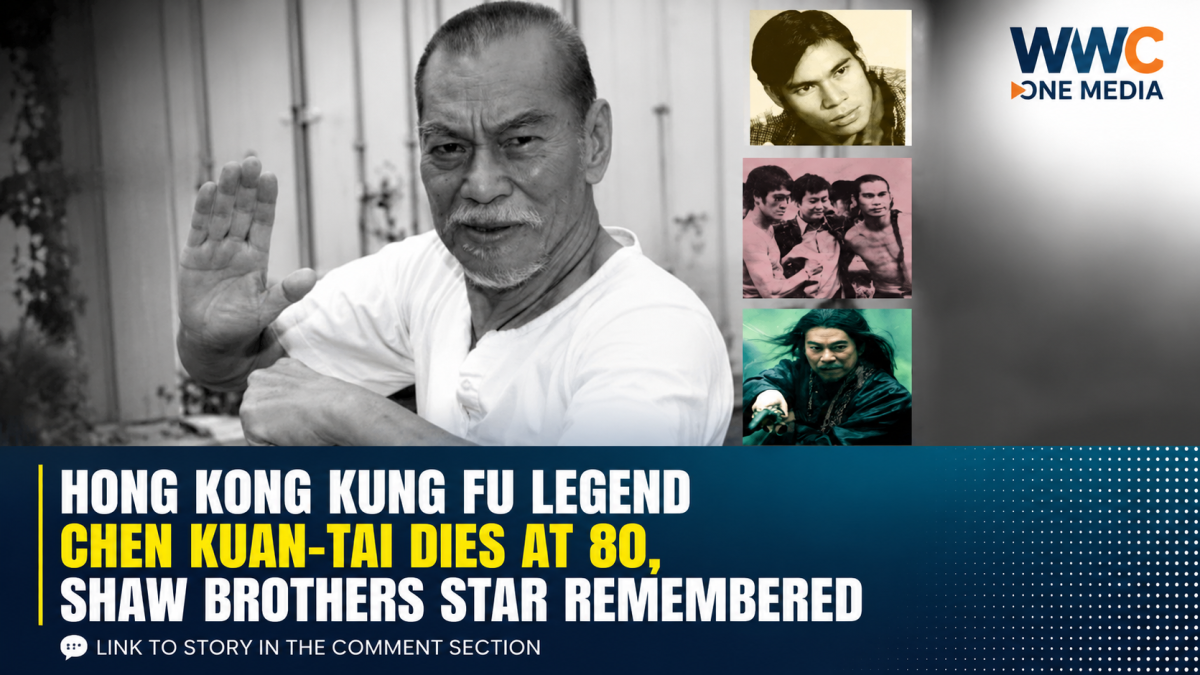
Hong Kong’s golden age of martial arts cinema has lost one of its most recognizable stars.
Veteran actor and martial artist Chen Kuan-tai (陳觀泰) died on the morning of September 2, 2026, aged 80, according to multiple Hong Kong and regional media reports. His death was reportedly confirmed by people close to him, including his apprentice and former Shaw Brothers associates.
Reports said Chen had recently been hospitalized with hydrocephalus, and Hong Kong media reported that he may have suffered a cerebral haemorrhage. Veteran journalist Wong Man Ling reportedly said Chen suffered a second cardiac arrest at about 5am, after which resuscitation efforts were unsuccessful. Because the precise medical circumstances have not been independently detailed in an official statement, his reported cause of death should be described cautiously.
From Martial Arts Champion to Shaw Brothers Superstar
Born in Hong Kong in 1945, Chen developed his martial-arts skills from a young age and trained in the Tai Shing Pek Kwar Moon tradition.
Before becoming an actor, he had a very different career: Chen worked as a firefighter after leaving secondary school. He later entered the film industry and joined the Shaw Brothers training system.
His competitive martial-arts credentials helped distinguish him from many screen performers of the era.
In 1969, Chen won the lightweight/light-heavyweight championship at the First Southeast Asia Kung Fu Tournament in Singapore, according to Hong Kong’s Film Archive and contemporary reports.
That achievement helped establish the authenticity that would become central to his screen persona.
‘The Boxer from Shantung’ Changed His Career
Chen’s breakthrough came in 1972, when he starred as Ma Yongzhen in Shaw Brothers’ The Boxer from Shantung.
Directed by Chang Cheh, the film became a defining work of Hong Kong action cinema and transformed Chen into a major kung fu star. His physical fighting ability and hard-edged screen presence helped create the image that audiences associated with him throughout the 1970s.
He subsequently appeared in numerous influential martial-arts films, including The Blood Brothers, Heroes Two, The Teahouse, The Flying Guillotine, Crippled Avengers and Executioners from Shaolin.
Hong Kong’s Film Archive describes The Boxer from Shantung as the film that propelled Chen to fame after fellow Shaw Brothers stars John Chiang and Ti Lung.
He Was More Than an Actor
Chen’s career eventually extended beyond acting.
He worked as a martial-arts choreographer, director and producer, taking on roles behind the camera as Hong Kong cinema evolved. His directing credits included Iron Monkey and Big Boss of Shanghai, according to reports about his career.
The transition reflected Chen’s long-standing interest in martial-arts filmmaking. In a 2025 interview, he reportedly said becoming an actor was not his ultimate goal and that he had originally wanted to become an excellent martial-arts choreographer.
A Health Scare Years Before His Death
Chen had previously experienced serious health problems.
In early 2020, reports said he was hospitalized after an imbalance involving his red and white blood cell counts and required blood transfusions. He later said his condition improved after changing his diet and adopting healthier habits.
In the weeks before his death, reports indicated that Chen had been hospitalized with hydrocephalus. A longtime Shaw Brothers associate reportedly said Chen had appeared well when they met for tea as recently as the previous month, making the news of his death particularly sudden.
A Quiet Final Chapter
In his later years, Chen lived largely out of the spotlight and was reported to have spent much of his time in Zhongshan, Guangdong, while maintaining connections with Hong Kong’s entertainment community.
Despite reducing his workload, he remained interested in filmmaking. Reports said he continued to express an interest in acting and working on new projects rather than formally declaring retirement.
His death marks the passing of another major figure from the Shaw Brothers era, a period that helped establish Hong Kong as one of the world’s most influential centres for martial-arts cinema.
Chen Kuan-tai’s legacy stretches from competitive kung fu to some of the most enduring action films of the 1970s—and from performing in front of the camera to shaping martial-arts filmmaking behind it.
Accuracy Note
Multiple reports published on September 2 confirm Chen Kuan-tai’s death at 80. Reports about cerebral haemorrhage and cardiac arrest remain media-reported accounts of the circumstances surrounding his death, rather than a publicly released official medical statement.
WWC ONE MEDIA J.M.D




Leave a Reply