
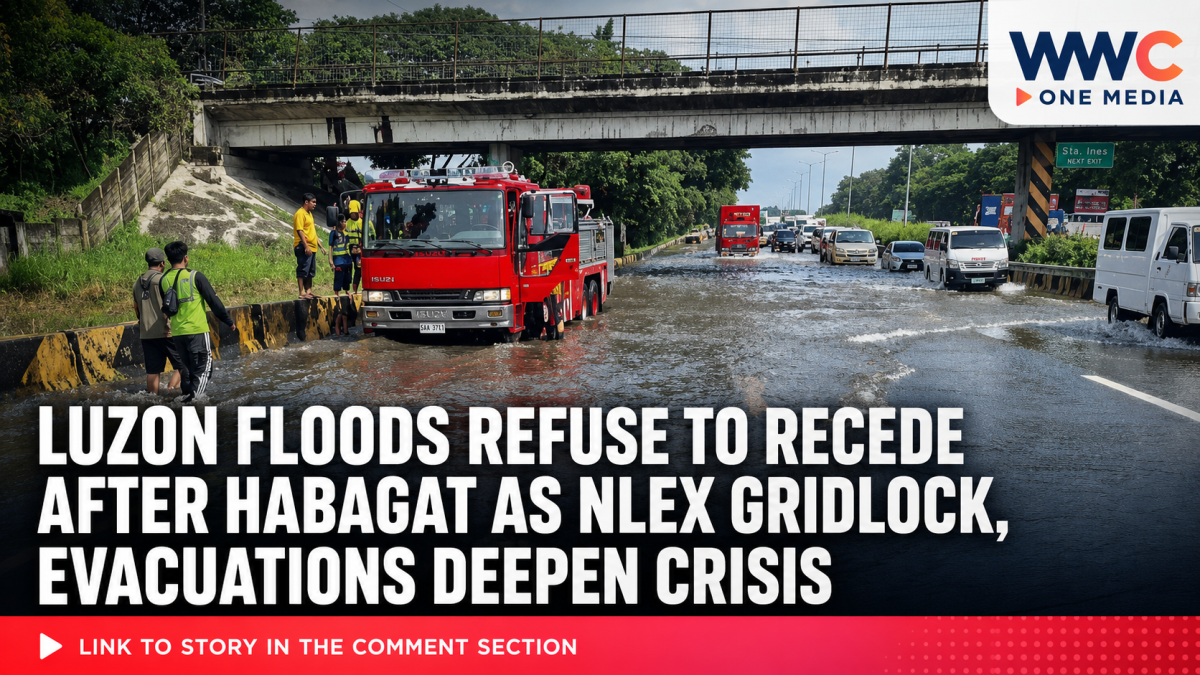
MANILA, Philippines — The rain may have weakened in parts of Luzon, but for thousands of families trapped by stubborn floodwaters, the disaster is far from over.
Days after torrential monsoon rains inundated communities across Central Luzon and other parts of the country, floodwaters remained dangerously high in several areas Wednesday, September 2, disrupting highways, isolating communities and keeping families inside evacuation centers.
The prolonged flooding has transformed what began as a severe weather emergency into a wider humanitarian, transportation and economic crisis.
Latest reports from the Office of Civil Defense showed that the combined effects of tropical cyclones Luis, Maymay and Neneng and the southwest monsoon, or Habagat, have been linked to 39 reported deaths, while 20 people were injured and three remained missing.
Official population figures continued to change as local reports were consolidated. An OCD report cited by GMA News listed 8,782,993 affected people, while a Philippine News Agency report later Wednesday, also citing OCD data, put the number at around 9.4 million people from roughly 2.7 million families.
The difference underscores how rapidly the disaster assessment continues to evolve.
Central Luzon Remains Underwater
Bulacan and Pampanga remain among the hardest-hit provinces.
The Philippine Star reported that 145 barangays in Bulacan remained flooded, including 32 villages in Malolos, 26 in Calumpit and 24 in Hagonoy. Across Luzon, 178 cities and municipalities have been placed under a state of calamity.
Calumpit shows just how long the crisis can persist even after heavy rainfall stops.
GMA News previously reported that around 1,341 families had evacuated to 29 evacuation centers in Calumpit, with residents in some communities relying on boats and motorized transport because roads remained submerged.
In Barangay Gugo, roughly 200 hectares were reported underwater and around 900 homes were affected. One elderly evacuee told GMA News she and her grandchildren had already been staying at an evacuation center for three weeks because floodwater at their home had failed to recede.
The flooding is also destroying livelihoods. Rice fields, businesses, household appliances and community facilities have been submerged, forcing some residents to find temporary ways of earning money while waiting for the water to disappear.
NLEX Flooding Turns Disaster Into Transport Crisis
The flooding has also brought one of Luzon’s most important transportation arteries to a crawl.
Portions of the North Luzon Expressway remained flooded Wednesday morning, particularly around San Simon and Apalit in Pampanga. Motorists and delivery trucks were stranded for hours, while some northbound entrances at Santa Rita, Balagtas and Pulilan were temporarily closed.
Vehicles were diverted through alternative routes as authorities attempted to manage congestion caused by high water levels. GMA News reported that the traffic buildup linked to the flooding had stretched as far as 10 kilometers in previous days.
For some travelers, delays became extraordinary.
The Inquirer reported that one motorist who departed La Union on Monday morning reached Taguig only early Tuesday — a journey of around 22 hours after being forced into multiple detours. Senator Robinhood Padilla separately said it took him around seven hours just to reach the San Simon area.
The Department of Transportation subsequently announced that toll fees between Pulilan, Bulacan and San Fernando, Pampanga would be waived while the abnormal traffic situation continued.
But the disruption has also raised a larger question: Why did a major toll expressway become so vulnerable to flooding?
The Toll Regulatory Board has ordered NLEX Corporation to explain the flooding near Tulaoc Bridge in San Simon and submit proposed measures to prevent a recurrence.
San Miguel Corp. president Ramon Ang separately claimed that soil and debris left during earlier bridge repair work had obstructed water flow near the area. Public Works Secretary Vince Dizon, however, has pointed to the extraordinary volume of water generated by the Habagat. These explanations remain part of the continuing scrutiny surrounding the flooding and should not be treated as a final technical determination of its cause.
Damage Already Runs Into Billions
The disaster is extending well beyond flooded homes and highways.
OCD figures cited by GMA News placed estimated infrastructure damage at ₱6.27 billion and agricultural losses at approximately ₱2.84 billion. Around 3,900 houses had also been reported damaged, including more than 500 completely destroyed.
The Department of Agriculture earlier reported that more than 72,000 farmers and over 64,000 hectares of agricultural land had been affected by the successive weather disturbances, highlighting the possible longer-term impact on rural incomes and food production.
And the Weather Threat Isn’t Completely Gone
The danger is not necessarily over simply because rainfall has weakened in some flooded communities.
PAGASA said Wednesday that the southwest monsoon continued to influence Luzon and the Visayas, with scattered rains and thunderstorms still possible across the Ilocos Region, Cordillera Administrative Region, Zambales and Bataan.
Tropical Storm Pilandok remained far from the Philippine landmass and was not expected to make landfall, but the continuing Habagat meant additional rainfall could still complicate drainage and flood-recession efforts.
That distinction matters.
Flooding does not always disappear when the rain stops. Water flowing downstream from rivers and dams, saturated soil, high tides, clogged waterways and inadequate drainage can keep low-lying communities submerged long after skies begin to clear.
The Bigger Question After the Water Recedes
The government is now facing growing pressure not only to provide relief but also to explain why severe flooding continues to overwhelm communities and strategic infrastructure.
President Ferdinand Marcos Jr. said Wednesday that the country has had a flood-control master plan for decades but that it is only now being fully implemented. Malacañang has also said agencies were being directed to accelerate both immediate and long-term flood mitigation measures.
For residents still living with water inside their homes, however, the debate over master plans is secondary to a much more immediate problem.
They need the flood to go down.
And as Central Luzon has shown this week, the end of the rain does not necessarily mean the end of the disaster.
WWC ONE MEDIA MJE




Leave a Reply