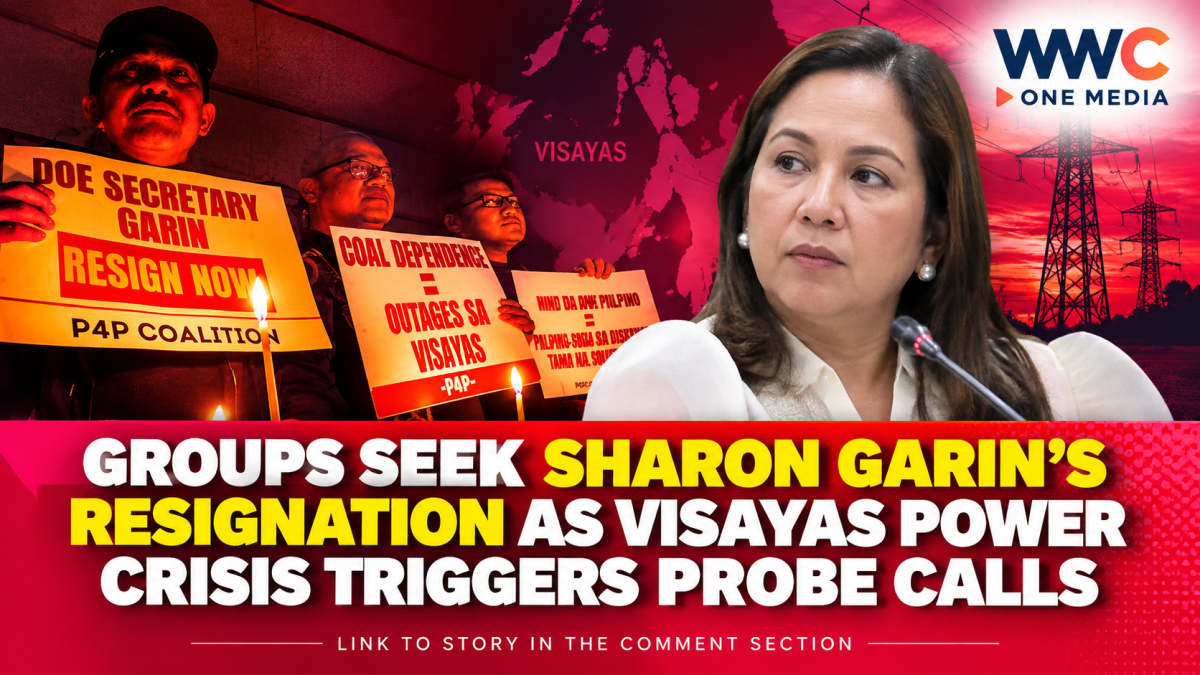
Consumer and civil society groups are calling for Energy Secretary Sharon Garin’s resignation and a deeper investigation into power generators as recurring electricity shortages continue to trigger red and yellow alerts across the Visayas.
The Power for People Coalition and allied groups made the demand on Sept. 24, citing prolonged generating-unit outages, repeated grid alerts and rising electricity costs. They are also asking authorities to determine whether power companies failed to meet contractual or regulatory obligations when generating units went offline.
The coalition said the Visayas grid had recorded 43 red-alert days and 107 yellow-alert days since May. However, figures cited earlier by Senate President Sherwin Gatchalian were lower, with 33 red-alert days and 96 yellow-alert days recorded from Jan. 1 through Sept. 7, underscoring differences in the periods and measurements being cited.
One major concern is the continued unavailability of generating units, including facilities operated by Therma Visayas Inc. and Panay Energy Development Corp. The Department of Energy has said the return of some offline units in September and October should help restore capacity and reduce the risk of additional grid alerts.
The groups are particularly questioning whether utilities that lose contracted electricity supply are adequately securing replacement power. When contracted supply is unavailable, distribution utilities may turn to the Wholesale Electricity Spot Market, where electricity prices can rise when supply is tight.
Representatives of the coalition have questioned whether prolonged plant outages could expose consumers to unnecessarily high spot-market costs. They have called for an investigation rather than asserting that wrongdoing occurred.
The issue has also reached Congress. Cebu Third District Representative Karen Hope Garcia filed a House resolution on Sept. 9 seeking an inquiry into recurring Visayas power disruptions, including generation failures, transmission constraints and their effects on electricity prices and consumers.
The proposed investigation would examine the roles of the Department of Energy, Energy Regulatory Commission, National Grid Corp. of the Philippines and major generation and distribution companies. It would also seek information on the operating history of individual power plants, the causes of outages and whether penalties were imposed when appropriate.
The Energy Regulatory Commission has separately introduced a regional secondary price cap for the Visayas and Mindanao grids, retroactive to the August 2026 billing period, in an effort to limit extreme wholesale electricity price increases.
Garin and the Energy Department have been pursuing measures to address the supply problem. The DOE has said it is working to restore offline generating units, address transmission constraints and prepare 253 megawatts of additional ancillary-service capacity, including battery-storage projects in Cebu, Leyte, Negros, Bohol and Panay.
The department has also outlined longer-term additions to generation capacity in Panay, including 135 megawatts targeted for 2028, 270 megawatts in 2029 and another 150 megawatts in 2030.
The DOE has separately said it is coordinating with the Philippine Competition Commission and Philippine Electricity Market Corporation to examine whether generation companies are maintaining reasonable prices amid the supply problems affecting the Visayas and Mindanao.
For consumers, the dispute goes beyond individual brownouts. Businesses and households can face higher electricity costs when supply shortages push utilities toward more expensive spot-market purchases, while companies may also incur additional expenses when they rely on backup generators.
The calls for Garin’s resignation and a broader investigation therefore come as authorities face pressure to explain why generating capacity has remained unavailable for extended periods and whether existing contracts and regulations are being properly enforced.
The immediate focus is now on restoring offline power plants and stabilizing the Visayas grid, while congressional and regulatory scrutiny could determine whether further action is warranted over the outages and their impact on electricity prices.