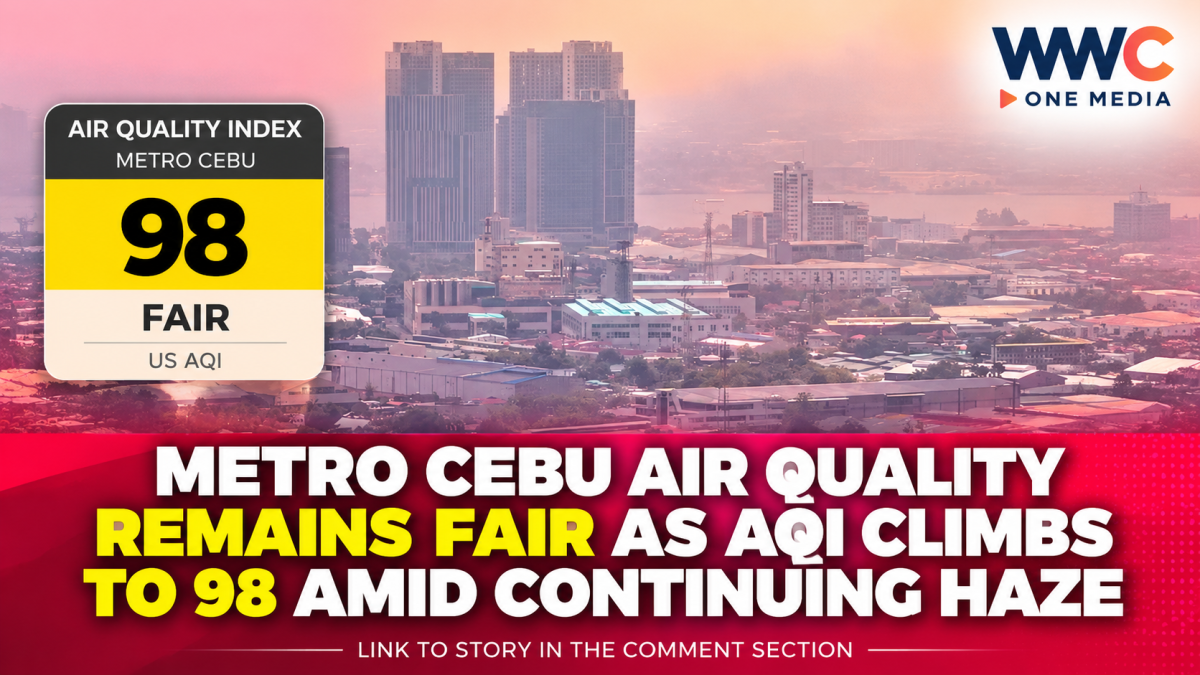
Air quality in Metro Cebu remained within the “fair” range on Thursday, Sept. 24, even as the Air Quality Index climbed to 98 by late afternoon amid continuing haze conditions in parts of Central Visayas.
The Environmental Management Bureau 7 recorded an AQI of 98 at 4 p.m., up from 86 at 11 a.m. and 81 at 7 a.m. The readings showed that air quality gradually deteriorated throughout the day, although it remained below the threshold for the next higher classification.
Under the EMB’s classification, AQI readings from 51 to 100 fall within the “fair” category. A reading of 50 or below is classified as “good.”
Conditions were considerably better at the EMB 7 monitoring station in Barangay Cabitoonan, Toledo City, where the AQI was recorded at 27 at 4 p.m., placing it in the “good” category.
The latest readings come after Metro Cebu experienced significantly worse air quality earlier in September. On Sept. 3, the area’s AQI reached 252, classified as “acutely unhealthy,” as smoke and fine particles from fires in Kalimantan, Indonesia, affected parts of the Philippines.
The haze has been linked to smoke and pollutants from fires in Kalimantan, with prevailing winds and atmospheric conditions helping carry fine particles across national borders. Local sources of pollution can also contribute to changes in Metro Cebu’s air quality.
Air-quality conditions have fluctuated throughout the month. On Sept. 11, Metro Cebu recorded AQI readings of 87 in the morning, 91 at 11 a.m. and 97 by 4 p.m., also remaining within the fair classification.
The latest readings indicate that the extreme pollution levels recorded earlier in September have eased, but the return of higher afternoon readings shows that air conditions can still change depending on wind direction, weather and the movement of smoke and other pollutants.
The Environmental Management Bureau continues to monitor air quality across Central Visayas as haze conditions fluctuate.
For Metro Cebu residents, the latest AQI of 98 remains within the fair range, but the continuing fluctuations underline the need to monitor official air-quality updates as atmospheric conditions change.