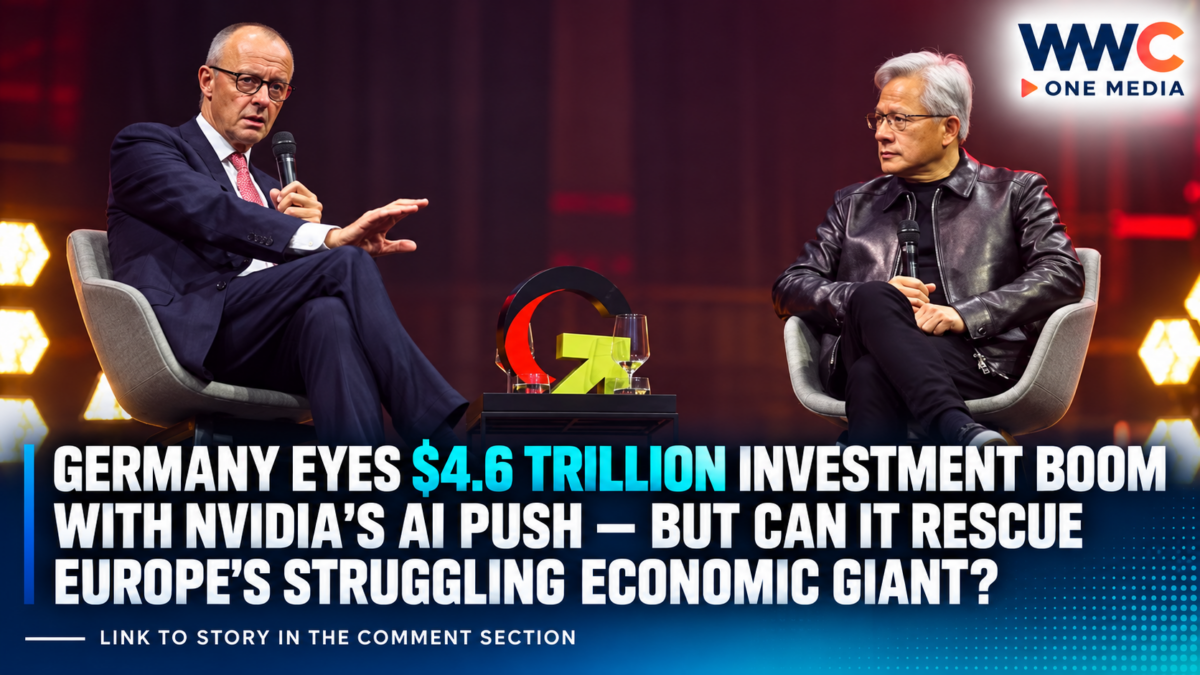
BERLIN, Germany — October 20, 2026 — Germany is turning to artificial intelligence in a high-stakes attempt to revive its struggling industrial economy, with Chancellor Friedrich Merz urging businesses to accelerate AI adoption as the country deepens cooperation with American technology giant Nvidia.
The ambitious push comes as a coalition of leading German companies and investors identifies as much as €4.1 trillion ($4.6 trillion) in potential investment opportunities by 2035, raising hopes that advanced technology, industrial modernization and new private-sector spending could help restore the country’s economic competitiveness.
But behind the multitrillion-dollar projections lies a critical challenge: Germany must prove that its AI ambitions can translate into stronger factories, more competitive businesses and sustainable economic growth.
Merz Sends Urgent Message: Germany Must Embrace Artificial Intelligence
Speaking alongside Nvidia CEO Jensen Huang at the Invest in Germany Summit in Berlin on October 19, Merz called on German companies to accelerate the adoption of artificial intelligence and make better use of their industrial data.
The chancellor warned that the global economy is experiencing a fundamental technological transformation driven by rapid advances in AI.
“Please open your doors for AI to make use of your data,” Merz told business leaders, according to Reuters.
His remarks reflect growing concerns over Germany’s economic position as the country’s powerful automotive, chemicals and engineering industries face increasingly intense international competition.
Long regarded as Europe’s industrial engine, Germany has struggled with weak economic momentum, high energy costs and structural challenges that threaten its traditional manufacturing advantages.
Merz is betting that advanced computing, artificial intelligence and industrial innovation can help reverse those pressures.
However, the government faces a difficult balancing act: accelerating modernization while ensuring German businesses can compete in an increasingly technology-driven global economy.
Nvidia Emerges as a Major Partner in Germany’s Industrial Transformation
At the center of Germany’s AI strategy is Nvidia, the U.S. semiconductor company whose computing technology powers many of the world’s most advanced artificial intelligence systems.
Germany’s economy ministry has signed a memorandum of understanding with Nvidia aimed at expanding AI adoption across German industries.
The broader cooperation is expected to support the development and deployment of technologies such as intelligent robotics, automated manufacturing and industrial AI applications.
While the agreement signals closer cooperation between Germany and Nvidia, the government had not disclosed complete partnership terms in the October 19 announcement.
Nvidia already works with major German industrial companies, including Mercedes-Benz, which is developing advanced autonomous-driving technology and premium robotaxi services using Nvidia software.
The partnership highlights how artificial intelligence is moving beyond chatbots and digital assistants into real-world industrial operations.
For German manufacturers, the potential applications range from improving factory productivity and equipment maintenance to developing autonomous machines and next-generation vehicles.
Nvidia Targets Four German Technology Startups
Nvidia is also expanding its presence in Germany’s startup ecosystem.
During the Berlin summit, Jensen Huang announced planned investments in four German companies:
- Agile Robots: A robotics company developing intelligent automation technologies.
- Avelios Medical: A healthcare technology company focused on digital software systems.
- Mirelo: An AI technology company working in audio generation.
- Reflex Aerospace: A satellite technology company developing advanced space systems.
The investments form part of Nvidia’s broader commitment of nearly $10 billion to Europe’s technology ecosystem.
The financial amounts allocated to the four individual startups were not disclosed in the initial announcement.
For Germany, these investments could strengthen the country’s technology startup sector and support innovation beyond traditional automotive and heavy manufacturing industries.
They also demonstrate Nvidia’s broader ambition to support companies building AI applications that depend on advanced computing systems.
$4.6 Trillion Investment Opportunity: What the Figure Really Means
One of the summit’s biggest announcements involved a report from a German business and investor group that includes corporate heavyweights Siemens and Deutsche Bank.
The group estimated that Germany has the potential to attract up to €4.1 trillion, equivalent to approximately $4.6 trillion, in investments through 2035.
The opportunities span multiple strategic sectors, including:
- Artificial intelligence and advanced digital technologies
- Energy generation and infrastructure
- Defense and industrial modernization
- Other areas supporting Germany’s long-term competitiveness
However, the figure is an estimate of potential investment opportunities — not $4.6 trillion in confirmed Nvidia spending, government funding or newly signed investment agreements.
This distinction matters because the economic impact will depend on how much investment is ultimately committed, financed and implemented.
The report nevertheless illustrates the scale of Germany’s industrial modernization challenge and the enormous amount of capital that may be required.
German Companies Plan More Than €850 Billion in Investments
Separately, Made for Germany, a private-sector initiative bringing together major companies and investors, announced that its members planned to invest more than €850 billion through 2028.
The group said participating companies had invested more than €200 billion in 2025.
The investment plans suggest that German businesses are preparing significant spending on their domestic operations and future growth.
However, those commitments should not be confused with the broader €4.1 trillion investment potential identified through 2035.
The figures cover different time horizons and scopes, and should not simply be added together.
Whether the planned investments deliver their expected benefits will depend on economic conditions, project execution and business confidence.
Nvidia CEO Jensen Huang Says Germany’s Biggest Advantage Is Its Industrial Knowledge
According to additional reporting by the Associated Press, Jensen Huang argued that Germany’s established manufacturing expertise could become a powerful competitive advantage in the age of AI.
Rather than replacing traditional industries, artificial intelligence could help Germany transform them.
The country possesses decades of engineering experience, manufacturing data and industrial knowledge accumulated by companies producing automobiles, precision machinery and sophisticated industrial equipment.
These resources could support the development of physical AI systems — technologies that enable machines, robots and vehicles to respond intelligently to real-world environments.
Huang also highlighted the importance of Germany’s Mittelstand, the small and medium-sized businesses that form the backbone of the country’s industrial economy.
For these companies, AI offers opportunities to modernize manufacturing, improve efficiency and strengthen competitiveness.
But accessing those benefits will require investment in advanced computing, workforce skills and digital infrastructure.
Germany’s AI Expansion Raises Questions About Europe’s Technology Independence
The partnership with Nvidia also exposes a strategic challenge facing European governments.
While Europe wants to strengthen its own artificial intelligence capabilities, much of the global AI computing industry remains dependent on American technology companies.
Germany must therefore balance access to Nvidia’s advanced hardware and software with efforts to protect industrial data and develop domestic technological capabilities.
The issue is especially important for manufacturers that handle commercially sensitive designs, production systems and proprietary engineering information.
Germany’s push toward industrial AI could increase Europe’s computing capacity and help businesses operate more sophisticated systems locally.
However, building AI infrastructure within Europe does not automatically remove reliance on foreign semiconductor technology.
For Merz, technological competitiveness will increasingly depend on both access to AI tools and the ability to retain control over strategically important industrial knowledge.
Global AI Investment Boom Faces Growing Financial Risks
Germany’s new investment drive arrives as investors worldwide are scrutinizing the enormous amounts being spent on artificial intelligence.
According to a separate Reuters report published on October 19, S&P Global warned that major technology companies could have greater exposure to AI-related debt than publicly available figures suggest.
The concern reflects the rapid expansion of data centers and advanced computing infrastructure, much of which requires substantial financing.
Investors are increasingly focused on whether the profits generated by artificial intelligence will justify the cost of developing and operating these systems.
For Germany, the warning adds another dimension to its industrial AI strategy.
Large-scale AI investment may create opportunities, but economic returns are not guaranteed.
German companies will need to demonstrate that artificial intelligence can genuinely improve productivity, lower operating costs and generate sustainable business growth.
Why Germany’s AI Revolution Matters Beyond Europe
Germany’s economic transformation carries implications for international industries, particularly across Asia.
German companies are deeply integrated into global automotive, machinery, chemicals and manufacturing supply chains.
As AI adoption accelerates, their demand for automation technology, digital infrastructure, software and specialized components could influence businesses and suppliers beyond Europe.
For Southeast Asian economies, including the Philippines, Germany’s push underscores the growing importance of investing in AI skills, digital infrastructure and higher-value technology services.
However, any benefits to regional economies will depend on actual investment decisions, international trade patterns and business partnerships.
Germany’s industrial AI strategy could become an example for manufacturers worldwide — or a reminder that technological spending alone cannot resolve deeper economic weaknesses.
The Bigger Question: Can AI Restore Germany’s Economic Power?
Germany has substantial advantages: world-class engineering, established manufacturers, experienced industrial workers and internationally recognized research institutions.
Nvidia brings advanced computing technology and expertise in developing artificial intelligence infrastructure.
Together, they could help modernize some of Europe’s most important industries.
But Germany’s economic recovery will require more than access to cutting-edge chips.
Energy affordability, skilled labor, infrastructure modernization, bureaucracy and international competition remain major obstacles.
The success of Berlin’s AI strategy will ultimately be measured not by investment announcements but by improvements in productivity, competitiveness and long-term economic performance.
Germany has identified a potential $4.6 trillion investment opportunity, secured closer cooperation with Nvidia and rallied major companies behind modernization. But the real test is only beginning: Can Europe’s largest economy turn the AI revolution into an industrial comeback before its global rivals move further ahead?