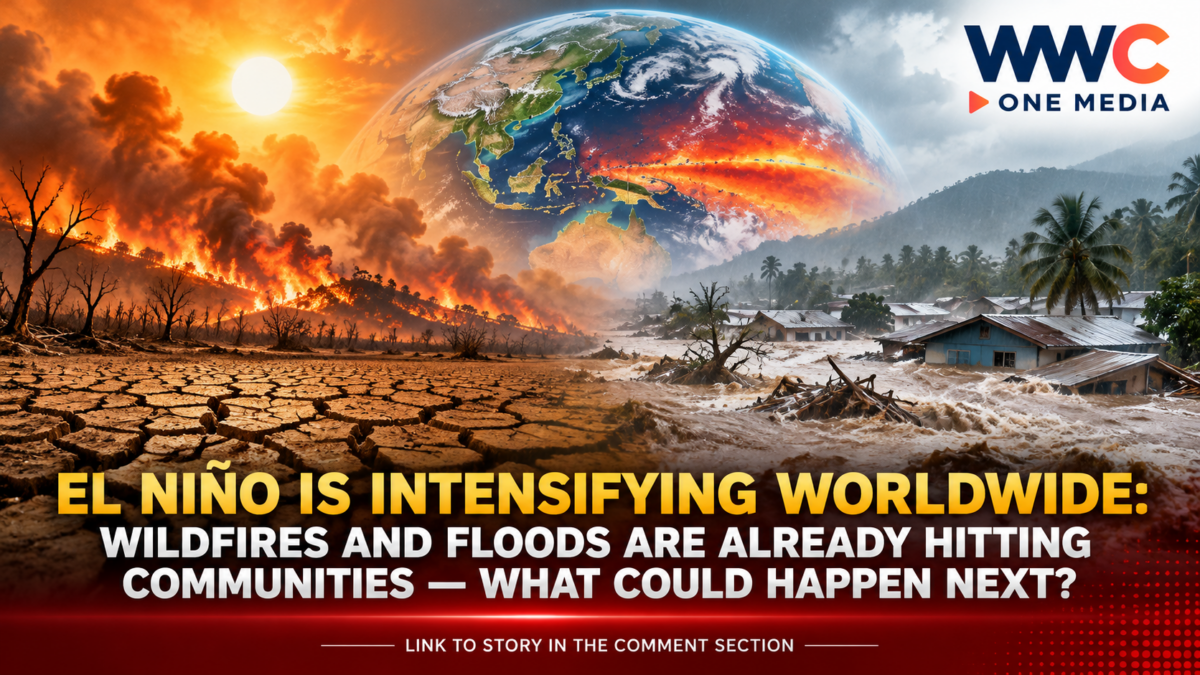
An intensifying El Niño is disrupting weather patterns across the world, raising concerns over wildfires, severe flooding, food security and pressure on electricity supplies as countries prepare for potentially more extreme conditions in the coming months.
The World Meteorological Organization (WMO) reported on October 8 that El Niño is expected to strengthen ahead of a projected peak around December 2026. Its latest outlook warns of unusually warm conditions across much of the globe, alongside shifting rainfall patterns that could increase the risks of drought in some regions and flooding in others.
The US National Oceanic and Atmospheric Administration (NOAA) likewise reported that a strong-to-very-strong El Niño was likely to persist through January–March 2027. NOAA’s forecast indicated an elevated possibility of a historically intense event, although the severity of its actual impacts will vary by location.
Sources: WMO and NOAA Climate Prediction Center.
Wildfires and hazardous haze threaten communities
One of the clearest warning signs is the growing wildfire crisis in parts of Southeast Asia and South America.
In Indonesia, prolonged dry conditions have contributed to fires across forested areas of Borneo and South Sumatra. Smoke has added to regional haze concerns, prompting responses from neighboring countries, according to reporting by Agence France-Presse published through Al-Monitor and Phys.org.
Brazil is also experiencing a serious fire emergency. Reuters reported on October 14 that Amazonas state recorded 1,679 fires during the first two weeks of October, a 253% increase compared with the same period in 2025. Smoke has affected air quality, while some schools and outdoor activities in Manaus were disrupted.
Officials and researchers cited delayed rainfall, El Niño, climate change and suspected deliberate land clearing as contributing factors. The fires demonstrate how dry weather, environmental pressures and human activity can combine to worsen an already dangerous situation.
Source: Reuters — Fires surge in Brazil’s Amazon.
South America faces another extreme: dangerous flooding
While some regions struggle with insufficient rainfall, others are dealing with destructive downpours.
The Associated Press reported on October 16 that flooding affected parts of Argentina, Paraguay and Uruguay after heavy rainfall caused rivers to overflow. In Argentina’s Corrientes province, the Paraná River reached 4.7 meters in the town of Ituzaingó, prompting evacuations.
More than 2,000 people had reportedly fled their homes in Paraguay’s border city of Ayolas. Rising river levels also disrupted access to parts of Iguazu Falls, while authorities prepared for additional rainfall.
The developments illustrate an important characteristic of El Niño: it does not produce the same weather everywhere. Its influence can increase the likelihood of heavy rainfall and flooding in certain areas while contributing to dry conditions elsewhere.
Source: Associated Press — El Niño rains flood South America.
Food security and livelihoods face growing pressure
The consequences extend beyond weather emergencies.
Drought can reduce harvests, dry up water sources and force farmers to spend more on irrigation. Flooding, meanwhile, can damage crops, destroy infrastructure and interrupt transportation, potentially making food distribution more difficult.
A report published by Global Issues, drawing on United Nations and UNICEF information, warned that more than 347 million children across nearly 100 countries and territories could be exposed to unusually wet or dry conditions between October and December 2026.
The risks are especially serious for communities already dealing with poverty, malnutrition, displacement and limited access to clean water.
The effects can also spread through international markets. Lower agricultural output, transport disruptions and higher production costs may place upward pressure on food prices, although the extent of any increase will depend on local harvests, supplies and government responses.
Source: Global Issues — From drought to deluge: ‘Super’ El Niño’s expanding reach.
What could El Niño mean for the Philippines?
The Philippines is among the countries identified in UNICEF-related reporting as facing a risk of drier-than-normal conditions during the October–December period.
For Filipino households, farmers and businesses, prolonged dry weather could mean increased pressure on water supplies, reduced agricultural productivity and greater demand for electricity in hotter conditions.
Hydropower generation could also face challenges if water levels in reservoirs decline. However, the actual effect on electricity supply will depend on reservoir conditions, rainfall, energy demand and the availability of other power sources.
Farmers and agricultural communities are particularly vulnerable because changes in rainfall can affect planting schedules, crop development and irrigation requirements. If production is disrupted, consumers could face additional pressure on the prices of affected food products.
These are potential risks, not a guarantee that every part of the country will experience drought or that food and electricity prices will necessarily rise. Local forecasts and official advisories remain essential for understanding conditions in individual provinces.
Source: Global Issues — UN and UNICEF-related El Niño outlook.
Why this El Niño deserves close attention
El Niño is a naturally occurring climate pattern involving unusually warm sea-surface temperatures in the central and eastern tropical Pacific Ocean. It changes atmospheric circulation and influences rainfall and temperature patterns across different parts of the world.
The WMO’s October outlook said ocean temperatures in the region were forecast to reach exceptional levels during October–December 2026. NOAA’s assessment also showed that the event was strengthening.
Climate change adds another concern. Higher background temperatures can intensify heat stress and increase the amount of moisture lost from soils and vegetation. However, individual disasters cannot automatically be attributed to El Niño alone; local weather conditions, land management and other climate influences also matter.
The combination of these factors makes preparedness particularly important for countries exposed to drought, flooding, wildfires and agricultural losses.
Governments urged to prepare before conditions worsen
The coming months will be important for communities and authorities responding to the developing climate pattern.
Practical preparations include monitoring official weather bulletins, conserving water where supplies are under pressure, protecting crops and livestock, reducing wildfire risks and preparing emergency measures for flooding.
In the Philippines, residents should follow advisories from the Philippine Atmospheric, Geophysical and Astronomical Services Administration (PAGASA), local disaster-risk reduction offices and relevant water and energy authorities.
The broader message is that El Niño is not simply a temperature issue. Its effects can reach farms, food markets, public health, ecosystems and household budgets.
With forecasts pointing to continued strengthening into late 2026, early preparation could help communities limit losses before the most serious local effects emerge.










