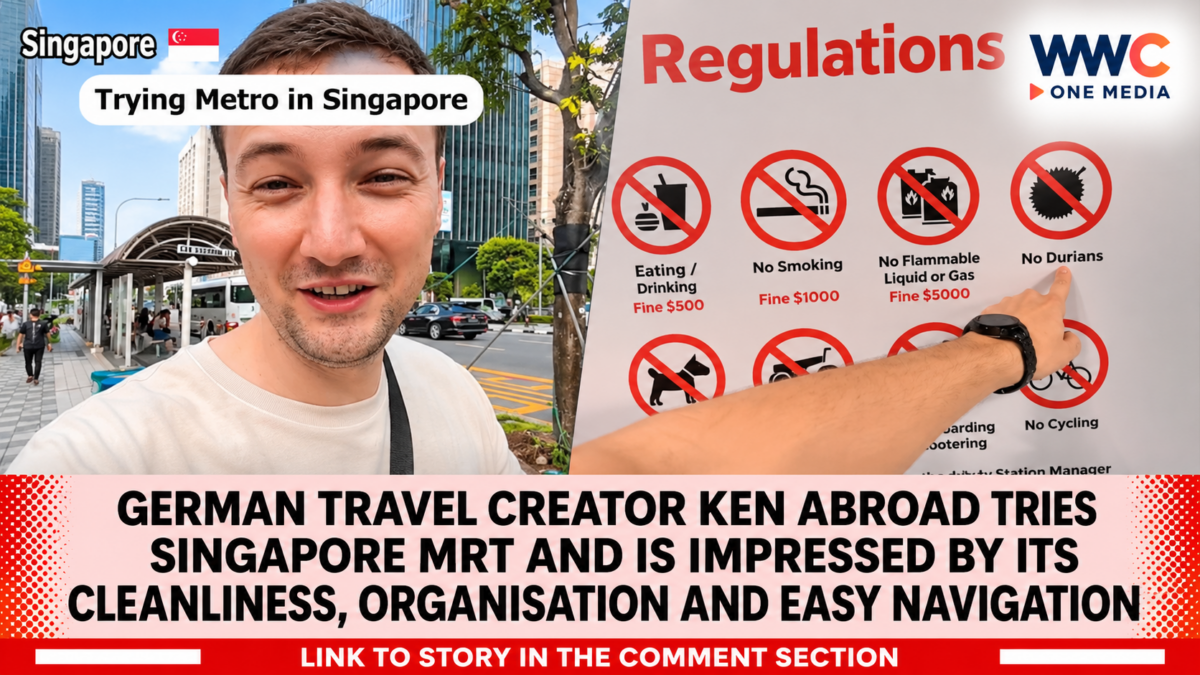
A German travel content creator has given Singapore’s Mass Rapid Transit (MRT) system a positive review after experiencing it for the first time, praising its cleanliness, organisation and convenience while joking about the many things passengers are not allowed to do.
Ken Abroad documented his journey from Somerset MRT station to Bugis in a Facebook video shared on November 11, 2026. His experience offered an entertaining look at how a foreign visitor navigates one of Singapore’s most important public transport networks.
The journey was relatively straightforward. Ken studied the MRT map, worked out that he needed to change trains at City Hall and successfully completed the trip using his credit card at the fare gates.
But it was not just the train journey that caught his attention. Singapore’s strict public transport rules, clean stations and unusual customer-service features also became talking points in his video.
His final assessment was positive: the MRT was clean, well-organised and easy to use, even for someone unfamiliar with Singapore.
German Traveller Notices Singapore’s Long List of MRT Rules
One of the first things Ken noticed was a sign displaying prohibited activities inside the MRT system.
The restrictions included eating, smoking and bringing durians onto trains and into stations.
Reacting to the sign, he remarked that there were many things passengers were not allowed to do in Singapore.
His observation reflects one of the distinctive features of the country’s public transport system: clear rules designed to maintain cleanliness, safety and comfort for commuters.
Smoking is prohibited throughout MRT stations and trains, while eating and drinking are also prohibited within the rail system. Durian restrictions are another familiar feature of Singapore’s public transport rules because of the fruit’s strong smell.
For local commuters, these regulations are part of everyday life. For visitors, however, they can be an unexpected introduction to Singapore’s strict approach to public spaces.
Ken Abroad Finds the MRT Clean and Easy to Navigate
After entering the station, Ken praised the appearance of Singapore’s MRT facilities.
He described the stations as clean and well-organised, highlighting the clear signage and layout that helped him understand where to go.
His route began at Somerset on the North-South Line. To reach Bugis, he needed to transfer at City Hall to the East-West Line.
Despite being unfamiliar with the network, he managed to follow the directions and complete the transfer without apparent difficulty.
The experience highlights an important advantage for international visitors: a well-marked rail system can make travelling around an unfamiliar city much less intimidating.
Singapore’s MRT network connects major shopping districts, business areas, residential neighbourhoods and tourist attractions, making it one of the most practical ways for visitors to explore the city-state.
Contactless Credit Card Payment Makes the Journey Easier
Another feature that caught Ken’s attention was the ability to tap his credit card at the station gates.
Rather than needing to purchase a separate ticket for the journey, he used his payment card to enter and exit the MRT system.
Singapore’s contactless public transport payment arrangements allow passengers to use compatible bank cards and mobile payment options, subject to card and payment-provider requirements.
For tourists, this can reduce the need to understand a separate ticketing system before travelling.
However, foreign-issued cards may incur additional fees depending on the card issuer and payment arrangements. Travellers should also check whether their cards support contactless transactions before relying on them for public transport.
Ken’s experience demonstrates how payment convenience can make the MRT more accessible to visitors who are only staying in Singapore for a short period.
An SMRT WhatsApp Service Surprises the German Creator
One of the more amusing moments came when Ken noticed a sign inside the train informing passengers that they could report faults to SMRT through WhatsApp.
He laughed at the idea, saying that contacting a metro operator through WhatsApp would be unthinkable in Germany.
The observation highlighted a service feature that local commuters may take for granted but that can appear unusual to visitors from other countries.
Digital communication channels give passengers another way to report problems or provide feedback without having to locate a station employee.
It also reflects how transport operators increasingly use familiar messaging platforms to communicate with the public.
Singapore’s MRT Is Attracting More Attention From Foreign Creators
Ken’s experience is part of a wider trend in which international visitors share their impressions of Singapore’s transport system online.
Just two days earlier, an American content creator living in Singapore attracted attention after praising the MRT in a comparison with New York’s subway.
She highlighted the air-conditioned trains and stations, cleanliness, convenient connections to shopping centres and frequent services. She also explained that the system’s comfortable environment helps her travel independently despite having a disability and experiencing heat sensitivity.
Her comments generated discussion about the differences between the two cities’ transport systems.
WWC ONE MEDIA covered the comparison in American Praises Singapore MRT Over New York Subway, Says Clean Stations and Comfortable Trains Make Every Ride a Better Experience.
The two creators focused on different aspects of the same network. Ken highlighted navigation, cleanliness, payment convenience and passenger rules, while the American creator placed greater emphasis on comfort, accessibility and the overall commuting experience.
Together, their observations show how ordinary features of Singapore’s transport system can become interesting subjects for international audiences.
Singapore MRT Has More Than 200 Kilometres of Rail Network
Singapore’s MRT has grown considerably since its first passenger services began in November 1987.
The network now spans more than 200 kilometres, with six operational lines and 146 stations, serving approximately 3.5 million passenger trips daily.
According to figures reported by VnExpress International, 99.4 per cent of Singapore’s trains ran on schedule in 2025, highlighting the network’s operational performance.
The MRT is also closely integrated with shopping centres, office developments, residential communities and major attractions.
For tourists, this means many destinations can be reached without renting a car or relying entirely on taxis and ride-hailing services.
However, the network is not without challenges. Crowding during peak periods, service disruptions and ongoing maintenance remain important issues for transport operators and commuters.
A positive visitor experience does not mean every journey is perfect, but it does demonstrate how the system can work effectively for someone using it for the first time.
How Singapore’s MRT Compares With Germany’s Public Transport
Ken’s reaction to the WhatsApp reporting service also highlights differences in how public transport operators communicate with passengers in different countries.
Germany has an extensive rail and urban transport network, including underground trains, suburban railways, trams and regional services. Its transport system operates across multiple cities and operators, unlike Singapore’s more compact national network.
The comparison is therefore not simply about which country has the better trains.
Singapore’s compact geography, integrated urban planning and centralised transport arrangements create a different commuting environment from Germany’s larger and more decentralised transport network.
For international travellers, the most important question is often whether they can understand the system, pay easily and reach their destination without unnecessary complications.
Ken’s Somerset-to-Bugis journey suggests that Singapore’s MRT performs well in those areas for a first-time visitor.
A Positive Review That Local Commuters May Take for Granted
For Singapore residents who use the MRT every day, clean stations, clear signs and contactless payment may seem ordinary.
But international visitors often notice the details that regular commuters no longer think about.
Ken’s reaction to the station rules, the WhatsApp reporting service and the ease of changing trains shows how even a short journey can reveal something about a city’s transport culture.
His experience also provides a reminder that public transport is an important part of a country’s image. Visitors often form impressions of a destination not only through its landmarks and attractions, but also through the everyday experience of getting around.
For Singapore, the MRT is more than a commuting option. It is a major part of how the city-state functions and welcomes millions of residents and visitors.
Ken’s verdict was simple: clean, organised and easy to use.
And for a foreign traveller navigating the system for the first time, that may be one of the strongest endorsements a public transport network can receive.