
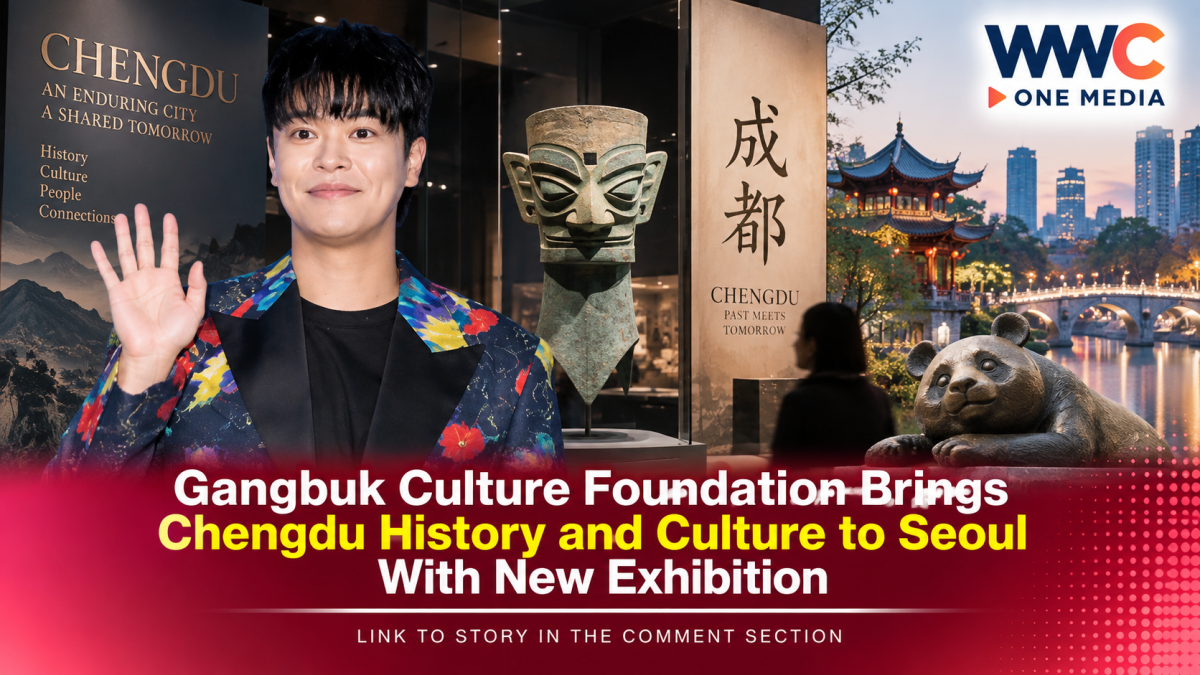
SEOUL, South Korea — Seoul is getting a closer look at the history and cultural heritage of Chengdu as the Gangbuk Culture Foundation opens a new exhibition designed to show that the southwestern Chinese city is about much more than its famous giant pandas.
The exhibition, titled “More Than Pandas: Chengdu” — also promoted in Korean as “Not Just Pandas, Chengdu” — runs from September 16 through September 30, 2026, at the Gangbuk Jindallae Hall Gallery inside Gangbuk Arts Center.
The project is a collaboration between the Gangbuk Culture Foundation, the Chengdu Culture, Radio, Television and Tourism Bureau, and the Cultural Center of the Chinese Embassy in Korea, with the Chengdu International Cultural Exchange Center serving as the organizer.
From Pandas to Ancient History
Chengdu is internationally associated with giant pandas, but the exhibition puts the city’s broader cultural identity in the spotlight.
Among the historical sites highlighted are the Du Fu Thatched Cottage, associated with Tang dynasty poet Du Fu, and Wuhou Shrine, a historic site connected with Zhuge Liang, the renowned strategist and chancellor of the Shu Han state during China’s Three Kingdoms period.
The exhibition therefore presents Chengdu through its literature, history, cultural heritage and arts rather than focusing solely on its best-known wildlife attraction.
First Joint Project Under New Cultural Partnership
The Seoul exhibition also marks the first joint project under a partnership agreement signed by the Gangbuk Culture Foundation and the Cultural Center of the Chinese Embassy in Korea on August 26.
According to Korean reports, it is also the first standalone exhibition in Korea by cultural institutions representing Chengdu.
That gives the event significance beyond a conventional tourism display: it creates a dedicated venue for introducing Chengdu’s cultural institutions and heritage to a Korean audience.
Korean and Chinese Performances Open the Exhibition
The opening ceremony is scheduled for 10:30 a.m. on September 16 at Gangbuk Arts Center.
The program brings together performers from both Korea and China.
Korean traditional vocalist and actor Oh Jung-hae, known for her role in the film Sopyonje, is scheduled to perform pansori. The Korean traditional performance group Cheonha Jeil Tal Gongjakso will present the Mundung Buk Chum, a drum dance associated with Goseong Ogwangdae, a Korean mask-dance tradition recognized as intangible cultural heritage.
The Chengdu Symphony Orchestra will also participate, with a woodwind quartet performing at the opening.
A New Cultural Exchange Between Seoul and Chengdu
The exhibition is part of a broader cultural-exchange effort linking Seoul’s Gangbuk district with Chengdu.
Rather than presenting Chengdu solely as a tourist destination, organizers are using the exhibition to highlight historical figures, heritage sites and artistic traditions that have shaped the city’s cultural identity.
The event also gives Seoul residents an opportunity to encounter Chengdu’s cultural heritage without traveling to China.
Exhibition Details
The exhibition runs September 16–30, 2026, at the Gangbuk Jindallae Hall Gallery, Gangbuk Arts Center.
The Gangbuk Culture Foundation lists visiting hours as 10 a.m. to 5 p.m., Tuesday through Saturday, with holidays excluded.
For Seoul audiences, the message behind the exhibition is straightforward: Chengdu has a cultural story that stretches well beyond pandas — and this time, that story is being told in the heart of Seoul.
Why This Exhibition Matters
The Chengdu exhibition comes at a time when cultural exchanges increasingly serve as a way for cities and cultural institutions to introduce audiences to traditions beyond entertainment and tourism.
By bringing together Chinese historical heritage with Korean traditional performances at the opening, the Gangbuk Culture Foundation is creating a cultural program that connects two different traditions on one Seoul stage.
And for visitors who know Chengdu mainly as the home of giant pandas, the exhibition offers another entry point into the city — through Du Fu, Zhuge Liang, heritage sites, music and history.
WWC ONE MEDIA G.A




Leave a Reply