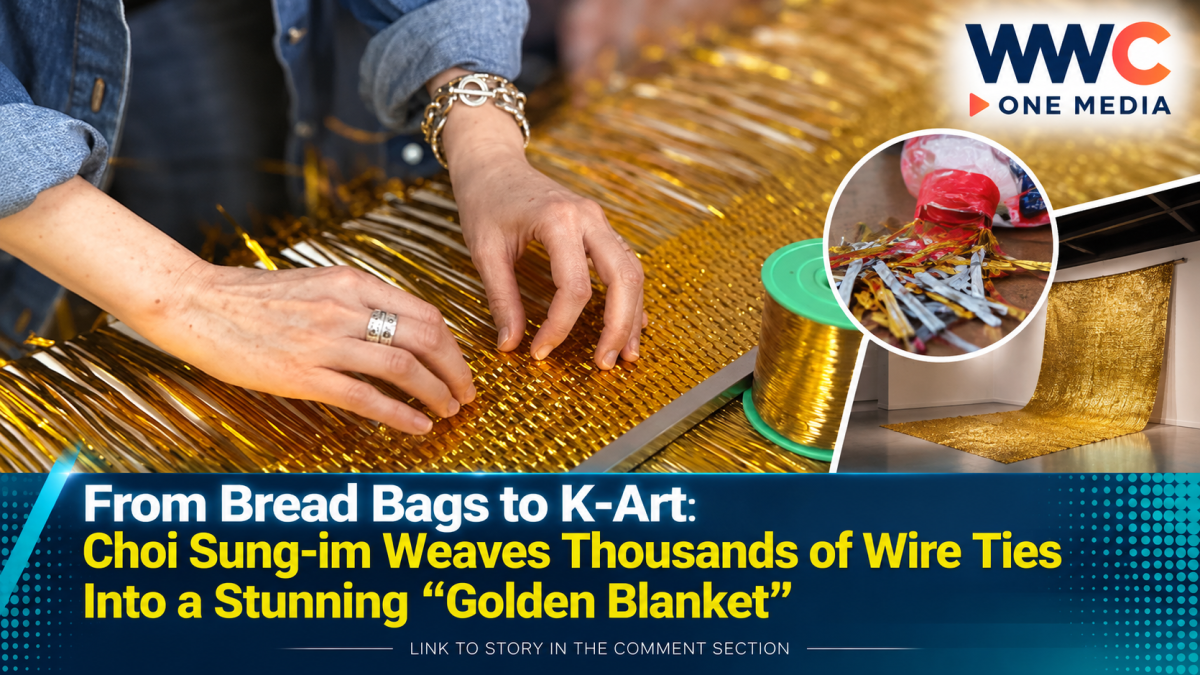
SEOUL — What looks like a shimmering golden carpet inside a traditional Korean house is actually made from thousands of tiny wire ties once used to seal bags of sliced bread.
The unexpected transformation is the work of Korean installation artist Choi Sung-im, whose Golden Blanket is drawing attention during Seoul’s busy autumn art season.
Measuring approximately 6.2 meters by 4.8 meters, the large-scale installation was woven entirely by hand over more than a month. It is currently presented at Sunhyewon in Samcheong-dong as part of PODO Museum’s group exhibition A Note From Trembling Things.
The Ordinary Becomes Something Extraordinary
At first glance, Golden Blanket appears luxurious.
Look closer, however, and its material reveals a very different story: small, inexpensive wire ties normally thrown away after a loaf of bread is opened.
Choi gathers these overlooked objects and connects them through repetitive handwork, allowing thousands of individually insignificant pieces to become one expansive artwork.
The result reflects a central theme in her practice — how fragile and easily discarded materials can acquire new meaning when gathered together over time.
For Choi, the blanket also carries a deeply personal meaning.
She has described a blanket as more than an ordinary household object, connecting it to the first visual and physical landscape encountered upon waking. By placing the work on the wooden floor of a hanok, or traditional Korean house, she also explores the boundary between interior and exterior.
A Different Kind of K-Art
Choi’s work stands apart from the polished image often associated with contemporary Korean cultural exports.
Instead of relying on expensive or technologically elaborate materials, she frequently turns to objects that are cheap, lightweight and easily discarded.
Her broader body of work has incorporated materials including onion sacks and plastic balls from children’s ball pits. Through cutting, tying, weaving and accumulating, she transforms them into large-scale installations.
Her Endless Trees series, for example, uses onion sacks and plastic balls, continuing her interest in how small individual elements can combine into something much larger.
Motherhood Changed Her Artistic Language
Choi’s journey into installation art was not immediate.
Born in 1977, she studied Western-style painting at Ewha Womans University before eventually moving away from traditional painting practices.
While raising four children, her relationship with everyday domestic life changed how she thought about art.
Rather than depicting household life directly, she began incorporating the materials surrounding her into her artistic process.
Choi has explained that conventional white canvases eventually felt disconnected from the reality of her daily environment. The stains, objects and repetitive routines of domestic life instead became possibilities for artistic transformation.
She held her first solo exhibition in 2012, at age 35, while raising her children.
Why Fragile Materials Matter
The word “fragile” is central to understanding Choi’s work.
The materials she chooses are often physically delicate or easily discarded. Yet when thousands of them are brought together, they can create structures that occupy an entire room.
Choi compares this process to small living things finding ways to survive collectively — much like ivy spreading across a wall or barnacles attaching themselves to a rock.
The idea gives her installations a sense of endurance without requiring monumental materials.
Golden Blanket therefore works on two levels: it is visually striking, but it also asks viewers to reconsider the value of objects they normally overlook.
Simplicity Is Part of the Message
Despite the scale of Golden Blanket, Choi says the technique itself is deliberately simple.
There is no elaborate embroidery or specialized technical process at its core.
The work depends on a repeated action: connecting one end to another, again and again.
That repetition turns time and labor into part of the artwork.
The significance, she suggests, lies less in mastering a complicated technique than in changing the way people see an ordinary object.
Why the Work Is Getting Attention During Seoul Art Week
The timing of Golden Blanket is significant.
Sunhyewon’s A Note From Trembling Things is one of several exhibitions taking place beyond the main fairgrounds during Frieze Seoul 2026, as galleries, museums and historic properties across Seoul host exhibitions during the city’s major art week.
The exhibition brings Choi together with internationally recognized Lebanese-British artist Mona Hatoum and Korean artist Kim Yun-soo.
Seoul Economic Daily noted that the exhibition reflects a broader movement within Seoul’s art scene: alongside major international names, art institutions are increasingly creating space for Korean artists whose practices have developed outside the biggest global spotlight.
That makes Choi’s installation particularly timely.
A humble bread-bag tie — something most people would never consider art material — becomes one of the memorable visual elements of an international art week.
More Than a Golden Carpet
Golden Blanket ultimately turns a familiar domestic object into a larger reflection on vulnerability and resilience.
Each wire tie is small.
On its own, it has little artistic presence.
Together, thousands of them become a work large enough to occupy an entire architectural space.
That transformation mirrors the central idea running through Choi Sung-im’s practice: things that appear fragile or insignificant can acquire strength, meaning and presence when they are gathered, connected and given time.
And perhaps that is what makes Golden Blanket so compelling during Seoul’s international art spotlight — it does not need an extraordinary material to make people stop and look.
It simply asks viewers to look again at something they normally throw away.