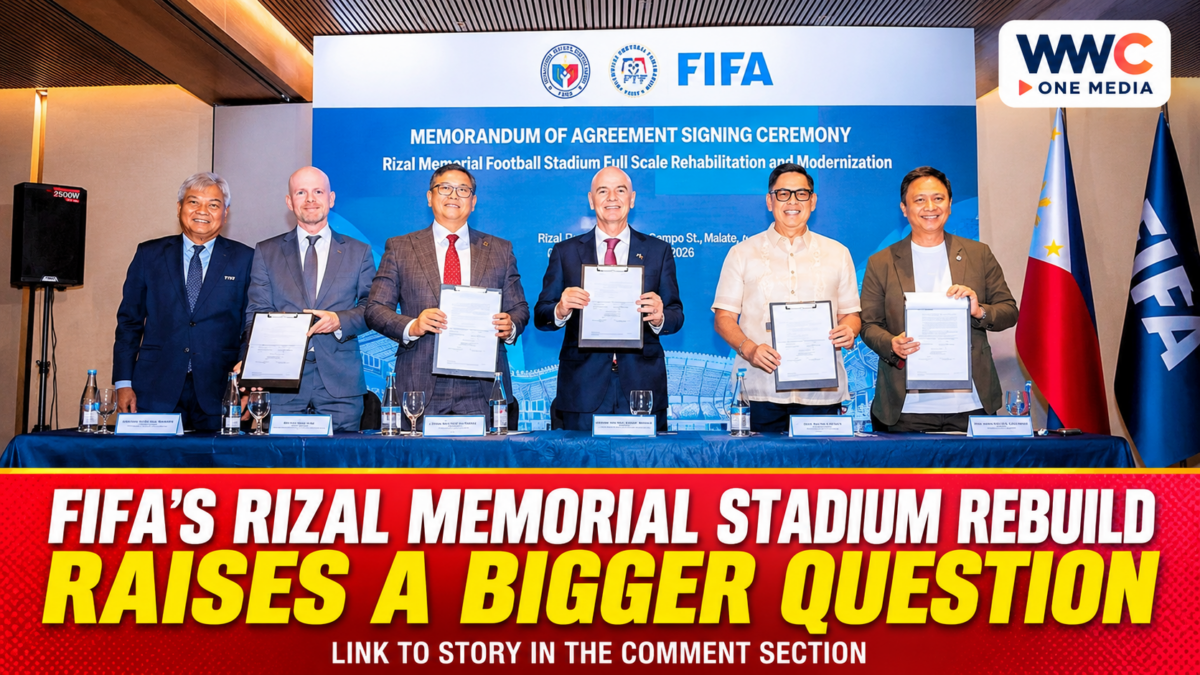
MANILA, Philippines — FIFA and Philippine sports officials formalised an agreement on Nov. 15, 2026, to redevelop Rizal Memorial Stadium, opening a new chapter for one of the country’s oldest major sporting venues.
The project puts the historic Manila facility at the centre of a wider effort to strengthen Philippine football infrastructure, but its long-term significance will depend on how the upgraded stadium serves athletes, national teams and the country’s developing football community.
For Philippine football, the announcement is an opportunity to address a longstanding infrastructure challenge: building facilities capable of supporting international competition while maintaining accessible pathways for local players.
Rizal Memorial Stadium: A historic sporting asset facing a new era
The stadium’s importance extends beyond its role as a football venue.
The Philippine Sports Commission’s official development-planning documents identify 1934 as the year the Rizal Memorial Sports Complex was inaugurated to host the Far Eastern Championship Games.
The complex subsequently underwent reconstruction following the Second World War and experienced several renovations over the decades.
Its heritage status also adds another dimension to the redevelopment.
In April 2017, the 9.4-hectare sports complex was declared a National Historical Landmark by the National Historical Commission of the Philippines and recognised as an important cultural property by the National Museum of the Philippines.
That designation means modernisation must be considered alongside heritage protection.
The challenge is not simply to construct a newer stadium. It is to improve the facility without disregarding the historical significance of the wider complex.
The PSC’s existing development-planning framework explicitly identifies heritage conservation and modern sports infrastructure as objectives that must be considered together.
What FIFA’s agreement means for Philippine football
The Nov. 15 agreement formalises cooperation between FIFA, the Philippine Football Federation (PFF) and the Philippine Sports Commission (PSC) on the stadium’s redevelopment.
FIFA President Gianni Infantino attended the signing, alongside PFF President John Gutierrez and Philippine sports officials.
The agreement follows the PFF’s announcement ahead of Infantino’s Philippine visit that the stadium would be a major focus of discussions about improving the country’s football infrastructure.
FIFA’s public project announcement describes a major stadium facelift, including a roof and a planned spectator capacity of 25,000. It identifies 2028 as the expected completion year.
These details indicate that the ambition extends beyond routine maintenance.
A larger, modernised venue could improve the Philippines’ ability to accommodate spectators, stage international fixtures and provide a more suitable environment for national-team football.
However, stadium capacity alone does not determine whether a country has a strong football development system.
The quality of the playing surface, athlete facilities, maintenance arrangements, event management and access to training opportunities will also matter.
The real test will be whether the redevelopment delivers a facility that can operate effectively beyond occasional major competitions.
Why Philippine football needs more than one modern stadium
A national football programme requires infrastructure at several levels.
Professional and international competitions need suitable stadiums. Developing players need accessible training grounds, qualified coaches and regular opportunities to compete.
These requirements are connected.
A modern national stadium can provide a venue for major matches, but it cannot independently solve the shortage of quality training opportunities in communities outside Metro Manila.
This is why the broader direction of Philippine sports infrastructure deserves attention.
The country has continued hosting international sporting competitions in different disciplines. Manila’s upcoming Asian U-19 Sepak Takraw Championship, for example, will use facilities within the Rizal Memorial Sports Complex.
WWC previously examined the country’s preparations in its coverage of the Asian U-19 Sepak Takraw Championship in Manila.
The wider lesson is that sports facilities serve multiple purposes across the national sporting calendar.
A redevelopment programme must therefore consider how construction, scheduling and facility management will affect other sporting activities within the complex.
The same principle applies to grassroots development. WWC’s coverage of the Palawan Group’s support for Philippine tennis development illustrates why sustained opportunities outside elite competitions are important to building a stronger national sporting system.
The heritage question: Modernisation without losing history
The stadium redevelopment is taking place within a historically protected sports complex.
That distinction matters because the Rizal Memorial Sports Complex is not simply an available parcel of land for unrestricted construction.
The PSC’s 2026 procurement documents for the complex’s conceptual master development plan call for a 20-year framework.
Its objectives include protecting historic Art Deco structures, improving sports facilities, addressing traffic and accessibility problems, and strengthening climate resilience.
The documents also identify the need to maintain essential athlete training and sports operations during redevelopment.
These are important considerations for a facility located in a densely developed part of Manila.
Major events can create traffic congestion, spectator-management challenges and pressure on surrounding roads.
The planning framework specifically identifies Pablo Ocampo Sr. Street, Adriatico Street and Quirino Avenue as areas requiring attention in the complex’s traffic and logistical planning.
This suggests that the future of Rizal Memorial Stadium should be assessed not only through the appearance of the finished football ground but also through its relationship with the surrounding urban environment.
Modern sports infrastructure must work for athletes, spectators and neighbouring communities.
What the redevelopment could mean for Filipino athletes
The potential benefits extend beyond the senior national teams.
A properly developed stadium could provide opportunities for youth tournaments, international fixtures, coaching activities and greater exposure to competitive football.
For young Filipino players, exposure to international-standard facilities can help make the pathway from local competitions to national representation more visible.
However, access will remain an important consideration.
The Philippines needs development opportunities that reach beyond a single venue in Manila.
Football programmes in provincial communities must have the facilities and resources needed to identify and develop players before they reach the national level.
This is particularly relevant when considering the country’s wider sporting ambitions.
Facilities, coaching systems and competitions must develop together if investment in elite venues is to produce lasting benefits.
There is also a broader lesson from other sports: women’s competitions and developing athletes need dependable access to quality facilities rather than relying entirely on the availability of major venues.
WWC has explored a related infrastructure issue in its reporting on stadium access challenges facing women’s professional football.
What happens next
The agreement establishes an important direction for the redevelopment, but the next stage will be measured through implementation.
The public will need clearer information about the detailed construction programme, procurement arrangements, project milestones, facility specifications and the operational arrangements during the works.
The FIFA announcement identifies 2028 as the expected completion year.
That timeline will make project management and coordination between the participating organisations particularly important.
The PSC’s wider master-planning work also provides an important framework for considering how the stadium fits into the long-term development of the entire complex.
The public interest should extend to whether heritage requirements are respected, whether the finished facility is properly maintained and whether Filipino athletes receive meaningful opportunities to use it.
Frequently Asked Questions
1. What is happening to Rizal Memorial Stadium?
FIFA, the Philippine Football Federation and the Philippine Sports Commission have formalised an agreement for the redevelopment of the historic football stadium.
2. When was Rizal Memorial Stadium established?
The Rizal Memorial Sports Complex was inaugurated in 1934 to host the Far Eastern Championship Games.
3. What capacity is planned for the upgraded stadium?
FIFA’s public announcement describes a planned spectator capacity of 25,000.
4. When is the redevelopment expected to be completed?
FIFA’s announcement identifies 2028 as the expected completion year.
5. Why is the project important to Philippine football?
It could provide a modern venue for national-team matches and international competitions while supporting the country’s broader efforts to improve football infrastructure.
The bigger question is no longer simply how Rizal Memorial Stadium will look after redevelopment. It is whether the investment can help build a stronger football system for Filipino athletes across generations.