
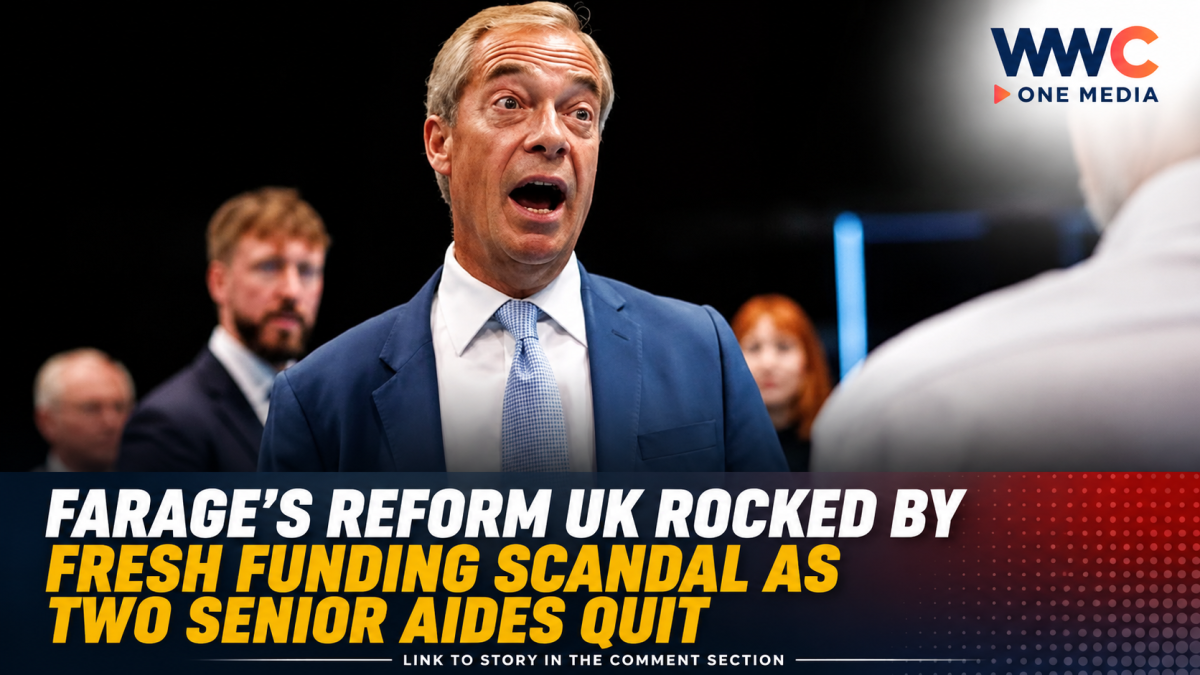
BIRMINGHAM, UK — Nigel Farage’s Reform UK has been plunged into a fresh political funding crisis after two senior party figures stepped down following an undercover investigation alleging that party officials discussed ways to obtain foreign-backed funding and conceal the source of money used for political polling.
The controversy erupted as Reform UK gathered in Birmingham for its annual conference, turning what was expected to be a major showcase for Farage and his party into a test of its financial credibility and political leadership.
Reform UK policy chief James Orr and senior adviser Dan Jukes announced they were stepping down on Friday after Channel 4 News broadcast an investigation by Verbatim, an investigative group founded by journalists from the Centre for Climate Reporting.
The investigation alleged that Reform officials discussed accepting funding linked to an American donor and arranging for an overseas company to pay for polling commissioned by the party.
Reuters reported that the polling payments exceeded £30,000, while ITV News said three polls costing a combined £32,500 were paid for by the undercover operation.
The allegations are significant because UK electoral law restricts political donations to permissible sources. The Electoral Commission says political parties must establish the true identity of donors and verify that donations above £500 come from permissible sources before accepting them.
The undercover sting that triggered the crisis
According to ITV News and The Guardian, undercover investigators posed as a British supporter and his wealthy American father.
During meetings, Reform officials were allegedly recorded discussing a potential £500,000 donation and a mechanism through which money from an American source could be channelled through a UK-based individual.
Investigators also alleged that an American company was used to pay for three political polls benefiting Reform UK.
The party believed the polling had been financed by a foreign source, according to the investigation. The polls were subsequently reported in the media, although the alleged funding arrangement was not publicly disclosed.
Farage was later filmed meeting the supposed donors and discussing the impact of the polling.
However, there is an important distinction between the undercover allegations and a proven breach of law: no court has established that Reform UK committed a criminal offence in relation to the sting.
The Metropolitan Police said it was aware of the media reports and would assess the information provided. ITV reported that, at the time of its report, the force had not opened a formal investigation.
Reform UK denies wrongdoing
Farage has rejected the allegations and accused the undercover operation of being a politically motivated trap.
Reform UK said the party had been targeted by a “hoax” involving people posing as prospective donors and argued that its donor-vetting procedures were robust.
Farage has also rejected suggestions that he knowingly participated in an illegal funding arrangement.
The party said the undercover operation was conducted by activists seeking to damage Reform UK and questioned the methods used to obtain the footage.
Channel 4, however, said the investigation was conducted by Verbatim independently of the broadcaster and that its journalists had checked and verified the findings before publication.
Why foreign money is such a serious issue in Britain
The allegations have landed at a particularly sensitive moment for British politics.
Under existing UK rules, political parties cannot simply accept money from anyone willing to provide it. The Electoral Commission lists permissible donors in Great Britain as including individuals registered on a UK electoral register and qualifying UK-registered companies and organisations.
The Commission also specifically warns against donations being made on behalf of another person without revealing the true donor.
That makes the alleged use of an intermediary particularly significant if investigators ultimately establish that a foreign donor was attempting to circumvent the rules.
The British government has meanwhile been moving to tighten political-finance safeguards even further.
In 2026, ministers announced measures including tougher checks on company donations, restrictions on overseas-elector contributions and a ban on cryptocurrency donations. The government has said the reforms are designed to reduce the risk of foreign money influencing British politics.
The latest scandal is not happening in isolation
The new controversy adds to a growing list of questions surrounding Reform UK’s finances and Farage’s personal financial affairs.
Farage is already facing scrutiny over a £5 million gift from cryptocurrency entrepreneur Christopher Harborne that was not declared at the time it was received.
Farage has maintained that the money was a private gift and that he was not required to declare it because it was unrelated to his political activities. A parliamentary standards investigation is examining the circumstances surrounding the payment.
Reform has also faced scrutiny surrounding donations associated with Fiona Cottrell, the mother of George Cottrell, a convicted fraudster and longtime Farage associate.
The Guardian reported in July that police were investigating two £250,000 donations made by Fiona Cottrell to Reform UK over concerns about whether the donations were intended to conceal funding from an impermissible source. The Metropolitan Police said two people had been interviewed under caution and that no arrests had been made at that point.
Farage has rejected wrongdoing in relation to the various funding controversies.
Reform still has substantial financial backing
Despite the controversy, Reform UK has continued to attract significant financial support.
Electoral Commission data reported in August showed that cryptocurrency entrepreneur Ben Delo had provided millions of pounds to Reform UK in the second quarter of 2026, accounting for roughly three-quarters of the party’s reported donations during that period.
That financial strength is politically important for Farage.
Reform UK has sought to present itself as a credible alternative to Britain’s established parties, and Farage has repeatedly emphasized the party’s ambitions to move beyond protest politics and prepare for government.
But that transition brings greater scrutiny.
The latest controversy therefore goes beyond one undercover investigation. It raises a broader question about whether Reform UK can build the financial controls, internal discipline and transparency expected of a party that wants to govern.
A conference overshadowed by crisis
Farage had hoped to use the Birmingham conference to demonstrate that Reform UK is ready for its next political phase.
Instead, the party entered the gathering with two senior figures stepping down, opposition parties calling for investigations and renewed questions about the way its political operation handles money.
Labour and the Liberal Democrats have called for authorities to examine the allegations, while the Electoral Commission is assessing the claims.
Reform UK has announced that it will conduct its own investigation.
For Farage, the timing could hardly be worse.
The Reform leader is attempting to turn growing electoral support into a credible governing movement. But as the party’s influence expands, so does the scrutiny surrounding its funding.
And with several financial controversies now converging around Reform UK, the central question is no longer simply whether Farage can attract money.
It is whether his party can convince voters that every pound behind its political machine is above board.


Leave a Reply