
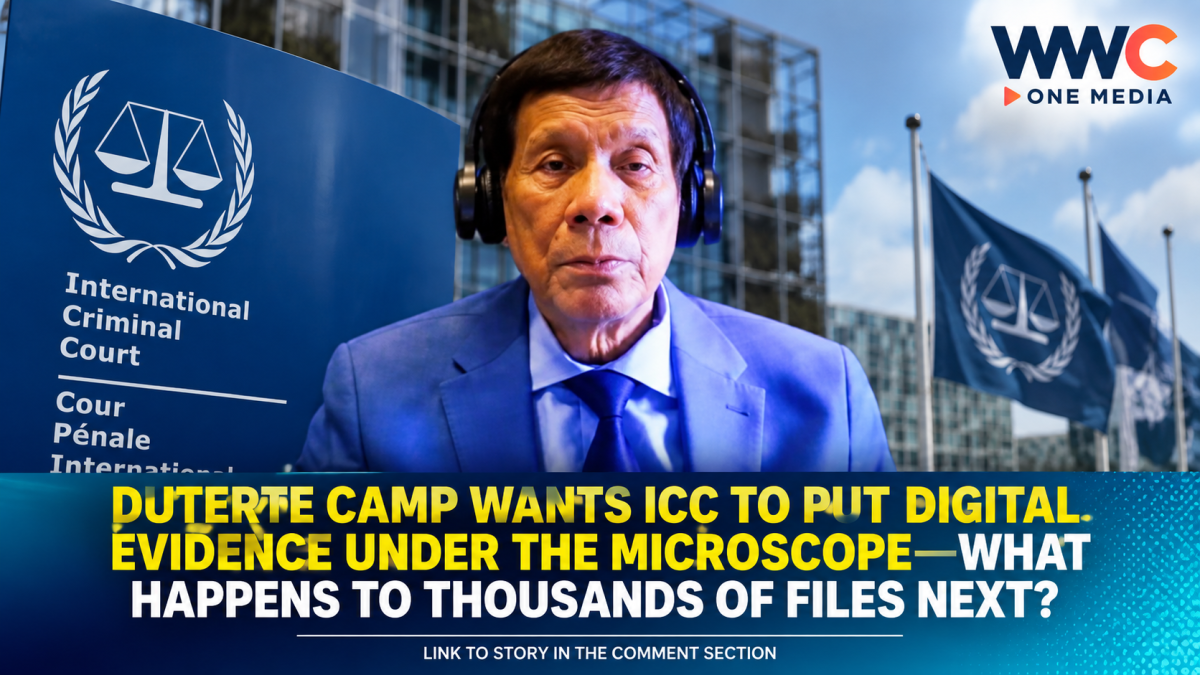
THE HAGUE, Netherlands — The defense team of former Philippine President Rodrigo Duterte is asking the International Criminal Court (ICC) to tighten its rules for digital evidence, arguing that online materials should undergo additional expert verification before being relied upon in his upcoming crimes-against-humanity trial.
In a filing dated Aug. 31, 2026, lead defense counsel Peter Haynes KC asked ICC Trial Chamber III to amend the court’s E-Court Protocol by adding an “expert verification” field for electronic evidence. The request was reported by multiple Philippine news organizations, including Manila Standard, Philippine Star, ABS-CBN News and Daily Tribune.
The defense argues that simply identifying a webpage through its URL is not enough to establish that digital material is authentic, reliable or untampered with.
Defense wants experts to verify online material
Under the proposal, evidence submitted electronically could include information indicating whether an expert report is required.
The defense says such a report should address important technical questions, including:
- Where the material originated
- Whether it is an original document or a copy
- Its chain of custody
- Available metadata
- Whether the material has been edited or manipulated
- The methods used to authenticate it
- The qualifications and experience of the person conducting the verification
According to the defense, those details would help the judges assess whether digital material is relevant and admissible.
The argument comes amid growing concerns worldwide about manipulated videos, altered photographs, fabricated documents and other forms of digitally generated or modified information.
Defense points to massive volume of evidence
Duterte’s lawyers are also raising concerns about the quantity and quality of evidence being disclosed by prosecutors ahead of the trial.
Daily Tribune reported that the defense said the prosecution’s evidence had increased from more than 5,000 items before the February confirmation-of-charges hearing to about 25,000 by Sept. 3.
The defense further said prosecutors had indicated that another 200 gigabytes of material could be disclosed. Lawyers argued that the sheer volume could make it difficult to distinguish relevant and reliable evidence from material that is irrelevant, unreliable or potentially manipulated.
The prosecution has not publicly responded to the defense request in the reports reviewed.
The OTPLink issue
The defense specifically raised questions about the ICC Office of the Prosecutor’s OTPLink, a system through which members of the public can submit information relating to alleged international crimes.
According to the defense filing as reported by Daily Tribune, prosecutors received more than 400,000 electronic files through OTPLink in 2024, with the number increasing to more than 570,000 in 2025.
Haynes argued that material submitted through such a system could potentially include falsified, manipulated or forged information.
The defense also questioned the identification and authentication of some material classified as “open source,” particularly because individuals can submit information anonymously.
That does not, however, establish that evidence in Duterte’s case is fake or fabricated. The defense is asking the ICC to create stronger mechanisms for determining the authenticity and reliability of digital material.
Why the request matters
Digital evidence can play an increasingly important role in modern international criminal cases.
Photographs, videos, social-media posts, websites, electronic communications, databases and other digital records can help establish what happened, when it happened and who may have been involved.
But the same technology also creates challenges.
A video can be edited. A photograph can be altered. A webpage can disappear or change. Metadata can be incomplete. And material circulating online can be copied and reposted thousands of times without a clear record of its original source.
The Duterte defense therefore wants the ICC to place greater emphasis on the provenance and technical authentication of electronic material.
ICC trial is scheduled for November 30
The request comes as Duterte’s case moves toward trial.
The ICC says its Pre-Trial Chamber I unanimously confirmed three crimes-against-humanity charges against Duterte on April 23, 2026, committing the case to trial. The charges concern alleged murder and attempted murder committed in the Philippines between Nov. 1, 2011, and March 16, 2019, in the context of the so-called war on drugs.
The ICC currently lists Nov. 30, 2026 as the scheduled opening of the trial.
The court says Duterte remains in ICC custody in Scheveningen, The Hague, following his transfer to the court in March 2025.
ICC has already ruled on the charges
It is important to distinguish the upcoming trial from the earlier confirmation-of-charges proceedings.
The April decision did not constitute a conviction. Rather, the ICC Pre-Trial Chamber determined that there were substantial grounds to believe Duterte was responsible for the crimes charged and committed him to trial.
The ICC also emphasizes that accused persons are presumed innocent unless proven guilty, and that the defense has the right to present evidence and call witnesses.
What happens to the defense request?
The immediate question is whether Trial Chamber III will adopt the defense’s proposed changes to the electronic evidence protocol.
The ICC’s own case information indicates that the Trial Chamber is expected to address preliminary matters concerning the timing and manner of evidence disclosure before the trial begins.
For Duterte’s lawyers, the issue is straightforward: before evidence is used to establish facts in a courtroom, they want stronger assurances that digital material can be traced to a reliable source and has not been altered.
For prosecutors, the challenge will be to present their case while satisfying the court’s evidentiary standards and responding to any defense objections.
With the trial scheduled to begin on Nov. 30, the battle over how thousands of digital files are authenticated could become one of the important procedural issues to watch before proceedings formally get underway.
The question now is not simply how much evidence will reach the courtroom—but how the ICC will determine which digital evidence can be trusted.
WWC ONE MEDIA M.J.E
Leave a Reply