
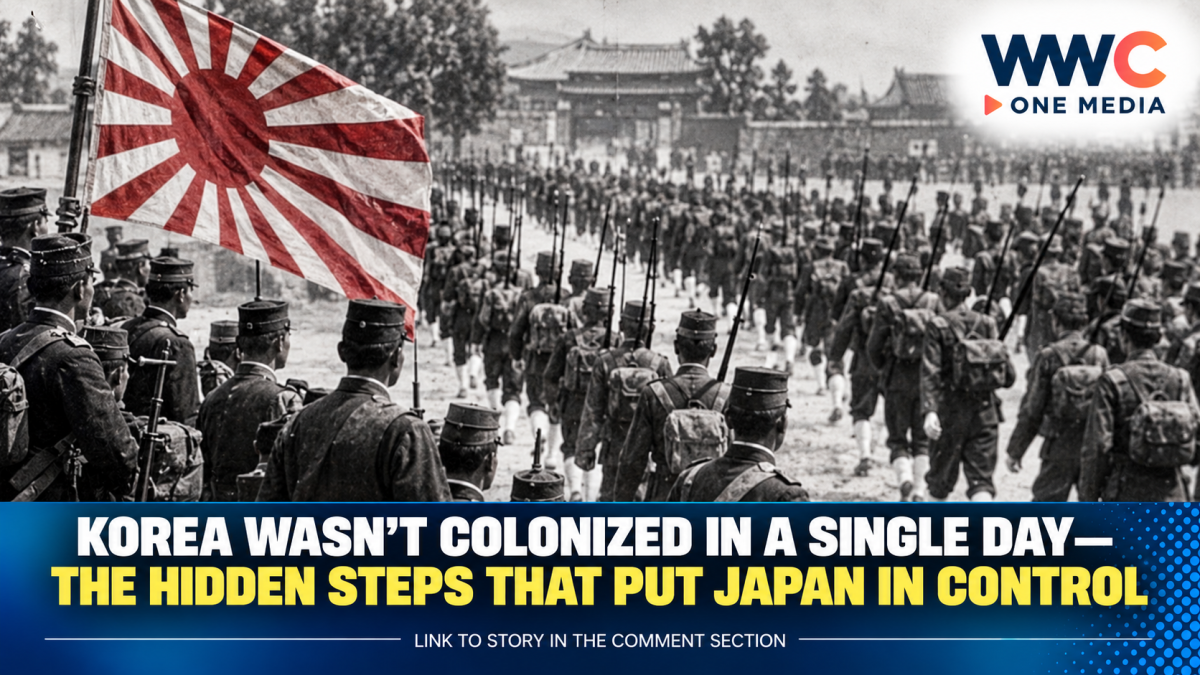
SEOUL — The story of how Korea became part of the Japanese Empire is often reduced to a single date: August 29, 1910.
That was the day the Japan-Korea Annexation Treaty was formally promulgated and took effect.
But historians and historical records tell a more complicated story.
Korea did not suddenly lose its sovereignty in one afternoon.
Japan’s takeover developed over several years through military pressure, diplomatic agreements, the removal of Korea’s control over foreign affairs, increasing Japanese domination of the Korean government and, ultimately, formal annexation.
That distinction is at the heart of a new Korea Times essay examining how Korea was “really colonized.”
The article, written by David A. Tizzard, also explores the deeper legacy of colonial rule—from language and identity to the experience of Korean athletes competing internationally under the Japanese flag.
Korea was already under enormous pressure before 1910
By the late 19th century, the Korean Peninsula had become strategically important to competing powers in East Asia.
The weakening of China’s traditional regional influence, Japan’s rapid modernization and expansion, and rivalry between Japan and Russia placed Korea at the center of a wider geopolitical struggle.
Japan’s victory over China in the First Sino-Japanese War (1894–1895) dramatically changed the regional balance.
Japan subsequently defeated Russia in the Russo-Japanese War (1904–1905), strengthening Tokyo’s position as the dominant power in Northeast Asia.
Historical scholarship describes Korea as being caught in this broader competition among imperial powers.
For Korea, the consequences were profound.
The Korean government was increasingly unable to control the foreign powers operating around the peninsula.
The 1905 treaty changed everything
One of the most important turning points came in 1905.
Following Japan’s victory over Russia, Japan imposed the Eulsa Treaty, also known as the Japan-Korea Protectorate Treaty.
Under the arrangement, Korea effectively lost control over its foreign affairs and became a Japanese protectorate.
Korean Emperor Gojong opposed the agreement and later attempted to challenge its legitimacy internationally.
He secretly sent representatives to the 1907 Hague Peace Conference in an effort to appeal against Japanese control.
The Korean representatives were not permitted to participate officially.
The episode demonstrated just how little international room Korea had left to maneuver.
Japan had moved from influencing Korea to controlling key elements of its sovereignty.
Japan’s military presence made resistance harder
The treaties did not exist in isolation.
Japan’s growing military and political presence gave Tokyo the ability to enforce its demands.
After the 1905 treaty, Japan’s Resident-General exercised enormous influence over Korean affairs.
Japan’s Ito Hirobumi, a major figure in the process, became the first Resident-General of Korea.
Korean independence activists increasingly regarded Japanese control as an existential threat.
One of the most famous figures to emerge from this resistance was Ahn Jung-geun, who assassinated Ito in Harbin in 1909.
Ahn regarded the treaties that paved the way for Japanese domination as illegitimate and sought to defend Korean independence.
Then came the 1910 annexation
On August 22, 1910, Japanese and Korean representatives signed the Japan-Korea Annexation Treaty.
The treaty stated that the Korean emperor would transfer “complete and permanent” sovereignty over Korea to the Japanese emperor.
Japan accepted that transfer and formally incorporated Korea into the Japanese Empire.
The treaty was promulgated on August 29, 1910, marking the beginning of Japan’s formal colonial rule.
Japan’s National Archives records the treaty’s signing and August 29 promulgation.
The historical debate, however, did not end there.
Was the annexation treaty legally valid?
This remains one of the most sensitive historical issues between South Korea and Japan.
Japan historically maintained that the 1910 treaty was legally concluded.
Korean historians and governments have disputed that interpretation, pointing to coercion, procedural irregularities and the circumstances surrounding the agreement.
A separate Korea Times historical examination noted that the Korean version of the treaty lacked the emperor’s signature and national seal in the form required by Korean law, while Japanese forces surrounded the royal palace during the negotiations.
South Korea and Japan later reached a different formulation in the 1965 Treaty on Basic Relations: the two countries agreed that treaties and agreements concluded between the Korean Empire and Japan before August 22, 1910 were already “null and void.”
The interpretation and historical meaning of that language have remained contested.
For that reason, responsible reporting should distinguish between Japan’s historical assertion of legality and Korea’s longstanding argument that the annexation was imposed under coercion and was invalid.
35 years under Japanese colonial rule
Formal Japanese colonial rule lasted from 1910 until 1945.
The Japanese Government-General of Korea exercised extensive authority over administration, legislation, policing and other areas of public life.
Seoul itself underwent a transformation.
During the colonial period, the city was officially known in Japanese as Keijō and in Korean as Gyeongseong, rather than simply being treated as the independent Korean capital it had been before annexation.
Japan also reorganized the peninsula’s administration and economy to serve the colonial state.
The system changed over time, but political control remained firmly in Japanese hands.
Korean language and identity came under pressure
The colonial period was not simply about political administration.
Japan increasingly pursued policies designed to assimilate Koreans into the Japanese imperial system.
Particularly during the wartime period, authorities promoted Japanese language use, Japanese names and loyalty to the Japanese emperor.
The National Museum of Korean History documents policies that included restrictions on Korean-language use, adoption of Japanese names and rituals of loyalty toward the Japanese imperial institution.
Historical research describes assimilation as an important element of Japanese colonial policy, particularly as Japan mobilized Korea for its wartime empire.
These policies left a lasting mark on Korean society.
Even Korean Olympic victories carried the Japanese flag
Perhaps one of the most powerful examples of the loss of national identity involved Korean athletes.
At the 1936 Berlin Olympics, Korean marathon runner Son Kee-chung won the gold medal.
Fellow Korean athlete Nam Seung-yong won bronze.
But neither competed under an independent Korean flag.
They competed as representatives of Japan because Korea was then under Japanese colonial rule.
The Korea Times essay recounts Son’s later discomfort at seeing the Japanese flag associated with his victory.
The episode remains one of the most emotionally powerful symbols of Korea’s colonial experience.
Son had achieved an Olympic victory, but his country did not exist as an independent Olympic nation.
Resistance never disappeared
Japanese rule did not mean that Koreans simply accepted colonial authority.
Resistance appeared in many forms—from armed independence fighters to underground political movements, cultural preservation and demonstrations.
The most famous nationwide uprising was the March First Movement of 1919.
Millions of Koreans participated in demonstrations demanding independence.
Japan suppressed the movement, but it became a defining moment in the Korean independence struggle.
It also helped lead to the establishment of the Korean Provisional Government in Shanghai later that year.
Liberation finally came in 1945
Japanese colonial rule ended with Japan’s defeat in World War II.
Japan surrendered to the Allies in August 1945.
Korea was liberated after 35 years of Japanese colonial rule.
But independence did not immediately produce a unified Korean state.
The peninsula was divided into Soviet and American occupation zones, eventually leading to the creation of separate governments in North and South Korea in 1948.
The Korean War would follow in 1950.
That means the consequences of the events that began during the late Joseon and Korean Empire periods continued long after Japanese rule ended.
The colonial legacy remains complicated
The history of Japanese rule remains deeply embedded in modern Korean identity.
Issues involving forced labor, wartime mobilization, “comfort women,” historical descriptions in textbooks, territorial disputes and differing interpretations of the annexation continue to influence Korea-Japan relations.
Historical records also show that the colonial period cannot be reduced to a simple story of one event.
Japan established control gradually.
Diplomatic sovereignty was weakened. Political authority was transferred. Military pressure increased. Resistance was suppressed. Then formal annexation completed the process.
That is why August 29, 1910, is remembered as the beginning of formal Japanese colonial rule—but understanding how Korea was colonized requires looking several years further back.
The lesson behind the history
The most important lesson may be that countries do not always lose sovereignty in one dramatic moment.
Sometimes sovereignty disappears gradually.
A treaty here.
A concession there.
A foreign military presence.
Control over diplomacy.
Control over government.
And eventually, a legal document declaring that the country no longer belongs to itself.
For Korea, the final document came in 1910.
But the struggle over sovereignty had already been underway for years.
And the consequences of that loss of independence would shape Korean identity, politics and relations with Japan for generations to come.



Leave a Reply