
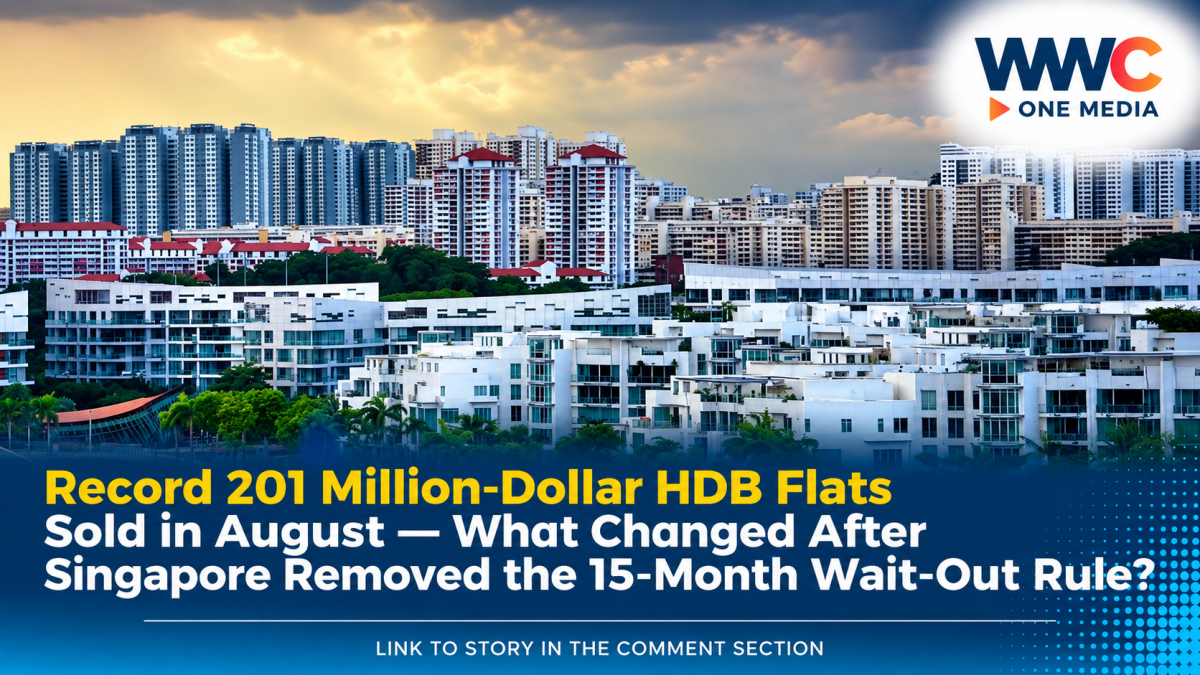
SINGAPORE — September 5, 2026 — Singapore’s million-dollar HDB resale market has crossed a psychological milestone.
A record 201 Housing and Development Board flats changed hands for at least S$1 million in August, the first time the monthly tally has exceeded 200.
The figure was up from 187 million-dollar transactions in July and surpassed the previous record of 188 set in June. Million-dollar flats accounted for about 8% of all HDB resale transactions in August.
The surge comes just weeks after the Government removed the 15-month wait-out period for eligible private-property owners seeking to buy non-subsidised HDB resale flats, reopening a segment of the market to former private homeowners.
But analysts caution against drawing a straight line between the two developments.
The policy change may have released some pent-up demand, especially for larger resale flats, but the record number of million-dollar transactions also reflects continued demand for well-located, spacious and newer HDB homes.
The 200-million-dollar-flat milestone
The August figures mark a dramatic change in the upper end of Singapore’s public-housing resale market.
Of the 201 million-dollar transactions, 177 were in mature estates, according to PropNex analysis.
Toa Payoh recorded the largest number with 32 transactions, followed by Queenstown with 26 and Bukit Merah with 21.
The concentration in established estates is significant because buyers are often paying premiums for location, transport connectivity, amenities, schools and larger floor areas.
But million-dollar deals are no longer confined entirely to Singapore’s traditional prime HDB locations.
Non-mature towns recorded 24 million-dollar transactions in August, the second consecutive monthly record for that segment.
That suggests the seven-figure HDB market is gradually broadening beyond the handful of locations that historically dominated the headlines.
The most expensive HDB resale deal of the month
The highest-priced HDB resale transaction recorded in August was a five-room flat at Tiong Bahru View on Boon Tiong Road, which sold for S$1,688,888.
The 112 sq m unit was located between the 28th and 30th floors.
Other eye-catching transactions emerged across Singapore.
In Bishan, an executive maisonette in Bishan Street 13 changed hands for S$1.65 million, setting a new record for the town and becoming the highest recorded price for an executive flat.
In Bedok, a five-room flat at Bedok South Road sold for S$1.45 million, also setting a new town record.
These transactions underline the premium buyers are willing to pay for unusually large flats or homes in highly sought-after locations.
The 15-month rule was removed in July
The record came shortly after a major policy change.
On July 28, 2026, National Development Minister Chee Hong Tat announced the immediate removal of the 15-month wait-out period for private residential property owners and former owners seeking to purchase eligible non-subsidised HDB resale flats.
Under the revised policy, eligible private-property owners can buy an HDB resale flat without waiting 15 months after selling their private home, provided they meet the applicable conditions.
The rule had originally been introduced as part of measures intended to moderate demand for HDB resale flats.
But the Government said market conditions had improved and the wait-out period had served its purpose.
HDB resale prices had declined for two consecutive quarters at the time of the announcement, with the resale price index falling 0.1% in the first quarter and 0.3% in the second quarter of 2026.
Former private homeowners are back in the game
The biggest potential impact of the policy change is on households selling private property and moving into HDB resale homes.
Before the rule was scrapped, such households could face a lengthy period between selling their private home and purchasing an HDB resale flat.
That created an additional housing and financial hurdle for people looking to right-size.
The Government said it had received about 1,800 appeals annually from private-property owners seeking waivers of the 15-month period since it was introduced in 2022. HDB had granted roughly one in four appeals, mainly for households facing financial difficulties or other extenuating circumstances.
Removing the waiting period therefore reopened the resale market to a group of buyers who had previously been restricted.
But did the policy create the 201 deals?
Not necessarily.
This is where the numbers need to be interpreted carefully.
The record 201 transactions occurred after the rule was removed, but that does not prove that the policy directly caused all — or even most — of the increase.
Property analysts interviewed by CNA said the removal could unlock pent-up demand, particularly among former private homeowners looking for five-room flats, executive apartments and other larger units.
However, they also pointed to other factors, including moderating HDB prices, a growing supply of flats reaching their Minimum Occupation Period and the availability of alternative housing options.
The broader market data reinforces that caution.
Overall HDB resale activity actually fell
While million-dollar transactions hit an all-time monthly high, overall HDB resale volume declined in August.
There were 2,524 resale transactions, down 5.1% from July’s 2,660.
Yet August remained the second-busiest month over the preceding year, and resale volume was still 14.1% higher than August 2025.
That creates an unusual “two-speed” market.
The top end is becoming more active, while the overall market is not experiencing the same explosive growth.
HDB prices are not surging across the board
Despite the record number of million-dollar transactions, overall HDB resale prices rose only 0.1% month on month in August.
Mature-estate prices increased 0.7%, while non-mature estate prices were unchanged.
By flat type, three-room prices fell 0.3%, four-room prices rose 0.2%, executive flats climbed 2.8% and five-room prices were unchanged.
Year on year, overall HDB resale prices were actually 0.5% lower than in August 2025.
That distinction is crucial.
A record number of million-dollar transactions does not mean the typical HDB flat in Singapore is suddenly worth S$1 million.
In August, million-dollar homes represented only about 8% of all resale transactions, meaning the overwhelming majority of HDB resale deals remained below that threshold.
Why are buyers paying seven figures?
Several characteristics can help explain why certain flats command extraordinary prices.
Large floor areas remain highly valued, particularly among households seeking more space without moving into private housing.
Location is another major factor.
Mature estates with established transport links, schools, shopping facilities and food options can command substantial premiums.
Newer resale flats can also attract buyers because they offer more remaining lease compared with older HDB stock.
In some cases, unusually high floors, panoramic views, rare layouts or large executive-style units can push prices even higher.
The Bishan executive maisonette is an example of how size and location can combine to produce a record transaction.
Nearly 1,300 million-dollar HDB flats sold in eight months
The August record is not an isolated event.
A total of 1,290 HDB resale flats had sold for at least S$1 million during the first eight months of 2026, compared with 1,593 such transactions during the whole of 2025.
If the pace continues, 2026 could therefore set another annual record for million-dollar HDB transactions.
But the eventual total will depend on whether demand remains concentrated at the top end or spreads more broadly across the resale market.
More HDB flats are coming onto the market
Supply could be an important counterweight.
Around 13,500 HDB flats are expected to reach their Minimum Occupation Period in 2026, compared with approximately 8,000 in 2025.
Analysts believe this growing pool of resale flats should help absorb additional demand and prevent the market from overheating.
This is one reason analysts have generally been reluctant to predict another sharp broad-based increase in HDB prices.
Singapore’s housing market is therefore facing two competing forces: additional demand from former private-property owners and increasing supply from flats reaching MOP.
A new phase for Singapore’s resale market?
The August numbers may ultimately prove to be more important than just another record.
The removal of the 15-month wait-out rule has changed the pool of potential buyers.
Former private homeowners can now enter the HDB resale market more quickly, while the supply of resale flats is also expected to expand.
The result could be a market where larger, newer and better-located flats continue to command substantial premiums, while prices for more ordinary resale units remain considerably more stable.
For buyers, that means the headline figure of 201 million-dollar transactions should not be mistaken for a market-wide price explosion.
For sellers of premium flats, however, the record is significant.
And for Singapore’s housing policymakers, the bigger question may now be whether the removal of the 15-month restriction produces a sustained increase in demand — or simply releases a backlog of buyers who had been waiting for the rules to change.
August has provided the first major clue.
The million-dollar HDB market is clearly not slowing down. The question is whether the rest of Singapore’s resale market will follow.
WWC ONE MEDIA J.M.D



Leave a Reply