
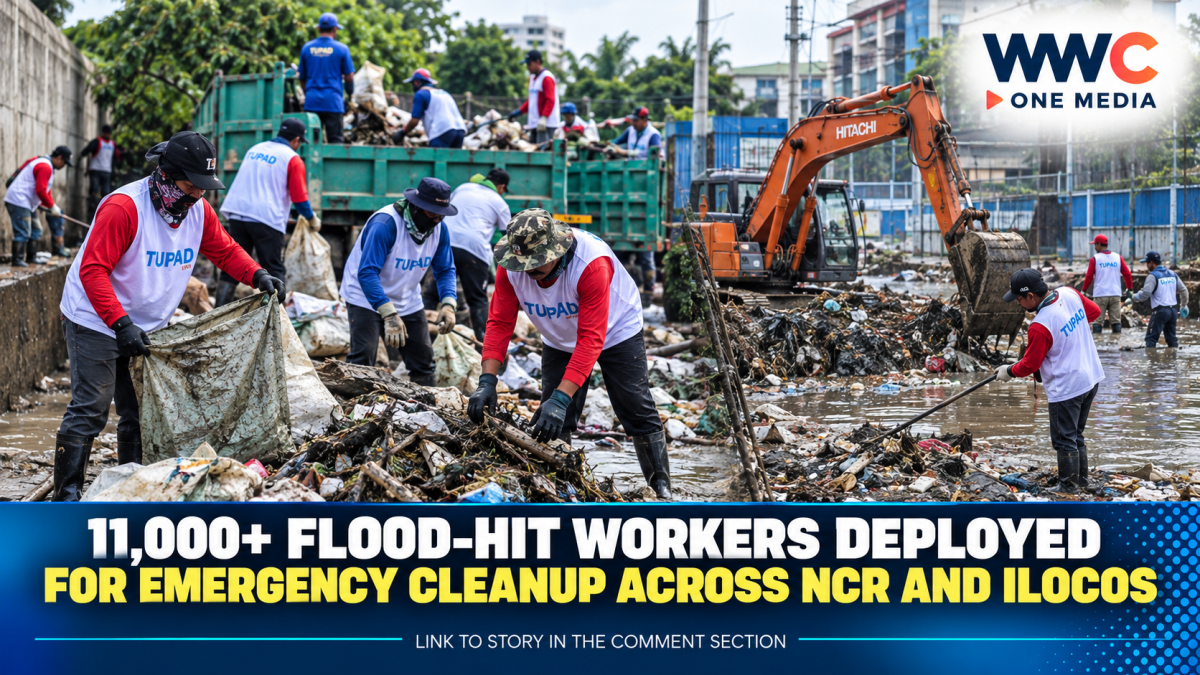
MANILA, Philippines — More than 11,000 workers affected by recent torrential rains and flooding are being given emergency employment as government agencies step up efforts to clear debris, unclog waterways and help battered communities recover.
The Department of Labor and Employment (DOLE) said 11,196 workers in the National Capital Region and Ilocos Region were mobilized under its Tulong Panghanapbuhay sa Ating Disadvantaged/Displaced Workers (TUPAD) program.
The deployment covers 1,418 workers in Metro Manila and 9,778 in the Ilocos Region, according to government figures reported by the Philippine News Agency and independently carried by SunStar.
Workers put to work as communities recover
In Metro Manila, the 1,418 TUPAD beneficiaries were deployed from August 24 to September 2 in flood-prone areas.
Their assignments include removing debris, clearing roads and public spaces, unclogging drainage systems and waterways, and assisting communities affected by flooding.
DOLE-NCR allocated about P39.637 million for the program.
In the Ilocos Region, the 9,778 beneficiaries are undertaking similar disaster-response activities, including clearing obstructions from waterways and drainage systems, debris removal and rehabilitation work. DOLE-Ilocos allocated approximately P61.17 million for the initiative.
Labor Secretary Francis Tolentino said the program is designed to serve two purposes at once: provide temporary income to workers affected by disasters while putting them to work helping communities recover.
The cleanup comes as flooding continues to strain communities
The latest deployment is part of a wider government response to weeks of severe weather and flooding.
Earlier reports showed government agencies turning to TUPAD workers for large-scale clearing operations in Metro Manila. In June, the government announced plans to use TUPAD beneficiaries to remove accumulated garbage, desilt clogged waterways and restore water flow in drainage channels.
By late August, the Metropolitan Manila Development Authority also reported plans to mobilize around 10,000 TUPAD workers for waterway cleanup across the capital following severe flooding.
That makes the latest NCR deployment part of a continuing effort rather than a one-time cleanup operation.
Assistance is also reaching flood-hit workers outside NCR
The government’s response extends beyond Metro Manila.
Philstar reported that DOLE had also released P386.6 million in emergency employment and livelihood assistance for 49,879 flood-affected workers in Central Luzon.
Of that amount, P357.85 million was earmarked for 48,667 beneficiaries in Bataan, Bulacan, Nueva Ecija, Pampanga and Tarlac, while another P28.79 million was allocated under the DOLE Integrated Livelihood Program for 1,212 beneficiaries.
The Central Luzon assistance illustrates the broader scale of the economic impact of recent flooding: workers are not only dealing with damaged homes and communities, but also disruptions to their ability to earn a living.
What TUPAD means for flood-hit families
TUPAD is an emergency employment program intended to provide temporary work and income to disadvantaged or displaced workers.
In disaster situations, beneficiaries can be assigned to community-based activities such as cleanup and rehabilitation. This allows government assistance to address an immediate household need—income—while also supporting recovery operations on the ground.
For flood-hit communities, the approach can be particularly important after the water recedes, when streets, drainage systems and waterways may remain blocked by mud, garbage and other debris.
But the deployment of thousands of temporary workers should not be confused with a permanent flood-control solution.
Clearing waterways can help restore drainage and improve local conditions, but it does not by itself address the larger structural issues behind recurring flooding, including drainage capacity, watershed management, land use, river maintenance and long-term flood-control infrastructure.
The bigger challenge begins after the cleanup
The deployment of more than 11,000 workers underscores the immediate human and economic cost of the latest flooding—but it also highlights a larger challenge facing flood-prone communities.
Once the debris is removed and waterways are cleared, residents still have to repair homes, restore livelihoods and prepare for the possibility of another major weather event.
DOLE said it remains prepared to mobilize TUPAD workers in areas affected by severe weather as part of continuing disaster-response and recovery efforts.
For thousands of displaced and flood-affected workers, the emergency jobs provide much-needed income. For the communities they serve, the work offers another critical layer of recovery.
But the question that remains is how quickly cleanup efforts can translate into long-term protection against the next flood.




Leave a Reply