
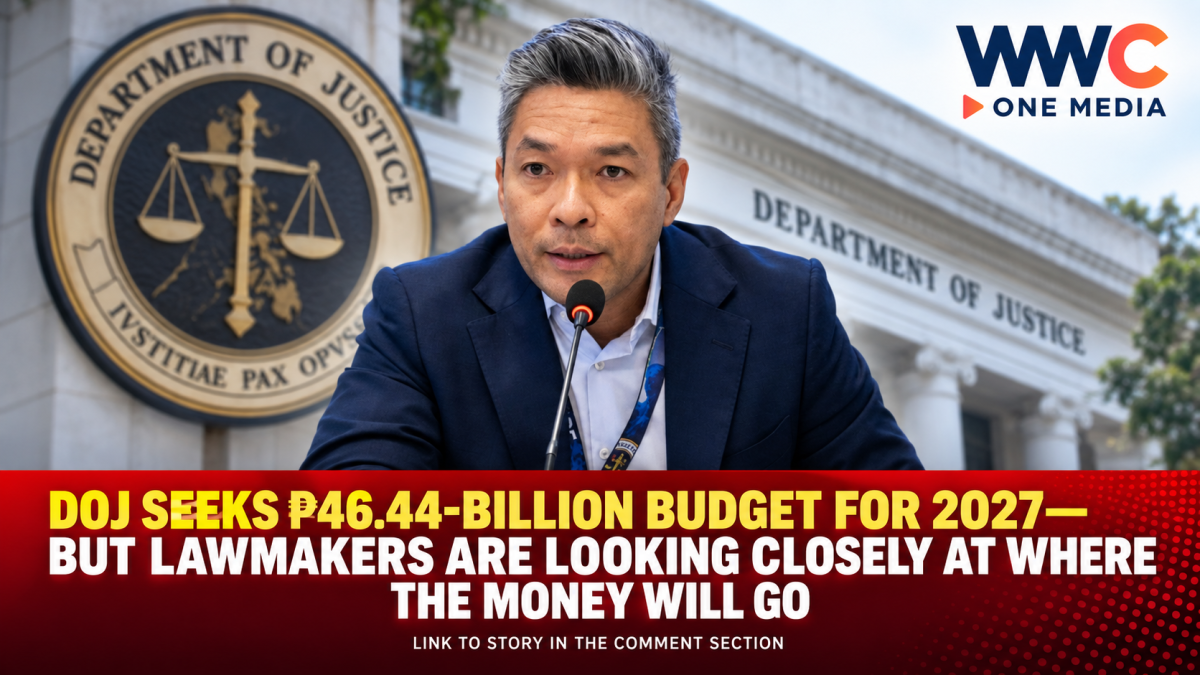
MANILA, Philippines — The Department of Justice (DOJ) is seeking a ₱46.44-billion budget for 2027, a modest increase from its ₱45.5-billion allocation this year, with officials saying much of the additional funding will go toward higher salaries and personnel benefits.
The proposed amount is ₱46.435 billion, according to the House of Representatives, which reviewed the DOJ and its attached agencies during budget deliberations.
Justice Undersecretary Ian Norman Dato said the increase is largely driven by adjustments in employee compensation and benefits rather than a major expansion of the department’s overall spending.
The DOJ said the proposal underwent internal preparations and discussions beginning as early as March before being presented to Congress.
Why the increase matters
At first glance, the proposed increase appears relatively small. The DOJ’s 2027 request is only about ₱935 million higher than its ₱45.5-billion 2026 budget.
But the budget review is about more than the overall figure.
Lawmakers are examining whether the proposed allocation will be enough to sustain the DOJ’s law enforcement, prosecution, corrections, immigration and access-to-justice functions while dealing with growing demands on the department and its attached agencies.
The House Committee on Appropriations said the proposed DOJ allocation represents about 0.68 percent of the proposed ₱7.2-trillion national budget for 2027.
Lawmakers flag reductions in several agencies
During the House budget hearing, lawmakers pointed out that several DOJ attached agencies are facing proposed reductions under the 2027 National Expenditure Program.
Among those identified were the Bureau of Immigration, National Bureau of Investigation and Office for Alternative Dispute Resolution. The House also cited proposed reductions affecting portions of the Special Enforcement and Protection Sub-Program.
Those areas include efforts involving anti-trafficking, anti-cybercrime and the fight against online sexual abuse or exploitation of children.
The proposed budget also includes a reduction in funding for victim compensation services, from ₱19 million to ₱8 million, according to the House committee.
That means the headline figure of ₱46.44 billion does not necessarily translate into increases across every DOJ program.
DOJ prosecution numbers show strong performance
The budget discussion comes as lawmakers also point to improvements in the DOJ’s prosecution performance.
The House said the National Prosecution Service recorded a 99.12-percent disposition rate in 2025, resolving or disposing of 395,780 of 428,779 cases received during the year.
The prosecution success rate was also reported at 90.84 percent.
House lawmakers said these gains need to be sustained despite resource pressures.
That puts the 2027 budget debate in sharper focus: the question is not simply whether the DOJ will receive more money, but whether the proposed allocation will provide enough resources for agencies handling investigations, prosecutions, immigration, corrections and other justice-related services.
Confidential funds also draw attention
Another point that has attracted attention is the proposed reduction in the DOJ’s confidential funds.
Bombo Radyo reported that the proposed allocation for 2027 is ₱364 million, compared with ₱700 million in 2026 and ₱1.5 billion in 2025. The report said Dato declined to elaborate on the specific allocation but maintained that the proposed budget had undergone careful review.
The reduction adds another layer to the congressional scrutiny of the DOJ’s proposed spending priorities.
Budget is still subject to congressional deliberations
The ₱46.435-billion figure is a proposed budget, not yet the final 2027 appropriation.
The Department of Budget and Management’s 2027 National Expenditure Program identifies the DOJ and its major attached agencies, including the Bureau of Corrections, Bureau of Immigration, National Bureau of Investigation, Office of the Solicitor General, Public Attorney’s Office and other justice-sector offices.
Congress will continue examining the proposed allocations before the final 2027 national budget is enacted.
For the DOJ, the challenge is therefore becoming increasingly clear: secure enough resources to maintain gains in prosecution and justice delivery while convincing lawmakers that every peso is aligned with the country’s most urgent law-enforcement and justice priorities.
And as lawmakers dig deeper into the individual allocations, the bigger question may no longer be how much the DOJ is getting—but which programs will gain, which will lose funding, and what those choices could mean for Filipinos seeking justice in 2027.
WWC ONE MEDIA J.M.S
Leave a Reply