
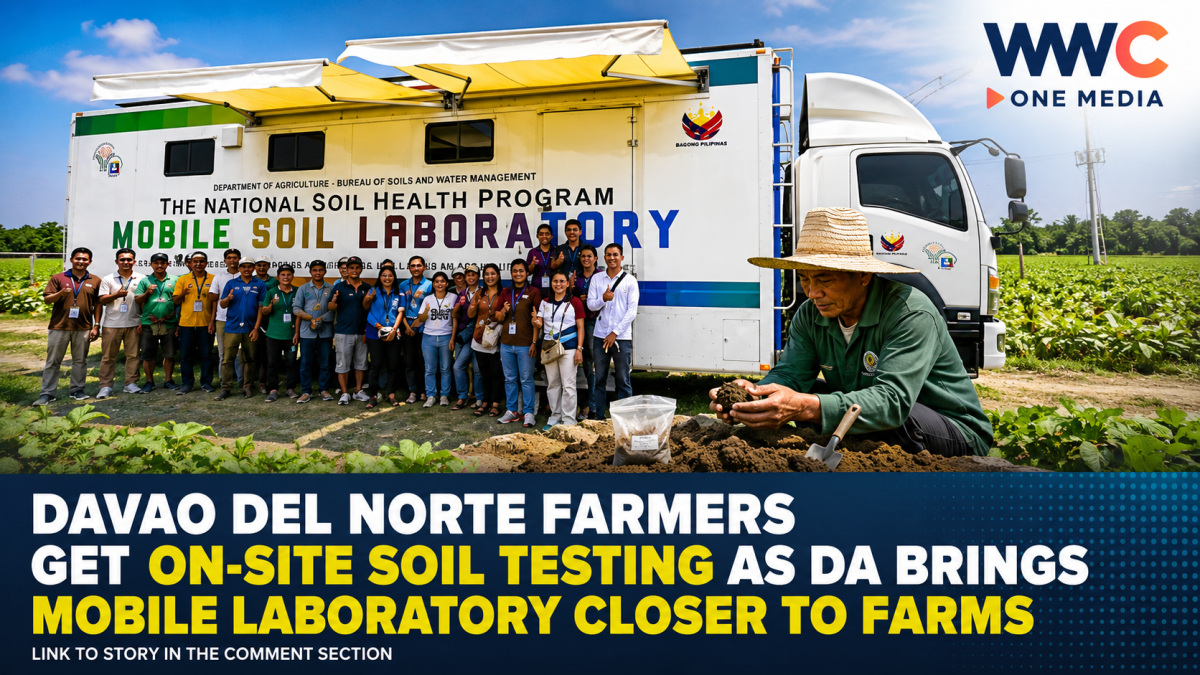
DAVAO CITY — Farmers in Carmen, Davao del Norte are gaining easier access to soil testing as the Department of Agriculture brings a mobile laboratory directly into farming communities, giving growers scientific information they can use to make better decisions about fertilizer, soil health and crop production.
The initiative is part of the Department of Agriculture’s broader push to make science-based agricultural services more accessible to farmers, particularly those who may find it difficult or costly to bring soil samples to fixed laboratories.
The Philippine News Agency reported on September 3 that farmers in Carmen are now benefiting from the on-site service provided through the Mobile Soil Laboratory (MSL).
From the laboratory to the farm
Traditionally, farmers who want their soil analyzed have had to collect samples and bring them to stationary laboratories, potentially adding transportation costs and waiting time to the process.
The DA’s Mobile Soil Laboratory is designed to bring that capability closer to the communities themselves.
The program is being implemented by the DA-Bureau of Soils and Water Management (DA-BSWM), which describes the mobile laboratory as a way to provide accessible, available and accurate soil-health services directly to farming areas.
A previous DA-Davao deployment in Panabo City and nearby areas of Davao del Norte demonstrated the scale of the initiative. The 10-wheeler laboratory can analyze as many as 44 chemical, physical and microbiological properties of soil and water, according to SunStar Davao.
Why soil testing matters to farmers
Soil may look healthy on the surface while lacking nutrients needed by crops.
Without testing, farmers may apply fertilizer based on experience, estimates or generalized recommendations. That can result in applying too little, too much or the wrong type of fertilizer.
Soil testing provides information that can help farmers determine what nutrients are present and what adjustments may be needed.
The DA says this supports more precise fertilizer recommendations and better farm management.
The goal is not simply to produce a laboratory report. It is to help farmers make more informed decisions about what their crops and soil actually need.
Potential savings for farmers
DA-Davao agriculture regional technical director for research and regulations Zabdiel Zacarias previously said the mobile laboratory can help farmers apply fertilizer at the right amount and the right time, potentially reducing input costs while supporting productivity.
That could be particularly important as farmers continue to deal with rising production expenses.
Fertilizer is one of the major operating costs for many crop producers. More targeted application can help reduce unnecessary use while maintaining soil fertility.
However, soil testing itself does not guarantee higher yields. Crop performance also depends on factors such as weather, water availability, seeds, pests, disease, farm management and market conditions.
Davao del Norte is a major agricultural province
The move is significant for Davao del Norte because agriculture remains central to the province’s economy.
The province is widely known for its extensive banana production and is described by the DA’s Special Area for Agricultural Development program as a major agricultural and agri-industrial area in the Davao Region.
The Philippine Statistics Authority’s 2022 Census of Agriculture and Fisheries, cited by SunStar Davao, recorded approximately 79,701 farms in Davao del Norte, with an agricultural population of 185,895 people aged 18 and above.
That means agricultural technologies that reduce the distance between farmers and technical services can potentially reach a substantial farming population.
The technology is not limited to soil
The Mobile Soil Laboratory can also conduct water analysis.
According to DA-Davao’s earlier deployment, the mobile facility can examine dozens of chemical, physical and microbiological properties of both soil and water.
That gives agricultural technicians more information when assessing farm conditions, irrigation-related concerns and nutrient management.
The BSWM’s national program also says the mobile laboratory provides soil analysis and the release of Soil Health Cards, allowing farmers to receive practical information from the tests.
A nationwide push for science-based farming
Davao del Norte is part of a much broader national effort.
The DA-BSWM launched its first Mobile Soil Laboratory operation in Tarlac in January 2025, describing the initiative as a way to make soil testing more accessible to farmers who previously had to rely on stationary laboratories.
The department has since expanded mobile laboratory activities to other parts of the country.
In 2026, for example, BSWM equipment and a service vehicle were turned over to the DA regional office in the Cordillera to support Mobile Soil Laboratory operations.
DA-Davao also deployed a Mobile Soil Laboratory in Panabo City from June 17 to September 4, 2026, covering Panabo and nearby areas of Davao del Norte.
Why the program matters beyond fertilizer
The bigger objective is soil health.
Healthy soil is fundamental to long-term agricultural productivity. Repeated cultivation, erosion, nutrient depletion and inappropriate fertilizer use can gradually affect soil quality.
By giving farmers better information about their soil, government agricultural technicians can provide recommendations that are more closely matched to actual field conditions.
That can contribute to more efficient use of farm inputs and more sustainable production.
What farmers can gain from the service
The Mobile Soil Laboratory model can potentially help farmers:
- Determine the nutrient condition of their soil
- Make more informed fertilizer decisions
- Avoid unnecessary fertilizer application
- Reduce the cost and inconvenience of transporting samples to distant laboratories
- Receive technical information closer to their farms
- Improve soil-management practices
- Better understand soil and water conditions
The BSWM says its mobile laboratory initiative is designed around three principles: accessible, available and accurate solutions for soil health.
The bigger picture
For farmers, the significance of the program may be simple: the laboratory is coming closer to them instead of requiring them to go looking for one.
For the government, however, the initiative represents a larger shift toward data-driven agriculture.
As farming becomes more pressured by input costs, climate risks and the need to maintain productivity, having accurate information about the land itself becomes increasingly important.
And in a province with tens of thousands of farms, bringing scientific soil analysis directly to farming communities could make a practical difference — one field at a time.
The next harvest will ultimately show the results, but for Davao del Norte farmers, a high-tech laboratory is now getting much closer to where the work actually happens: the farm.
WWC ONE MEDIA G.A




Leave a Reply