
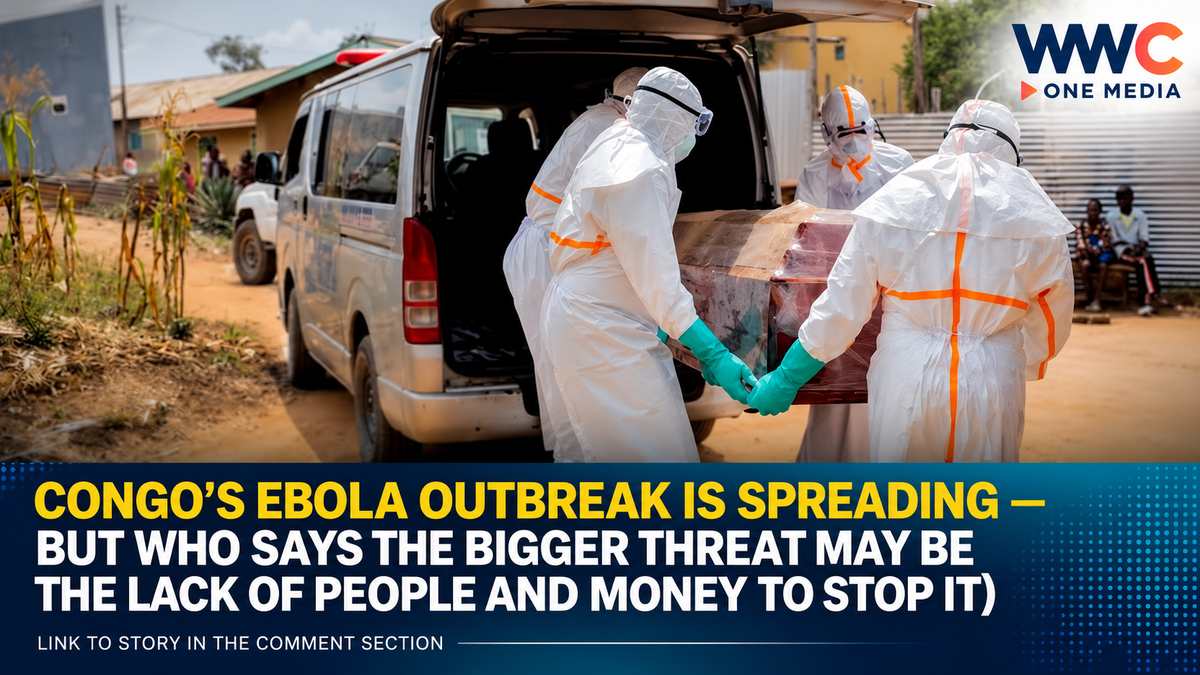
GENEVA — The Democratic Republic of Congo’s worst Ebola outbreak on record is spreading faster than health authorities can expand the response, with the World Health Organization warning that shortages of trained medical workers, operational partners and funding are creating dangerous bottlenecks.
The outbreak, caused by the Bundibugyo virus, has expanded from its initial epicenter in Ituri Province to six provinces, forcing authorities to move away from a highly centralized response and establish treatment facilities closer to newly affected communities.
According to the latest WHO figures cited by Reuters on September 8, the outbreak had infected more than 6,000 people and killed more than 3,100, making it the deadliest Ebola epidemic ever recorded in the Democratic Republic of Congo.
Thousands more health workers are needed
WHO technical officer Luca Fontana said nearly 1,400 treatment beds have already been established across 59 treatment centers.
But that capacity is still far from enough.
WHO estimates that another 1,600 beds will be required, bringing the target to roughly 3,000 beds. Because about three health workers are needed for every Ebola treatment bed, authorities could need approximately 9,000 health workers — around 5,000 more than are currently available.
The shortage is particularly alarming because Ebola treatment requires specialized infection-control procedures and protective equipment.
WHO estimates that simply equipping a health worker to enter a patient’s treatment area costs about $25 per use of personal protective equipment, while operating a 50-bed Ebola treatment center can cost approximately $500,000.
The international response is also stretched
The staffing problem extends beyond Congo’s own health system.
WHO says only a small number of international organizations currently have the expertise and capacity to establish and operate Ebola treatment centers. According to Fontana, just five or six major organizations have the necessary capabilities, leaving experienced groups at risk of being tied down managing facilities that are already operating instead of moving into newly affected areas.
The WHO has linked part of the problem to broader reductions in international donor funding.
The agency is urging donors to accelerate contributions toward a $1.3 billion, six-month Ebola response plan led by the Congolese government.
WHO had already warned that the outbreak was outpacing capacity
The latest warning follows increasingly alarming assessments from WHO.
In an August 2026 disease outbreak report, WHO said the Bundibugyo virus outbreak had reached 54 health zones across six provinces and described transmission as intense. As of August 12, WHO recorded 4,665 confirmed cases and 2,184 confirmed deaths, while noting that the increase partly reflected expanded surveillance and testing but also the geographic expansion of the outbreak.
WHO’s International Health Regulations Emergency Committee subsequently called for an immediate, unified and fully funded intensification of the response. It said the epidemic’s growth had outpaced the combined capacity of the Congolese government and its partners, with a need for about 3,000 treatment beds.
The committee also noted serious logistical problems, including access constraints, population displacement and disruptions to supply chains.
Frontline workers are exhausted
The shortage is not simply a numbers problem.
Associated Press reporting from the outbreak zone has documented health workers working extremely long hours while struggling with unpaid wages, inadequate supplies and increasingly difficult contact-tracing operations.
AP reported in August that between 60% and 70% of newly detected Ebola cases were being identified among people who were not already on contact lists, making it much harder for surveillance teams to contain transmission before infected people expose others.
Some health workers have also staged strikes over delayed payments.
The pressure extends to burial teams, who must follow strict infection-control procedures while facing exhaustion, fear and hostility from families whose traditional funeral practices are restricted by Ebola safety measures. AP reported that some burial workers have faced attacks and intense community anger.
The outbreak is also testing Congo’s fragile health system
WHO’s Africa office said some treatment centers in Ituri are already operating under significant pressure, with occupancy reaching 90% to 100% at some facilities in Bunia, even though the province-wide average was lower.
The agency estimates that more than 6,200 additional staff members will be needed over the next three months to support more than 2,000 additional operational beds and meet the changing demands of the outbreak.
The crisis is further complicated by insecurity, displacement and distrust within affected communities.
The Guardian has also reported that attacks against health workers and resistance within communities have complicated efforts to conduct contact tracing, safe burials and other measures needed to interrupt transmission.
Why the funding gap matters
The Congo outbreak illustrates a difficult reality in epidemic response: treatment centers, vaccines, laboratories and protective equipment are useless without enough trained people to operate them.
WHO has warned that international organizations capable of running Ebola treatment centers are becoming increasingly stretched. If additional partners do not enter the response, the organizations already operating facilities may have limited ability to deploy teams to newly affected areas.
Earlier in the outbreak, WHO also reported receiving only about 40% of the funding it had requested for the emergency response, highlighting the financial pressure surrounding the crisis.
The European Union and WHO have separately expanded assistance, including funding and emergency supplies for Congo and neighboring countries.
What happens next could determine how far Ebola spreads
For now, health authorities are racing to expand treatment capacity, strengthen surveillance, protect frontline workers and reach communities where transmission is occurring outside established contact networks.
WHO has stressed that the response needs predictable financing, sufficient personnel, secure access to communities and reliable supply chains for the coming months — potentially longer.
The message from health officials is increasingly clear: Congo is not simply fighting an Ebola outbreak. It is fighting a race against time — and the virus is gaining ground in places where the response does not yet have enough people, beds or resources.
The biggest question now is whether international support can arrive quickly enough to close those gaps before the outbreak expands even further.



Leave a Reply