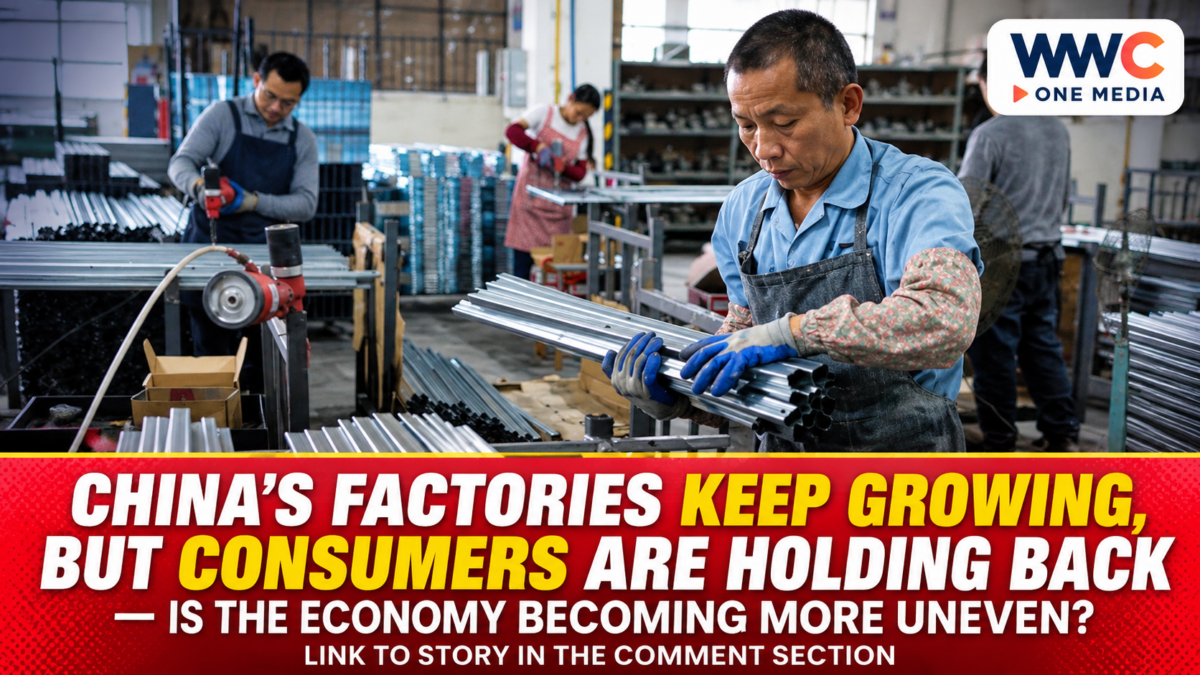
China’s economic slowdown is becoming more visible in the gap between industrial production and household spending, with October 2026 figures showing factories continuing to expand while retail growth remained weak.
Data released by China’s National Bureau of Statistics (NBS) on Nov. 16 showed industrial value added rising 4.8% year on year in October, but retail sales of consumer goods increased by only 0.4%. Meanwhile, fixed-asset investment fell 8.1% during the first 10 months of the year. National Bureau of Statistics+1
The figures do not describe an economy in which every major sector is contracting. Manufacturing, technology-related production and international trade continue to show areas of strength. However, weak consumer sales, declining investment and continued property-sector pressure raise questions about how evenly economic activity is spreading across China.
For businesses and trading partners, the distinction matters. Strong production can support exports, but a domestic market that struggles to absorb goods creates a different set of challenges for manufacturers, retailers and investors.
China economic slowdown: Industrial output remains positive
China’s industrial sector continued to expand in October, although the headline figure needs to be understood alongside the different industries contributing to it.
The NBS reported that the value added of industrial enterprises above the designated size increased by 4.8% compared with October 2025. Manufacturing grew 5.4%, while mining increased 0.7% and electricity, heat, gas and water production and supply rose 4.4%. National Bureau of Statistics
Some advanced manufacturing categories performed considerably better. Equipment manufacturing increased 10.6%, while high-tech manufacturing grew 17.6%.
Production of 3D-printing devices increased 85.9% year on year. Lithium-ion battery production rose 30%, while industrial robots increased 26%. These results show that China’s industrial expansion is not uniform: some technology-oriented sectors are growing much faster than the overall industrial average. National Bureau of Statistics
However, the manufacturing purchasing managers’ index stood at 49.3 in October. That is below the 50-point threshold commonly used to distinguish expansion from contraction in the survey.
This is an important distinction. The industrial production figure measures actual output growth, while the PMI reflects surveyed business conditions. A PMI below 50 does not mean industrial production itself fell by that percentage.
The two indicators together suggest that positive output growth is continuing even as surveyed manufacturing conditions remain under pressure.
Retail sales expose the weakness in domestic demand
The clearest contrast appears in consumer spending.
China’s retail sales of consumer goods reached 4.6463 trillion yuan in October, increasing only 0.4% from a year earlier. For January to October, total retail sales reached 41.6464 trillion yuan, up 1%. National Bureau of Statistics+1
The figures show that sales are still increasing, but at a modest pace compared with the growth recorded in several industrial categories.
There were differences across types of spending. October goods retail sales increased 0.3%, while catering revenue rose 0.7%. Urban retail sales grew 0.2%, compared with 1.5% in rural areas. National Bureau of Statistics
Online sales of goods and services offered a stronger result. Their combined value increased 3.7% during the first 10 months, with online services rising 5% and online goods increasing 2.9%. National Bureau of Statistics
The broader retail picture is therefore mixed. Digital services and selected product categories continue to grow, but the overall consumer market is expanding slowly.
This matters because manufacturers ultimately need buyers. Production capacity can increase, but businesses still need sufficient demand to sell their products profitably.
WWC previously examined the changing behaviour of Chinese shoppers in its coverage of Singles’ Day sales and consumer caution. The latest official retail figures add a wider national measure to that discussion.
Investment weakness reaches beyond the property market
The investment figures provide another warning about the strength of domestic economic activity.
China’s fixed-asset investment, excluding rural households, reached 36.4824 trillion yuan during January–October, down 8.1% year on year. Private investment fell 11.4%, while manufacturing investment declined 2.9%. National Bureau of Statistics
Investment outside property also weakened. The NBS reported that fixed-asset investment excluding real estate development was down 5.1%.
Real estate development investment fell 21.6% during the same period. The floor area of newly built commercial buildings sold declined 13.7%, while the value of those sales fell 14.3%. National Bureau of Statistics
These numbers matter because property activity affects more than developers. Construction, building materials, appliances, furniture, transport and other related businesses can all be affected when investment and property transactions weaken.
There are areas of growth within the investment data. Investment in high-tech industries increased 4%, and investment in information services grew 20.5%. Investment in intellectual property products also increased 9.2%. National Bureau of Statistics+1
That contrast suggests investment is being directed towards some newer industries even as broader spending remains weak.
The important question is whether growth in these selected sectors can offset weakness elsewhere.
Strong trade offers support, but exports cannot replace consumers
International trade remains a major source of strength in the latest figures.
China’s total goods imports and exports reached 4.8683 trillion yuan in October, up 31.2% year on year. Exports increased 28.7%, while imports rose 34.7%. For January–October, total goods trade increased 20%. National Bureau of Statistics
Exports of mechanical and electrical products increased 25.2% during the first 10 months. Private enterprises recorded a 20.1% increase in imports and exports over the same period. National Bureau of Statistics
These results show that China’s manufacturers continue to benefit from international demand. They also help explain why industrial output can remain positive while domestic retail growth is relatively weak.
But strong overseas sales do not automatically resolve problems at home.
A company may be able to sell more products abroad while still facing cautious consumers, declining property-related investment and weaker private-sector spending within China.
That imbalance can also affect competition in overseas markets. When manufacturers depend more heavily on external customers, international businesses may face stronger competition from Chinese suppliers.
WWC has examined the international dimension in its report on China’s import expo and the challenge facing foreign businesses seeking Chinese customers.
The trade figures demonstrate China’s export capacity, but the domestic retail figures show why the size of its consumer market should not be confused with the strength of actual household spending.
Technology growth is not the same as broad economic recovery
China’s high-tech manufacturing results are among the strongest parts of the October release.
Rapid increases in industrial robots, lithium-ion batteries and 3D-printing equipment suggest that investment and production in selected advanced industries remain important sources of growth.
However, the gains are not evenly distributed across the economy.
A factory producing advanced batteries can record strong output growth while a traditional retailer faces weak sales. A technology company may expand investment even as property developers reduce spending.
This is why headline industrial growth alone cannot provide a complete picture of economic conditions.
China’s demographic and consumer policies also form part of the longer-term response. WWC’s coverage of China’s expanding silver economy and older consumers examined one potential avenue for developing new sources of domestic demand.
The challenge for policymakers is to ensure that new industrial capacity and technology-led growth translate into stronger demand, sustainable investment and wider business opportunities.
What happens next
The next important indicators will show whether the October pattern continues or begins to improve.
Retail sales growth will be particularly important. A stronger consumer market would help businesses sell more goods and services domestically rather than relying as heavily on external buyers.
Investment will also require close attention, especially private-sector spending and property development. A sustained improvement in these areas could help support construction, employment and related industries.
Manufacturing output, exports and high-tech production remain important strengths. But their contribution to the wider economy will be more balanced if household demand and private investment also improve.
The NBS itself acknowledged that domestic supply remains stronger than demand and that some enterprises continue to face operational difficulties. It said that strengthening domestic demand and implementing policies effectively would remain priorities. National Bureau of Statistics
For now, China’s October figures reveal an economy with substantial industrial and export capabilities, but a less convincing recovery in household spending and investment.
The central question is not whether China can continue producing goods. Its latest figures show that it can.
The harder test is whether domestic demand can grow strongly enough to support that production over the longer term.
FAQ
Is China’s economy slowing in October 2026?
The October figures show mixed performance. Industrial production increased 4.8% year on year, while retail sales rose only 0.4%. Fixed-asset investment declined 8.1% during January–October. National Bureau of Statistics+1
How much did China’s industrial production grow in October?
Industrial value added among enterprises above the designated size increased 4.8% year on year in October 2026. Manufacturing grew 5.4%. National Bureau of Statistics
How much did China’s retail sales increase?
Retail sales of consumer goods reached 4.6463 trillion yuan in October, up 0.4% year on year. For January–October, they increased 1%. National Bureau of Statistics
Why is China’s property market important to the economy?
Property development is connected to construction, building materials, appliances, furniture and other businesses. The latest NBS data showed real estate development investment declining 21.6% during January–October. National Bureau of Statistics
Are China’s exports still growing?
Yes. October goods exports increased 28.7% year on year, while total goods trade rose 31.2%. National Bureau of Statistics