
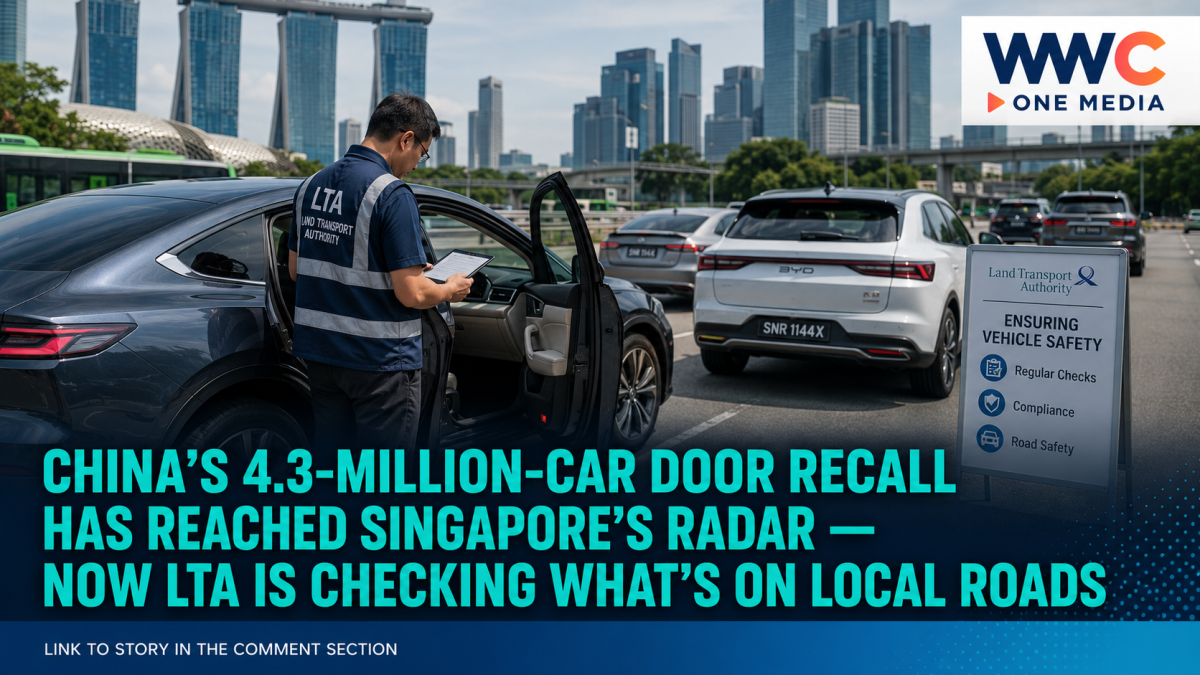
SINGAPORE — A massive vehicle safety recall involving about 4.3 million cars in China has now drawn the attention of Singapore regulators, with the Land Transport Authority assessing whether vehicles already on local roads could be affected by concerns surrounding electronic doors and emergency mechanical releases.
For Singapore motorists, however, there is an important distinction: no recall linked to the Chinese campaign has been announced in Singapore as of August 29, 2026.
LTA said it has not received reports from motorists here of difficulties operating electronic doors or accessing their vehicles’ mechanical emergency releases. It also said no authorised dealer in Singapore has announced a related recall.
But the regulator is not dismissing the issue.
LTA is engaging vehicle manufacturers and motor dealers to establish whether models sold or registered in Singapore could fall within the scope of the safety concerns that triggered China’s unprecedented recall campaign.
The development turns what initially appeared to be a China-specific automotive safety problem into a question with potential relevance for EV owners far beyond the mainland.
Why China Is Recalling Millions of Cars
China’s latest campaign involves around 4.3 million vehicles from nine automakers, making it the country’s largest automotive recall to date.
Tesla accounts for the biggest share, with approximately 2.98 million vehicles involved. Other manufacturers caught up in the broader campaign include Chinese EV makers such as Xiaomi, Leapmotor, Xpeng and Geely-linked brands.
At the centre of the controversy is not simply whether an electronic door works during normal driving.
The bigger concern is what happens after a serious crash or electrical failure.
Modern EVs increasingly use electronic buttons, switches or flush-mounted door mechanisms instead of conventional mechanical handles. Many vehicles still include a manual emergency release, but regulators are concerned that these releases may sometimes be difficult for occupants to identify or operate quickly under extreme conditions.
That distinction could become critical when seconds matter.
If a collision disables a vehicle’s low-voltage electrical system, the normal electronic door-opening mechanism may no longer function. Occupants then have to rely on the mechanical backup system.
China’s market regulator has identified cases in which those emergency mechanisms could be insufficiently obvious or difficult to operate.
For example, an official recall notice covering more than 390,000 Xiaomi SU7 vehicles said the interior emergency mechanical handles could be difficult to identify because their appearance was too similar to surrounding interior trim.
The remedy includes clearer warning labels as well as software changes affecting central unlocking and window-lowering behaviour following severe collisions.
Other manufacturers are deploying similar combinations of physical markings and over-the-air software updates.
What LTA Says About Cars in Singapore
Singapore already requires approved vehicles equipped with electronic doors to include mechanical failsafe features that allow occupants to open the doors from inside during an emergency.
LTA said it regularly reviews vehicle safety requirements as automotive technology develops and is studying the latest international developments surrounding electronic door systems.
For now, the agency is working with the motor industry to determine whether the Chinese recall has any direct implications for Singapore.
Vehicle owners who are concerned have been advised to contact their authorised dealers.
There is also a more immediate precaution motorists can take regardless of whether their vehicle is eventually recalled: learn exactly where the mechanical emergency door release is located and how to operate it.
It may seem like a minor detail during everyday driving, when electronic buttons work instantly.
After a major crash or electrical failure, it could be one of the most important controls inside the car.
A Bigger Fight Over Hidden Door Handles
The recall comes amid a broader global debate over one of the EV industry’s most recognisable design trends: flush or concealed door handles.
Popularised by Tesla and subsequently adopted by numerous manufacturers, flush handles can improve aerodynamics while giving vehicles a cleaner, futuristic appearance.
But safety regulators are increasingly asking whether those design advantages are worth the potential complications during an emergency.
China has moved faster than most countries.
Its new mandatory national standard, GB 48001-2026, takes effect on January 1, 2027.
The rules require vehicle doors to have mechanically operable exterior and interior handles and specify minimum operating space for external handles, effectively eliminating fully concealed designs that provide no accessible mechanical operation.
Chinese authorities have said the rules are intended to ensure doors remain usable even if a vehicle loses electrical power.
The transition will not happen entirely overnight. Chinese authorities have provided manufacturers additional time for existing vehicle programmes, with broader compliance requirements extending into 2029.
The Concern Is Going Global
China is not alone in examining the issue.
In the United States, the National Highway Traffic Safety Administration has also been studying risks associated with electronically operated doors.
A federal investigation opened in 2025 examined reports involving Tesla Model Y vehicles whose exterior electronic door handles allegedly became inoperative when low-voltage battery power was insufficient.
More recently, US regulators indicated they would consider new vehicle-safety requirements addressing emergency access and exit from vehicles equipped with electrically operated door systems.
European regulators are also watching developments.
The Netherlands’ RDW, which plays an important regulatory role for Tesla vehicles in Europe, said this week there was no corresponding Tesla recall in Europe at present, while stressing that vehicle doors should remain intuitively accessible even when electrical power is unavailable.
The issue is also being discussed in international vehicle-safety forums.
That makes China’s recall potentially much more significant than the number of cars being repaired within China.
Because global manufacturers often build vehicles around common platforms and components, tougher standards in a market as large as China can influence how future cars are designed elsewhere.
What Singapore Drivers Should Do Now
There is currently no reason for Singapore motorists to conclude that their vehicles are automatically affected simply because the same brand has recalled cars in China.
Vehicles sold in different countries can use different specifications, production dates, components and regulatory configurations.
Owners should therefore check information using their vehicle identification number or through an authorised distributor rather than relying only on the brand or model name.
Drivers of cars with electronic door-opening systems should also locate the manual emergency releases for every seating row where applicable.
The instructions are normally contained in the vehicle owner’s manual.
Passengers and family members who regularly use the vehicle may benefit from knowing their location as well.
What Happens Next Could Matter Beyond This Recall
Singapore’s immediate question is straightforward: Are any vehicles currently on its roads covered by the same safety concerns identified in China?
LTA and the automotive industry are now trying to answer it.
But the longer-term question is considerably bigger.
Cars are becoming increasingly dependent on software, touch-sensitive controls and electrically operated mechanisms. Features once controlled by obvious mechanical levers are being replaced by buttons, sensors and electronic actuators.
Most of the time, that technology makes vehicles easier and more sophisticated to use.
The test comes when the electronics stop working.
China’s record recall has put that trade-off under an unusually bright spotlight — and with regulators from Singapore to the United States and Europe now paying attention, the humble car door could become the next major battleground over how far automakers should go in replacing mechanical controls with technology.

Leave a Reply