
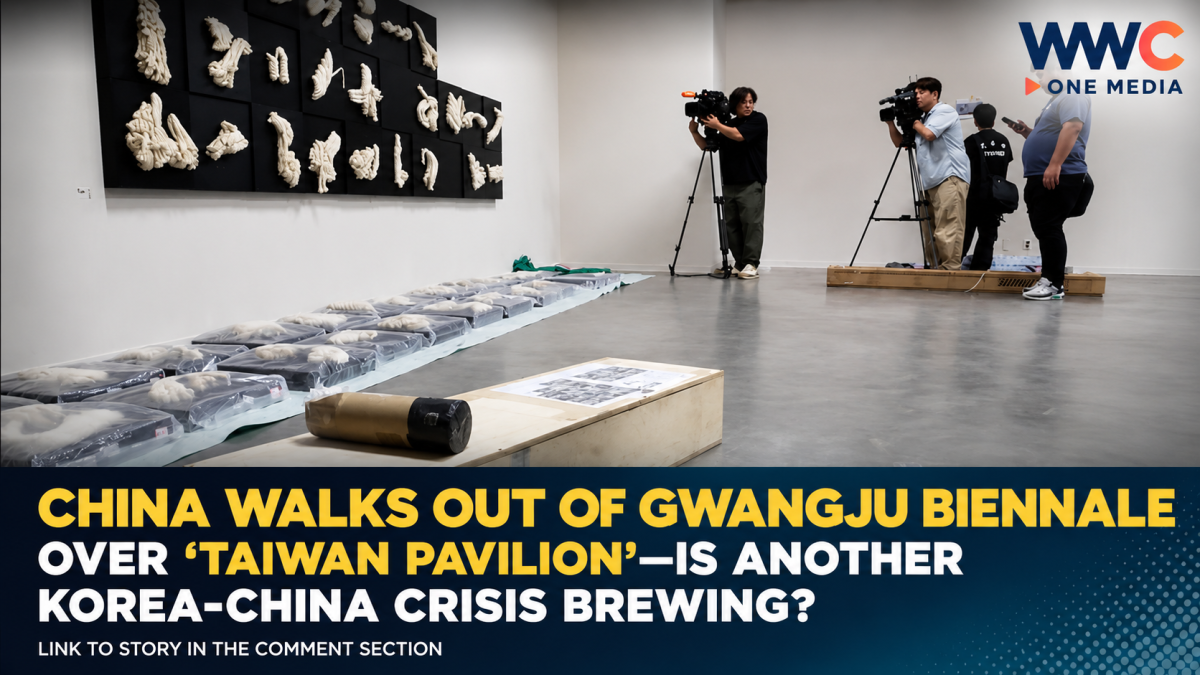
China has withdrawn from South Korea’s Gwangju Biennale over the use of the name “Taiwan Pavilion,” raising fresh concerns about tensions between Beijing and Seoul and comparisons with the 2017 THAAD dispute.
Gwangju, South Korea — Sept. 3, 2026 — What began as a dispute over the name of an art exhibition has suddenly turned into a sensitive diplomatic issue between China and South Korea, after Chinese participants withdrew from the 2026 Gwangju Biennale over the use of the name “Taiwan Pavilion.”
The withdrawal came just two days before the international art festival is scheduled to open, dramatically raising the stakes in a dispute that has already drawn in the Chinese Embassy, South Korean officials and the Gwangju city government.
The controversy has also prompted comparisons with the much larger THAAD dispute of 2017, when South Korea’s decision to deploy the U.S.-made Terminal High Altitude Area Defense missile system triggered severe tensions with Beijing and economic pressure on South Korean businesses.
But there is an important distinction: there is currently no evidence that Beijing has announced economic retaliation against South Korea over the Biennale dispute. The comparison is a warning about what could happen if the confrontation expands, not a claim that another THAAD-style retaliation campaign has already begun.
Why China is angry over two words: “Taiwan Pavilion”
At the center of the dispute is the National Taiwan Museum of Fine Arts, which is participating in the pavilion program of the 16th Gwangju Biennale.
According to reporting by The Korea Times and Yonhap, organizers initially approved the designation “Taiwan Pavilion.” The organizers later changed the name to “NTMoFA Pavilion,” referring to the National Taiwan Museum of Fine Arts.
Taiwanese officials and artists objected to the change, while artists and cultural organizations criticized what they viewed as political interference or censorship.
After mounting criticism, the Gwangju Biennale Foundation reversed course on Aug. 25, allowing the exhibition to use the name “Taiwan Pavilion.”
That reversal triggered the backlash from Beijing.
Chinese officials argued that using “Taiwan Pavilion” violated the One China principle and objected to what they regarded as the elevation of Taiwan’s status in an international cultural event.
Chinese participants subsequently stopped preparations for their own pavilion before announcing their withdrawal on Sept. 3.
China withdraws just before opening
Chinese curator Ruan Yuelai said the Chinese participants unanimously decided to withdraw as a protest.
According to Yonhap, the Chinese exhibition team argued that the naming decision brought political considerations into the artistic sphere.
The timing makes the development particularly damaging for the Biennale: the exhibition is scheduled to open on Sept. 5 and run through Nov. 15.
The 2026 Biennale includes artists and institutions from 27 countries, while its pavilion program includes 16 countries and 11 institutions, including the National Taiwan Museum of Fine Arts.
The pavilion project itself was launched in 2018.
Seoul moves quickly to distance the government from the dispute
South Korea’s Foreign Ministry sought to draw a clear line between the controversy and Seoul’s official Taiwan policy.
Foreign Ministry spokesperson Park Doo-soon said Thursday that South Korea’s basic position of respecting the One China policy has not changed.
The ministry said the decision concerning the pavilion was independently made in the private cultural and artistic sector and does not represent a change in the South Korean government’s position toward Taiwan.
Yonhap also reported that South Korea’s diplomatic position is rooted in the 1992 Korea-China normalization agreement, under which Seoul recognized the People’s Republic of China as the sole legitimate government of China and said it respected Beijing’s position that Taiwan is part of China.
That distinction could prove crucial if Beijing decides to push the issue beyond the cultural sphere.
Gwangju apologizes—but the controversy isn’t over
Gwangju authorities have attempted to contain the dispute.
The Gwangju Biennale Foundation issued an apology over the confusion surrounding the pavilion naming process, saying the organization regretted that disagreements among the parties had not been sufficiently resolved before the matter became a public controversy.
Gwangju’s city government has also reaffirmed its respect for the One China policy, while emphasizing that the pavilion’s naming was an artistic-sector decision rather than a declaration recognizing Taiwan as an independent state.
Yet the damage may already have been done.
China has now pulled its exhibition team from the event, transforming what was initially an administrative naming dispute into a highly visible confrontation involving China, Taiwan and South Korea.
Why everyone keeps mentioning THAAD
The most alarming comparison comes from the history of the 2017 THAAD dispute.
South Korea and the United States agreed to deploy THAAD as a defense against North Korean ballistic missile threats. Beijing strongly opposed the deployment, arguing that the system’s radar capabilities threatened China’s security interests.
The dispute eventually spilled into the economic and tourism sectors.
Chinese authorities restricted group tourism to South Korea, while South Korean businesses—including Lotte—became major targets of pressure. Korean entertainment and other commercial sectors were also affected.
The consequences were significant enough that the THAAD episode became one of the defining crises in modern South Korea-China relations.
That is why Chinese officials’ current objections are being watched so closely.
However, the present situation is nowhere near the scale of the THAAD confrontation yet. There has been no confirmed announcement of broad Chinese economic sanctions or tourism restrictions against South Korea related to the Biennale.
The immediate consequences remain concentrated around the exhibition itself.
Could the Taiwan Pavilion dispute become bigger?
That is now the key question.
The Korea Times reported that Chinese officials view the pavilion naming issue as crossing a sensitive political “red line” and warned that the dispute could potentially develop into a serious Korea-China diplomatic conflict similar to the fallout from THAAD.
The risk comes from the intersection of three highly sensitive issues:
- China’s One China policy
- Taiwan’s international participation
- South Korea-China diplomatic relations
Beijing has consistently opposed Taiwan being presented internationally in ways that it believes imply separate statehood.
The issue is not confined to Korea.
Just this week, China has also been protesting Taiwan’s participation in the Pacific Islands Forum in Palau, where Chinese officials warned of unspecified “consequences” over Taiwan’s involvement. Reuters and AP reported that the dispute has become one of the major geopolitical tensions surrounding the forum.
That broader backdrop makes the Gwangju controversy even more politically sensitive.
For now, the biggest question is what happens next
The Gwangju Biennale dispute remains primarily a cultural and diplomatic confrontation, rather than a full-scale Korea-China crisis.
South Korea has reaffirmed its One China position.
Gwangju has apologized.
The Biennale has maintained the “Taiwan Pavilion” designation.
And China has withdrawn its participating team.
But the real test may come after the exhibition opens.
If Beijing treats the dispute as an isolated cultural disagreement, the confrontation could remain contained.
If additional diplomatic or economic measures follow, however, the Gwangju Biennale could become an early warning sign of a much broader deterioration in Korea-China relations.
For now, the art exhibition has become the stage—but the real story is how far Beijing and Seoul are willing to let this dispute go.
And that is what makes the next move the one to watch.
WWC ONE MEDIA G.A




Leave a Reply