
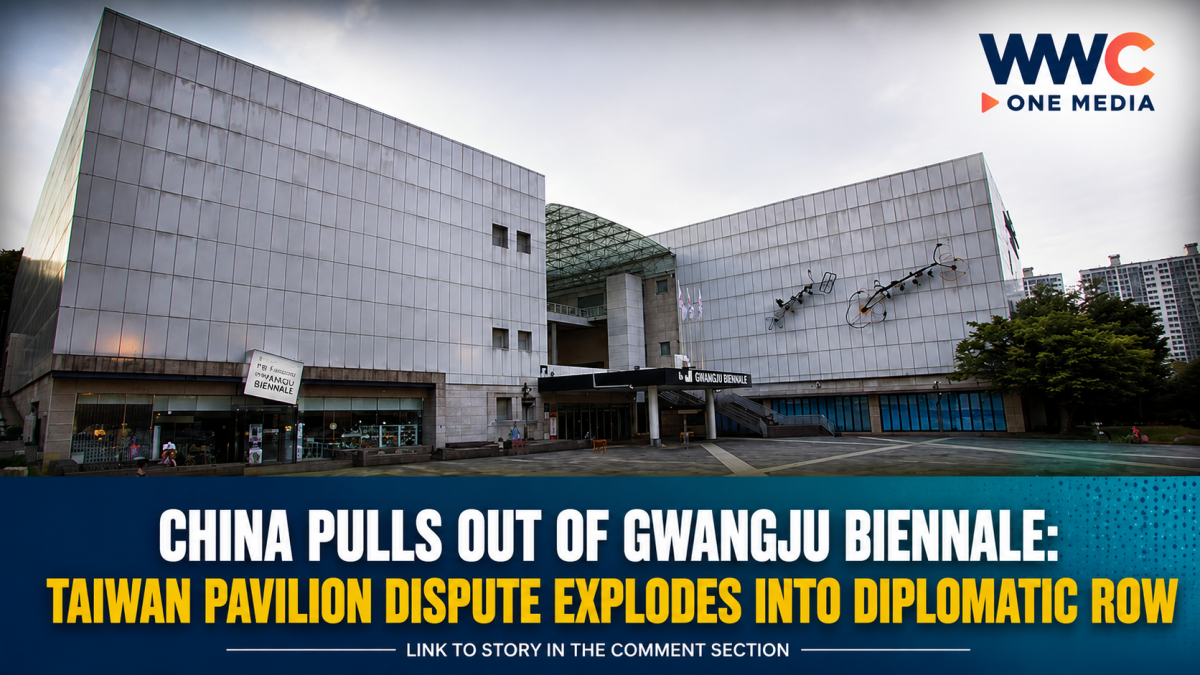
China is set to withdraw its participation from South Korea’s Gwangju Biennale after a dispute over the use of the name “Taiwan Pavilion” escalated into a political and diplomatic confrontation just days before the major international art event opens. Chinese participants announced their withdrawal on September 3, saying they could not accept what they described as political interference in the arts after the Gwangju Biennale Foundation approved the Taiwanese exhibition’s use of the name “Taiwan Pavilion.”
The controversy began over how the National Taiwan Museum of Fine Arts (NTMoFA) would be identified at the 16th Gwangju Biennale. Taiwanese organizers and participating artists said their exhibition had been planned under the name “Taiwan Pavilion,” but the Gwangju Biennale Foundation later changed the designation to “NTMoFA Pavilion,” effectively removing “Taiwan” from promotional materials. Ten Taiwanese artists and curators publicly protested the decision, accusing the organizers of political censorship and arguing that participants should be allowed to identify their exhibition as they had originally proposed.
The Gwangju Biennale Foundation gave a different explanation, saying the issue was an administrative matter rather than political censorship. The foundation said NTMoFA had been classified as an institutional participant and that the exhibition was therefore identified by the name of the participating museum. It maintained that it had not interfered with the artists’ works, curatorial decisions or freedom of expression.
After mounting criticism from Taiwanese officials, artists and international members of the art community, the foundation reversed course. On August 25, it approved the use of “Taiwan Pavilion,” allowing the Taiwanese presentation to proceed under that name. The decision triggered an immediate backlash from China. Chinese Ambassador to South Korea Dai Bing met Gwangju officials and expressed concern and regret over the restored designation, according to multiple reports.
China then halted preparations for its own pavilion. Chinese artists and installation staff left the venue, leaving the China Pavilion unfinished. Korean JoongAng Daily reported that the walkout followed China’s objections to the use of “Taiwan Pavilion,” while The Art Newspaper reported that China’s ambassador had told Gwangju’s mayor that China’s pavilion would be suspended.
The situation escalated further on September 3, when Chinese participants formally announced that they would withdraw from the biennale. South Korean news agency Newsis reported that Chinese artists and curators held a press conference in Gwangju and unanimously declared their decision to pull out, arguing that the naming controversy had allowed political considerations to enter the artistic sphere.
The timing makes the dispute particularly significant. The 16th Gwangju Biennale is scheduled to open on September 5 and run through November 15. This year’s event includes participants from 16 countries and 11 institutions in its pavilion program, while the broader biennale involves artists and cultural organizations from 27 countries, cities and institutions. The pavilion program has been part of the biennale since 2018.
Gwangju’s local government has attempted to contain the diplomatic fallout. It issued an apology over what it described as insufficient communication during preparations and reaffirmed South Korea’s adherence to the “One China” policy. At the same time, the city said the use of “Taiwan Pavilion” was an artistic designation and did not mean that Gwangju or the biennale was recognizing Taiwan as a sovereign state.
The dispute has placed the Gwangju Biennale in the middle of the longstanding political conflict between Beijing and Taipei. China claims Taiwan as part of its territory and strongly objects to international organizations treating the island as a separate country. Taiwan, meanwhile, maintains its own democratically elected government and has repeatedly resisted efforts to restrict how it identifies itself internationally.
The controversy also carries particular weight because of Gwangju’s history. The city is closely associated with South Korea’s democracy movement, and the biennale has long been connected to themes involving political freedom, human rights and social change. Taiwanese artists argued that the removal of “Taiwan” was therefore especially troubling at an event whose identity is closely linked to democratic values.
For the organizers, the challenge now goes beyond a simple naming dispute. They must balance their administrative rules, South Korea’s diplomatic relationship with China, Taiwan’s demands for recognition of its chosen exhibition name, and the Gwangju Biennale’s reputation as an international forum for artistic expression.
The immediate outcome is already clear: the Taiwan Pavilion is proceeding under the name approved by the organizers, while China’s pavilion has been abandoned by its participating artists and curators. What remains uncertain is how far the diplomatic consequences will extend beyond the exhibition itself.
An art festival that was supposed to showcase international creativity has instead become the latest stage for the China-Taiwan dispute.
And with the biennale opening on September 5, the biggest question now is whether China’s withdrawal will end the controversy — or turn the Gwangju Biennale into a much larger diplomatic flashpoint between Beijing and Seoul.
WWC ONE MEDIA G.A




Leave a Reply