
CHINA TURNS LITHIUM WASTE INTO A POTENTIAL NEW SOURCE OF CRITICAL METALS
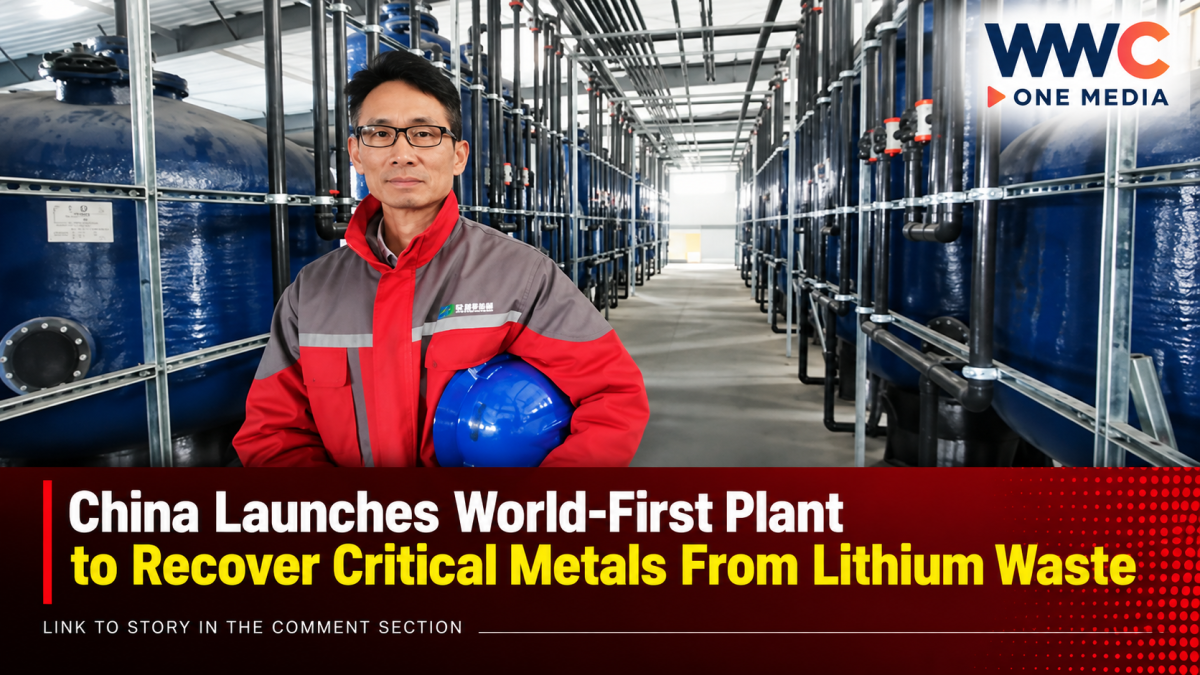
China has taken a potentially significant step in resource recycling with the launch of a 500-tonne-per-year production line designed to extract rubidium and caesium from lithium-processing waste.
The demonstration facility in Jiangxi province has reportedly achieved stable production using a continuous tower extraction and separation process. According to the Institute of Process Engineering under the Chinese Academy of Sciences, it is the world’s first production line of this type at the 500-tonne annual scale.
The development could give new value to material that would otherwise be treated as industrial waste—and potentially strengthen supplies of metals used in several advanced technologies.
WHY RUBIDIUM AND CAESIUM MATTER
Rubidium and caesium are not household names, but their chemical and physical properties make them useful in specialized industries.
Applications include aerospace, quantum computing, biomedicine and new-energy technologies, according to Chinese researchers cited in the latest report.
Caesium, for example, has specialized uses in precision timing and scientific instruments, while rubidium is important in areas including frequency standards and other advanced technologies.
That makes recovering these elements from existing industrial material potentially attractive as demand for specialized metals grows.
THE SURPRISE IS WHAT THE FACTORY IS USING AS ITS RAW MATERIAL
The technology’s significance lies in its starting point.
Rather than relying exclusively on conventional mining, the Jiangxi facility is designed to recover low-grade rubidium and caesium contained in lithium waste.
The process uses continuous extraction and separation technology to concentrate the metals from the waste stream. The newly launched line has an annual capacity of 500 tonnes, making it a demonstration-scale industrial operation rather than a full-scale national recycling system.
If the approach proves economically viable at larger scales, it could offer another pathway for recovering valuable resources from China’s rapidly expanding lithium and battery-related industrial ecosystem.
THIS IS ABOUT MORE THAN LITHIUM BATTERIES
The phrase “lithium waste” can be misleading if interpreted as simply discarded consumer batteries.
China has a huge industrial ecosystem surrounding lithium extraction, processing and battery manufacturing. Waste and residues generated during these processes can contain other economically valuable elements.
Recovering those materials could therefore complement existing efforts to recycle lithium-ion batteries and recover metals from industrial residues.
Research into lithium-battery recycling has increasingly focused on recovering valuable materials while reducing waste and the environmental burden associated with extracting fresh resources.
A POTENTIAL ADVANTAGE FOR CHINA’S CRITICAL-MINERAL STRATEGY
The development also arrives at a time when countries are increasingly concerned about secure supplies of critical minerals.
Materials needed for advanced electronics, clean-energy technologies, aerospace systems and other high-tech industries have become strategically important as governments seek to make supply chains more resilient.
China already occupies a major position in global mineral processing and refining, and technologies that recover additional resources from industrial waste could further strengthen its ability to extract value from existing supply chains.
But the new plant should not be interpreted as proof that China has solved the global critical-mineral supply problem.
It is still a demonstration line, and its long-term commercial impact will depend on factors such as operating costs, the concentration of recoverable metals in different waste streams, energy consumption and the ability to scale the technology.
WHY “URBAN MINING” AND WASTE RECOVERY ARE GAINING ATTENTION
The Jiangxi project fits into a broader global shift toward treating waste as a potential source of raw materials.
Instead of viewing discarded batteries, industrial residues and other waste streams solely as disposal problems, researchers are exploring whether valuable elements can be recovered and returned to manufacturing.
This approach can potentially reduce pressure on new mining projects while creating additional sources of strategically important materials.
However, recycling and recovery are not automatically environmentally harmless. Processing waste still requires energy, chemicals and infrastructure, meaning the environmental benefits depend on how efficiently the entire system operates.
THE BIG QUESTION: CAN CHINA SCALE IT?
The biggest story may not be the opening of the 500-tonne line itself.
It is whether the technology can move from demonstration scale to large-scale commercial production.
A successful scale-up could turn previously underused industrial residues into a secondary source of rubidium and caesium while reducing the amount of material sent for disposal.
For China, it could also demonstrate how advanced processing technology can extract more resources from the same industrial supply chain.
For the rest of the world, the development is another reminder that the competition for critical materials is no longer only about finding new mines.
It is increasingly about who can process, recycle and recover the most value from the resources already available.
FROM LITHIUM WASTE TO HIGH-TECH MATERIALS
China’s new Jiangxi facility does not mean every tonne of lithium waste can suddenly be transformed into valuable metals.
But it demonstrates something potentially important: industrial waste can contain resources worth recovering when the technology becomes sophisticated enough.
The 500-tonne production line is therefore both a recycling project and a test of China’s ability to push resource recovery toward industrial scale.
If the technology can be scaled economically, today’s waste stream could become tomorrow’s strategic resource—and that could have consequences far beyond China’s lithium industry.



Leave a Reply