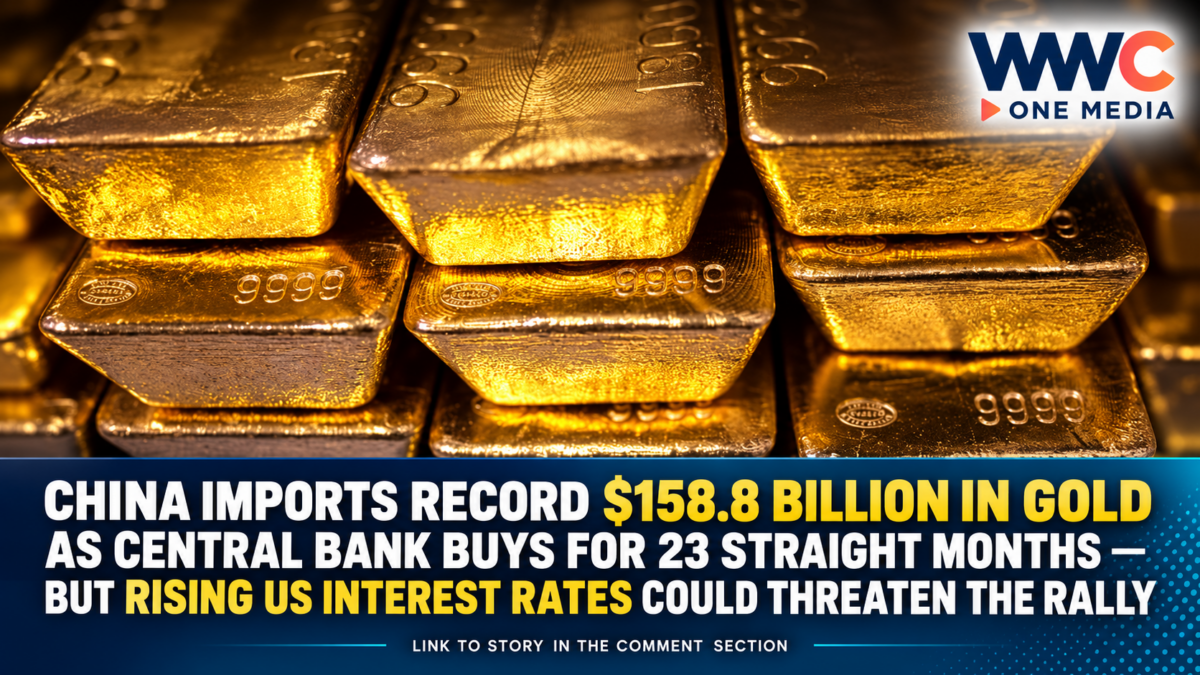
BEIJING, China — China is accumulating gold at an extraordinary pace, with its central bank extending a buying spree to 23 consecutive months and the country’s gold imports exceeding $158 billion in just eight months, underscoring a major shift in how the world’s second-largest economy is protecting its wealth.
The surge comes as Beijing seeks to diversify its international reserves, while Chinese households and businesses increasingly turn to precious metals amid persistent concerns over the domestic property market, uncertain investment returns and geopolitical risks.
According to CNBC’s October 12 report, China imported more than 1,000 metric tonnes of gold worth a record $158.8 billion between January and August 2026.
That exceeds the 886 tonnes imported during the entire previous year, when the country spent approximately $96.5 billion on the precious metal.
But the unprecedented buying campaign is unfolding against a challenging global backdrop.
Rising US Treasury yields, inflation concerns and uncertainty over the Federal Reserve’s interest rate policy are putting pressure on gold prices, raising an increasingly important question for investors: Can China’s enormous appetite for bullion continue supporting the market even as higher interest rates make gold less attractive?
China’s Central Bank Extends Gold-Buying Streak to 23 Months
The People’s Bank of China (PBOC) significantly increased its official gold holdings in September, continuing an accumulation campaign that has become a major feature of the global precious metals market.
According to figures released by China’s State Administration of Foreign Exchange, the central bank’s gold reserves increased to 77.47 million fine troy ounces at the end of September, compared with 76.73 million ounces in August.
The increase of approximately 740,000 ounces — equivalent to about 23 metric tonnes — marked the bank’s largest reported monthly purchase in almost three years.
September was also the 23rd consecutive month in which the PBOC increased its reported gold holdings.
The prolonged buying streak reflects Beijing’s efforts to strengthen its reserve diversification and reduce exposure to risks associated with reliance on a single currency or asset class.
Unlike foreign government bonds, physical gold is not another government’s financial liability, making it attractive to monetary authorities concerned about geopolitical tensions and international financial sanctions.
However, central bank purchases do not necessarily mean China is preparing to abandon the US dollar.
Reserve diversification can occur gradually, with gold complementing rather than entirely replacing traditional foreign-exchange assets.
China Spends $158.8 Billion on Gold Imports in Just Eight Months
China’s central bank is not the only force driving demand.
Customs data show that the country imported more than 1,000 tonnes of gold during the first eight months of 2026, with the value of those imports reaching $158.8 billion.
That represents a substantial increase from the $96.5 billion spent on 886 tonnes during all of 2025.
The figures underline the scale of demand from Chinese investors, businesses and the broader domestic gold market.
However, national gold import volumes should not be interpreted as central bank purchases alone.
Imports can serve jewelry manufacturers, commercial banks, individual investors, wholesalers and other participants in China’s bullion market.
Bloomberg reported in September that stronger investment demand, a firmer Chinese yuan and lower international bullion prices had helped encourage imports.
The publication also noted that gold prices in China’s domestic market had remained slightly above international benchmarks, creating incentives for additional shipments.
These developments suggest that China’s gold demand is being supported by more than government policy.
Why Chinese Households Are Turning to Gold
China’s long-running property market difficulties have made wealth preservation an increasingly important concern for many households.
Property has traditionally represented a significant portion of household wealth, but falling prices and uncertainty surrounding developers have weakened confidence in the sector.
At the same time, relatively low domestic government bond yields and uncertain stock market returns have encouraged some investors to consider alternatives.
Gold has emerged as one such option because it can be held physically, traded in established markets and used as a store of value.
Chinese investors are increasingly buying gold bars and coins rather than relying exclusively on jewelry purchases.
During an October industry conference, Shanghai Gold Exchange representative Zeng Hui highlighted how investment demand had altered China’s gold market.
In 2025, demand for gold bars and coins exceeded jewelry consumption in China for the first time.
This shift illustrates the growing role of bullion as an investment and wealth-preservation asset.
Nevertheless, gold is not risk-free.
Its price can fluctuate sharply, and physical ownership can involve premiums, storage expenses and differences between buying and selling prices.
Beijing’s Gold Strategy Reflects a Broader Shift Away From Dollar Dependence
China’s accumulation of bullion is also attracting attention because of changes in its holdings of US government debt.
CNBC reported that Chinese holdings of US Treasury securities declined to approximately $618 billion in July, their lowest level in about 18 years.
The decline reflects a broader evolution in how Beijing manages its international reserves.
For central banks, gold offers several advantages during periods of geopolitical uncertainty.
It is internationally recognized, highly liquid under normal market conditions and not directly dependent on the creditworthiness of a foreign government.
Gold also avoids certain counterparty risks associated with financial securities, although its storage, custody and transport present separate challenges.
The shift has implications beyond China.
If more central banks increase gold allocations while reducing reliance on government bonds, the resulting demand could provide longer-term support to the precious metals market.
However, changes in Treasury holdings may also reflect currency management, portfolio rebalancing and market conditions.
It would therefore be inaccurate to assume that every reduction in Chinese Treasury holdings represents a direct exchange of US bonds for gold.
Rising US Interest Rates Threaten the Gold Rally
Despite strong demand from China, gold remains vulnerable to changes in global interest rates.
Unlike government bonds and bank deposits, gold does not pay interest.
When US Treasury yields increase, investors can earn higher returns from interest-bearing securities, raising the opportunity cost of holding bullion.
A stronger US dollar can also make gold more expensive for investors using other currencies.
These pressures became evident in early October.
Reuters reported that spot gold fell to a two-month low of approximately $4,113.89 per ounce on October 7 as rising Treasury yields and a stronger dollar weighed on the market.
Gold had already declined more than 6% in September, despite continued purchases by China’s central bank.
This divergence highlights a fundamental tension in the precious metals market.
Structural demand from governments and long-term investors may support prices over time, while monetary policy and short-term financial conditions can still produce significant corrections.
Gold Holds Near $4,200 as Investors Await US Inflation Data
By October 12, gold had recovered modestly.
Reuters reported that spot bullion was trading around $4,198.19 per ounce during early Monday trading, supported by a softer US dollar and lower oil prices.
US gold futures for December delivery were around $4,221.80 per ounce.
Investors were also preparing for important US economic releases, including consumer inflation data scheduled for October 14.
The inflation figures could influence expectations for the Federal Reserve’s next interest rate decisions.
Higher-than-expected inflation could strengthen the case for restrictive monetary policy, potentially putting renewed pressure on gold.
Conversely, weaker inflation readings or signs of easing financial conditions could improve sentiment toward bullion.
The outlook remains particularly sensitive because geopolitical conflicts and energy price volatility have created uncertainty over inflation and global economic growth.
Global Central Banks Continue Supporting Gold Demand
China’s gold accumulation is part of a wider international trend.
At the London Bullion Market Association’s annual conference in October, central banking officials emphasized gold’s continuing importance as a reserve asset despite higher bond yields.
Reuters reported that officials from major European central banks identified geopolitical risks, global debt and financial uncertainty as factors supporting demand for the metal.
A World Gold Council survey published in June 2026 found that 45% of surveyed central banks expected to increase their gold reserves over the following year.
That was the highest proportion recorded since the survey began in 2018.
The result suggests that reserve managers continue to view gold as a strategic asset even when market conditions create short-term price pressure.
However, a survey of intentions should not be interpreted as a guarantee that all planned purchases will materialize.
Actual buying will depend on market prices, reserve policies and changing economic conditions.
Could Gold Climb Toward $5,500 in 2027?
Despite the recent correction in bullion prices, some investment strategists remain optimistic about gold’s medium-term prospects.
CNBC’s October report cited Aakash Doshi’s forecast that gold could reach between $4,750 and $5,500 per troy ounce by the end of the first quarter of 2027.
Such a move would represent a substantial recovery from October’s trading levels.
The bullish scenario depends on continued central bank accumulation, strong investment demand and the possibility that global financial conditions eventually become more favorable for non-yielding assets.
Gold could also benefit if geopolitical risks remain elevated or investors become more concerned about government debt and currency stability.
But the forecast is not a guaranteed outcome.
Sustained increases in US bond yields, prolonged dollar strength or weaker physical gold demand could prevent bullion from reaching those targets.
Analyst projections are estimates based on assumptions that can change rapidly.
Why China’s Gold Purchases Matter to Global Investors
China’s buying campaign is particularly important because of its scale and potential influence over the global bullion market.
Demand from one of the world’s largest economies can support international prices, especially when combined with purchases by other central banks.
The trend also highlights how gold’s role in investment portfolios may be evolving.
Traditionally, investors have viewed gold primarily as a hedge against inflation, currency weakness and financial instability.
Increasingly, central banks are also emphasizing its usefulness for diversification and reserve security.
However, gold’s performance is not determined by Chinese demand alone.
Global interest rates, inflation expectations, currency movements, exchange-traded fund flows and geopolitical developments will continue to shape prices.
This means the market can experience sharp declines even while long-term demand remains strong.
For individual investors, China’s buying spree provides useful information about global demand, but it is not a guarantee of positive investment returns.
The Bigger Question: Can China’s Gold Buying Overpower Higher US Yields?
China’s record gold imports and prolonged central bank purchases illustrate how economic uncertainty is changing investment behavior.
For Beijing, gold offers an additional layer of financial diversification.
For Chinese households, it represents an alternative to property and other traditional investments.
For international markets, the scale of Chinese demand provides a potentially important source of support.
But the competing forces are becoming increasingly difficult to ignore.
Rising US bond yields make interest-bearing assets more attractive, while inflation and geopolitical tensions continue to create volatility.
China’s gold-buying campaign may help establish a stronger long-term foundation for bullion demand, but it cannot eliminate the risks created by global monetary policy.
The next major test will come as investors assess new US inflation data and the Federal Reserve’s interest rate outlook.
If China continues accumulating gold while international financial conditions become less restrictive, the metal could regain upward momentum.
But if interest rates remain elevated and the dollar strengthens further, bullion may face renewed pressure despite Beijing’s purchases.
For the global gold market, the central question is no longer simply how much China is buying — but whether that demand will be powerful enough to withstand the next wave of US interest rate increases.