
CHINA’S AMBITIOUS MOON MISSION HITS PAUSE
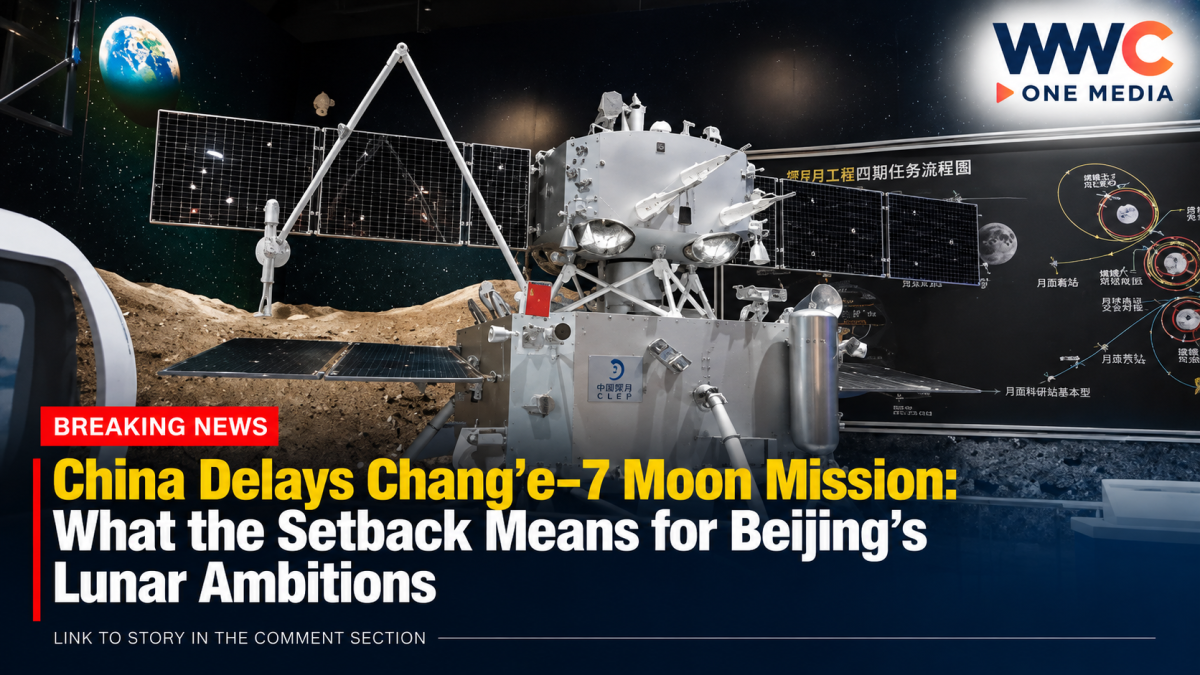
China has postponed the launch of Chang’e-7, one of its most ambitious robotic lunar missions yet, putting a temporary hold on a mission designed to investigate the Moon’s south pole and search for water ice.
The China Manned Space Agency announced in August that Chang’e-7 would not launch during its planned 2026 window, saying after a comprehensive assessment that the mission did not meet the necessary launch conditions. Officials did not provide a specific technical explanation or immediately announce a new launch date.
The postponement has attracted international attention because Chang’e-7 is not simply another lunar probe. It is an important step in China’s longer-term plan to develop technologies and knowledge needed for a sustained human presence on the Moon.
WHY CHANG’E-7 MATTERS
Chang’e-7 is designed to travel to the Moon’s south polar region, an area that has become one of the most strategically important targets in modern lunar exploration.
Scientists are particularly interested in permanently shadowed areas near the lunar poles, where extremely low temperatures may allow water ice and other volatile materials to survive for very long periods.
Chang’e-7 is expected to combine an orbiter, lander, rover and small hopping probe. Together, the spacecraft are intended to study the lunar environment, investigate resources and search for water ice in difficult polar terrain.
Finding and understanding lunar water could have major implications for future exploration because water can potentially support life-support systems and, after processing, provide hydrogen and oxygen for other uses.
That makes the mission scientifically important—and strategically significant.
THE DELAY DOES NOT MEAN CHINA HAS ABANDONED THE PROGRAM
The postponement should not be interpreted as China backing away from lunar exploration.
In fact, Chang’e-7 is part of a much larger sequence of missions. China successfully completed Chang’e-6 in 2024, becoming the first country to return samples from the Moon’s far side. Chang’e-7 is intended to build on that momentum by moving China’s exploration efforts toward the lunar south pole.
China has also identified the Moon as an important part of its longer-term space strategy, including plans for a crewed lunar landing by 2030.
Chang’e-7 and the planned Chang’e-8 mission are expected to help develop technologies and scientific knowledge that could support those ambitions.
WHAT CAUSED THE POSTPONEMENT?
This is where the story gets particularly interesting.
Chinese authorities have not publicly identified a single technical problem as the reason for the delay. The official explanation focused on launch conditions and the need to prioritize prudence, reliability and mission success.
Several independent reports have pointed to weather near the Wenchang Spacecraft Launch Site in Hainan as a likely contributing factor. Tropical weather, including the system known as Narra, developed around the period when Chang’e-7 was preparing for launch.
However, analysts have also noted that the lack of a detailed official explanation leaves open other possibilities, including additional technical or operational considerations.
That distinction matters: weather has been widely reported as a likely factor, but China has not officially said that weather alone caused the postponement.
WHY THE MOON’S SOUTH POLE IS SO IMPORTANT
The lunar south pole has become a focal point for international exploration because of its unusual lighting and extreme environments.
Some polar craters contain regions that receive little or no direct sunlight. These permanently shadowed areas can remain extraordinarily cold, potentially preserving water ice and other compounds.
At the same time, nearby elevated areas can receive sunlight for much longer periods, making the region particularly attractive for future exploration and possible infrastructure.
Chang’e-7 is therefore designed to do more than simply land and take photographs. Its instruments and robotic vehicles are intended to help scientists understand the resources and environment of one of the Moon’s least explored regions.
CHINA AND THE UNITED STATES ARE WATCHING THE SAME PART OF THE MOON
The postponement also comes as the United States and China pursue increasingly ambitious lunar programs.
NASA’s Artemis program is aimed at returning astronauts to the Moon and developing a longer-term human presence, while China is working toward its own crewed lunar landing target.
Other countries—including India, Japan, Russia and European partners—also have lunar exploration ambitions, making the south pole an increasingly important destination in international space exploration.
The Chang’e-7 delay could therefore affect the timing of China’s progress, but it does not automatically hand the United States or another country a decisive advantage.
A DELAY CAN ALSO BE A STRATEGIC CHOICE
For an extremely complex lunar mission, postponement can be preferable to accepting unnecessary risk.
Chang’e-7 involves multiple spacecraft elements and is expected to operate in a particularly challenging environment. A failure at the Moon could cost years of development and billions in resources while also delaying subsequent missions.
Scientific American reported that the mission is now expected to slip to at least 2027, while other reports have discussed possible future launch windows. But China has not publicly confirmed a specific new launch date, so 2027 should be treated as an expected timeframe rather than a fixed schedule.
WHAT THIS MEANS FOR CHINA’S SPACE PROGRAM
The immediate impact is straightforward: China’s south-pole exploration timeline has moved back.
But the larger picture is more complicated.
China’s recent achievements—including the Chang’e-6 far-side sample return—show that the country continues to develop increasingly sophisticated lunar capabilities. Chang’e-7 represents the next major technological step, particularly in operating robotic systems around the Moon’s difficult polar terrain.
A delay could therefore mean more preparation time rather than a fundamental change in direction.
For Beijing, the priority now is likely to make sure Chang’e-7 works when it finally leaves Earth.
THE BIGGER QUESTION IS WHAT COMES AFTER CHANG’E-7
The postponed launch is unlikely to end China’s lunar ambitions.
If Chang’e-7 successfully surveys the south pole and provides new information about water ice, the findings could feed directly into later missions, including Chang’e-8 and China’s broader plans for human lunar exploration.
The delay may slow the timetable—but it does not erase the destination.
China still wants the Moon’s south pole. The question now is not whether Beijing is giving up on the lunar race, but how much the Chang’e-7 delay will reshape the timetable for what comes next.
And with water ice, future lunar bases and human missions all tied to the same region, the next launch attempt could be far more important than the delay itself.



Leave a Reply