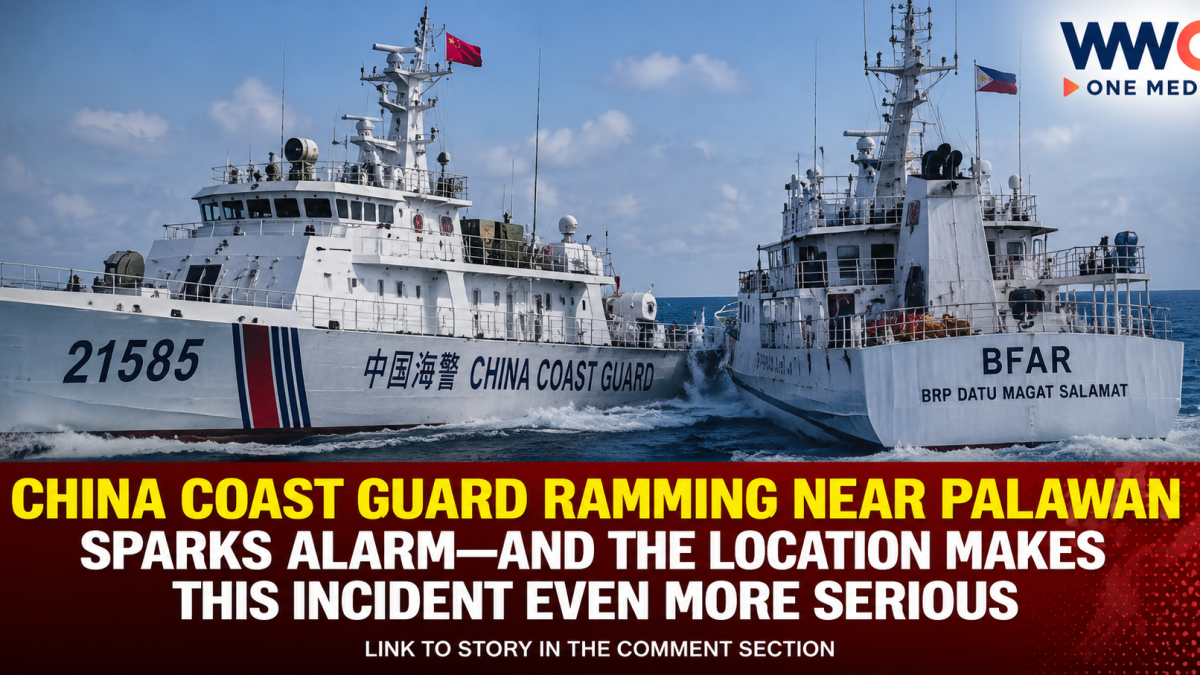
MANILA, Philippines — A confrontation in the West Philippine Sea has drawn fresh attention after a China Coast Guard vessel struck a Philippine fisheries vessel just about 54 nautical miles off Palawan, in what Philippine officials described as one of the closest such incidents to the Philippine coastline.
The Philippine Coast Guard said China Coast Guard vessel CCG-21585 made contact with the BRP Datu Magat Salamat, a Bureau of Fisheries and Aquatic Resources vessel conducting a mission to deliver fuel assistance to Filipino fishermen.
According to the PCG, the incident happened at around 11:13 a.m. on September 18, after the Chinese vessel had made a dangerous maneuver behind the BFAR ship.
The PCG said CCG-21585 first crossed behind the BRP Datu Magat Salamat at a distance of roughly 10 meters at about 11:04 a.m. Nine minutes later, the Chinese vessel allegedly repeated the maneuver and struck the Philippine vessel while it was maintaining its course.
The impact damaged portions of the BFAR vessel’s starboard side, including railings, metal stanchions, support structures and deck fixtures. No injuries among the Filipino crew were reported.
The PCG also said the Chinese vessel passed behind the BFAR ship again after the incident, this time at a distance of only about five meters.
The location raises the stakes
The encounter occurred approximately 6.36 nautical miles north-northwest of Abad Santos Shoal and about 54 nautical miles from Palawan’s coast, according to Philippine authorities.
The PCG placed the incident within the Philippines’ exclusive economic zone (EEZ) and said the BFAR vessel was performing a civilian mission connected to assisting Filipino fisherfolk.
The mission was part of government efforts to provide fuel assistance and other support to Filipino fishermen operating in the West Philippine Sea.
The National Task Force for the West Philippine Sea condemned the incident, saying Philippine government missions intended to support Filipino fisherfolk should continue without intimidation or coercion.
China disputes Manila’s account
Beijing has rejected the Philippine characterization of the incident.
China Coast Guard spokesperson Jiang Lue said the Philippine vessel ignored repeated warnings and suddenly changed course, allegedly cutting across the path of the Chinese coast guard ship.
China therefore placed responsibility for the incident on the Philippine side and called on Manila to stop what Beijing described as infringement and provocation.
The conflicting accounts mean the circumstances surrounding the exact moment of contact remain disputed between Manila and Beijing.
DFA calls for restraint
The Philippine Department of Foreign Affairs condemned what it described as aggressive and dangerous conduct by the Chinese vessel.
The DFA said the Philippine ship was carrying out a routine humanitarian mission to support Filipino fishermen and argued that there was no justification for actions that damaged the civilian government vessel and endangered its crew.
The department also called on China to exercise restraint and avoid actions that could further escalate tensions in the region.
Philippine officials cited international maritime rules, including the United Nations Convention on the Law of the Sea (UNCLOS), the 2016 South China Sea arbitral award, the International Regulations for Preventing Collisions at Sea (COLREGs), and the Safety of Life at Sea Convention (SOLAS).
Incident came just one day after BFAR vessel ran aground
The latest confrontation came only a day after the BRP Datu Magat Salamat ran aground in the shallow waters of Hasa-Hasa Shoal while conducting its fisherfolk assistance mission.
The vessel was subsequently refloated with assistance from the Philippine Coast Guard.
The PCG said it had also monitored a Chinese aircraft conducting apparent surveillance over the area while the BFAR vessel was being refloated.
The sequence of events has added another layer to an already tense operating environment for Philippine civilian and law-enforcement vessels in the West Philippine Sea.
Why this incident matters
The encounter is significant not only because of the damage to the BFAR vessel but also because of its proximity to Palawan and the nature of the Philippine mission.
Unlike a military resupply operation, the BRP Datu Magat Salamat was carrying out a fisheries-related mission intended to assist Filipino fishermen.
The incident also comes amid continuing confrontations between Philippine and Chinese vessels in disputed areas of the South China Sea.
Escoda Shoal, also known as Sabina Shoal, has previously become a major flashpoint. Philippine officials have repeatedly accused Chinese vessels of blocking, shadowing and maneuvering dangerously around Philippine ships operating in the area.
China, meanwhile, continues to assert extensive claims in the South China Sea and maintains that Philippine vessels have violated Chinese jurisdiction.
The 2016 arbitral tribunal ruling rejected the legal basis of China’s expansive “nine-dash line” claims, although Beijing has rejected the ruling.
What happens next?
The Philippine Coast Guard has directed surface and air assets to assist the BFAR vessel and ensure the safety of its crew.
The BRP Datu Magat Salamat is expected to undergo assessment to determine its seaworthiness following the damage.
The Department of Foreign Affairs will determine the appropriate diplomatic response, while Philippine authorities have indicated that government missions supporting Filipino fishermen in the country’s EEZ will continue.
For now, the most important question is no longer simply how the two vessels came into contact.
It is how Manila and Beijing respond to an encounter that occurred unusually close to the Philippine coastline—and whether another confrontation at sea can be prevented from becoming a larger regional crisis.