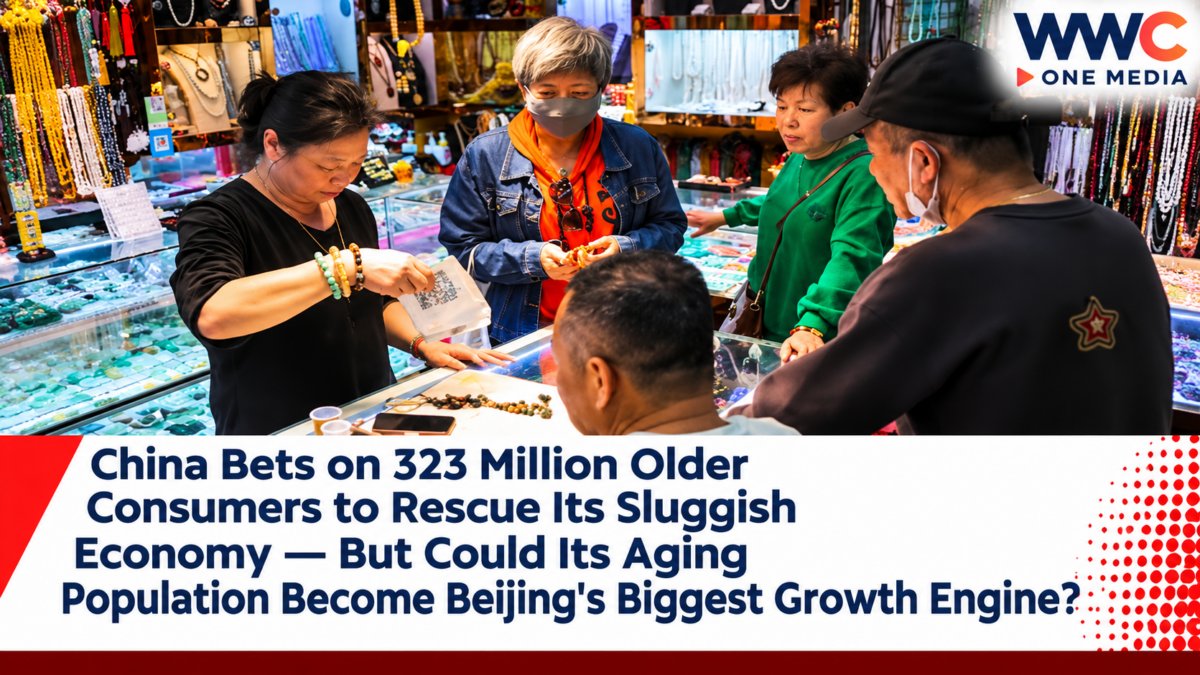
BEIJING, CHINA / MANILA, PHILIPPINES — November 11, 2026 — China’s government is turning to an unexpected source of economic growth as its property market struggles, consumer confidence remains weak and manufacturers depend heavily on overseas buyers: the country’s rapidly growing population of older consumers.
With approximately 323.4 million residents aged 60 and above, Beijing is betting that retirees and other older adults can help revive domestic spending through tourism, healthcare, fitness, entertainment and specialized services.
The strategy is part of China’s expanding silver economy, a market encompassing products, services and infrastructure designed for an aging society.
The potential is enormous.
Chinese authorities and industry researchers have cited projections that the silver economy could grow to 30 trillion yuan, or approximately US$4.5 trillion, by 2035.
But the country’s aging population presents a serious contradiction.
While financially secure retirees are increasingly spending on travel, exercise and leisure, millions of older Chinese still live on modest pensions and remain concerned about healthcare expenses.
The government is therefore facing a complex challenge.
Can China transform population aging into a powerful new engine of domestic consumption—or will retirement insecurity prevent hundreds of millions of older residents from spending enough to revive the economy?
China Turns to Retirees as Consumer Spending Remains Weak
China has spent decades building one of the world’s largest manufacturing and export industries.
Its factories dominate sectors ranging from consumer electronics and machinery to electric vehicles, batteries and solar equipment.
But its domestic economy remains unbalanced.
Manufacturing and exports have generally performed more strongly than household consumption, while the prolonged property downturn has weakened household wealth and confidence.
This has encouraged Beijing to search for new sources of economic demand.
Older consumers are now receiving increased attention.
Many recently retired Chinese benefited from decades of economic expansion and improvements in living standards.
Some accumulated substantial savings, property wealth and reliable pension income.
Unlike working-age households managing child-rearing costs, these consumers may have more time available for travel, recreational activities and personal interests.
The government hopes businesses can capitalize on those changing priorities.
However, the spending potential varies greatly by income, location and pension coverage.
As WWC ONE MEDIA previously reported in its examination of China’s growing manufacturing output and weak household spending, Beijing’s challenge is to translate economic production into stronger domestic demand.
Expanding the silver economy is one possible part of that solution.
China’s Elderly Population Reaches 323.4 Million
Official figures show that China’s population aged 60 and above reached approximately 323.4 million at the end of 2025.
That represented roughly 23% of the country’s population.
More than 223 million residents were aged 65 or older.
The demographic transformation is accelerating.
China’s population has been declining, while the number of working-age people supporting retirees is coming under pressure.
Recent government statistics showed that the ratio of elderly dependents to working-age people had overtaken the equivalent measure for children.
The aging trend creates major challenges for pension financing, healthcare provision and economic productivity.
But it also creates new demand.
Older consumers need suitable housing, accessible transportation, medical services, insurance and everyday products adapted to their circumstances.
Many also want activities that provide enjoyment rather than merely support basic survival.
The silver economy attempts to address these needs while generating business opportunities.
Importantly, the 323.4-million figure represents all residents aged 60 and above, not 323.4 million wealthy retirees.
China’s Silver Economy Could Reach $4.5 Trillion
The government is seeking to make the silver economy an important contributor to growth over the coming decade.
Long-term projections suggest the market could reach approximately 30 trillion yuan by 2035.
The figure covers a broad range of activities, potentially including eldercare, health products, insurance, tourism, technology and services.
It should not be interpreted as the amount Chinese retirees currently spend each year.
Nor does the projection guarantee that the sector will reach that size.
The outcome will depend on household income, government support, healthcare costs, business investment and the willingness of older consumers to spend.
In January 2026, China’s Ministry of Civil Affairs announced measures to develop elderly-care businesses and expand age-friendly goods and services.
The program encourages stronger cooperation involving commerce authorities, industrial policymakers and service providers.
The government’s broader 2026–2030 economic planning also identifies population aging as an important structural challenge.
Beijing is increasingly treating the elderly not simply as recipients of social support but also as consumers with changing needs.
Wealthier Retirees Are Spending More on Fitness and Recreation
Recent research from Citi suggests that some Chinese retirees are changing how they use their money.
Rather than directing most discretionary spending toward their children and grandchildren, financially secure seniors are increasingly prioritizing their own well-being.
Activities such as hiking, dancing, fitness classes and outdoor recreation are attracting greater interest.
Citing Accenture consumer research, Citi reported that 39% of surveyed Chinese consumers aged 55 to 65 planned to increase spending on fitness and sports.
That compares with 27% in 2021.
Meanwhile, the proportion planning to increase spending on their children’s education declined from 37% in 2021 to 15% in 2025.
These findings suggest that some older households are shifting toward more experience-driven consumption.
China’s State General Administration of Sport also reported that regular sports participation among people aged 60 and above reached 33.9% in 2025, compared with 14.9% in 2015.
The trend could benefit sportswear companies, fitness facilities, outdoor recreation providers and specialized travel businesses.
But the survey figures should not be generalized to every elderly Chinese household.
Older consumers with limited income may have very different spending priorities.
Tourism Operators See an Opportunity in the Retirement Boom
Travel has become one of the most visible components of China’s silver economy.
Retirees often have greater flexibility to travel outside traditional holiday periods.
That can be attractive to tourism operators seeking customers during quieter seasons.
Chinese authorities have been encouraging destinations and transport operators to develop services tailored to older travelers.
These include age-friendly itineraries, accessible accommodation, long-stay tourism and specialized transport.
The government has also backed plans to expand silver tourist trains equipped with services appropriate for older passengers.
A national network of these trains is being developed with a target of expansion by 2027.
Some regions are offering incentives to attract retirees seeking longer stays, healthcare services and recreational activities.
The opportunity could be significant for hotels, restaurants, rail operators and tourist destinations.
However, older travelers may also face restrictions that limit participation.
The South China Morning Post reported in September that some healthy elderly consumers were being excluded from recreational facilities because of blanket age-based policies.
Such restrictions can prevent businesses from benefiting fully from a growing consumer market.
China’s Tourism Boom Still Faces a Spending Problem
The focus on older travelers comes as China’s broader services economy experiences uneven growth.
Tourism and passenger movement can increase without producing equally strong growth in business revenue.
Consumers may take more trips while choosing cheaper accommodation, discounted transportation and lower-cost attractions.
As WWC ONE MEDIA reported on China’s services PMI falling to 50.8 in October despite the Golden Week holiday, the services industry has struggled to translate travel activity into sustained economic momentum.
A PMI reading above 50 indicates expansion, but the decline from September signaled slower growth.
The challenge for businesses serving older consumers is therefore not simply attracting more visitors.
They also need to offer affordable services that customers consider worth purchasing.
Healthcare and Preventive Wellness Become Major Growth Markets
Healthcare is another important component of the silver economy.
As people live longer, demand can increase for medical consultations, rehabilitation, preventive care, nutrition support and services that help older adults remain independent.
Citi research highlighted growing spending on health-related products among some older Chinese consumers.
Industry estimates suggest China’s market for vitamins, minerals and health supplements reached approximately 236.1 billion yuan in 2026.
The market has expanded as consumers increasingly emphasize preventive wellness and healthy aging.
However, spending on a health product is not evidence that it is medically effective.
Consumers may face misleading claims or inappropriate marketing, particularly when products are promoted as solutions to age-related illnesses.
Regulators and healthcare professionals therefore have an important role in ensuring product safety and accurate information.
For businesses, the potential demand is substantial.
For households, affordability and genuine health benefits must remain priorities.
Insurance Companies Could Become Major Beneficiaries
China’s aging population is also transforming the insurance industry.
As family sizes shrink, more households may need financial arrangements that support long-term care.
Citi analysts have estimated that senior-care services could help generate up to 3.6 trillion yuan in associated insurance premiums by 2030.
That is a forecast, not an amount already collected.
Insurance providers are exploring combinations of financial protection, medical support and access to elderly-care services.
Some companies are developing care networks or investing in facilities that support older policyholders.
But the affordability of insurance remains a major issue.
Higher premiums can be difficult for retirees with limited incomes.
Coverage conditions, exclusions and claims processes also influence whether policies provide meaningful protection.
The silver economy’s success will depend partly on whether financial products can serve middle- and lower-income households, not only wealthy retirees.
China’s Pension Gap Could Undermine the Entire Strategy
Despite the industry’s potential, retirement income remains one of the biggest obstacles.
China’s pension system includes different arrangements for urban employees and other residents.
Benefits can vary substantially.
Some former public-sector employees and urban workers receive relatively generous pensions.
Others, particularly rural residents and people with limited formal employment histories, may depend on considerably smaller payments.
This creates a major divide in spending power.
A wealthy retiree may be able to purchase fitness memberships, private healthcare and international vacations.
A low-income pensioner may need to reserve most available money for food, medication and basic household expenses.
In February 2026, an International Monetary Fund working paper examined how China’s aging population could place growing pressure on pension finances and economic growth.
The research found that population aging presents substantial long-term fiscal challenges and highlighted the importance of pension reform.
For Beijing, that means developing the silver economy cannot be separated from improving retirement security.
Without sufficient income, a large population does not automatically become a strong consumer market.
Better Social Protection Could Encourage More Spending
China’s unusually high precautionary savings have long been an important economic issue.
Households may save heavily because they are concerned about future medical bills, education expenses and retirement needs.
Those concerns can reduce consumer spending even when families have money available.
Reuters reported in January that Beijing was placing greater emphasis on services such as elderly care, healthcare, tourism and recreation as it sought to strengthen domestic demand.
But economists warned that expanding the supply of services alone would not be enough.
Improving household income and strengthening the social safety net would also be important.
This creates a policy dilemma.
The government wants older people to spend more money.
But many retirees may continue saving unless they feel confident about their future medical and living expenses.
China has been expanding policies around long-term care insurance and services for people with disabilities.
Such measures could help reduce uncertainty, although their effectiveness will depend on funding, eligibility and implementation.
Businesses Are Racing to Capture the Silver Economy
China’s demographic transition is creating opportunities for companies across multiple sectors.
Tourism operators are developing age-friendly travel packages.
Sportswear companies are targeting older fitness enthusiasts.
Technology manufacturers are producing assistive devices and home-monitoring systems.
Healthcare companies are expanding rehabilitation and preventive services.
Insurance firms are developing products tailored to retirement needs.
Businesses are also experimenting with digital services designed to make everyday activities easier for seniors.
But the market carries risks.
The Associated Press previously reported that some businesses entering China’s eldercare industry struggled to generate sustainable profits despite strong demand.
Operating care facilities requires staff, specialized equipment, premises and regulatory compliance.
Customers may be unable or unwilling to pay prices high enough to cover those costs.
A growing elderly population therefore creates market potential, not automatic business success.
Companies will need to balance affordability, service quality and financial viability.
Beijing’s $1-Trillion Sports Ambition Fits the Retirement Strategy
The silver economy is closely connected to China’s broader effort to develop consumer-oriented services.
Beijing has outlined plans to expand the national sports industry to more than 7 trillion yuan by 2030.
That is roughly equivalent to US$1 trillion.
The strategy includes fitness, sporting events, outdoor activities and sports-related tourism.
Older adults are one potential source of additional demand.
As WWC ONE MEDIA reported on China’s plan to build a trillion-dollar sports industry, policymakers hope to generate employment and consumer activity through recreation and other services.
However, the sports-industry target covers consumers of all ages.
It is not a projection of retiree spending alone.
The distinction matters because the broader policy aims to encourage service-sector growth throughout the economy.
Older consumers are one important part of that strategy rather than its only intended beneficiaries.
China’s Massive Export Success Reveals Why Domestic Demand Matters
The silver-economy push comes as China continues relying heavily on overseas markets.
Reuters reported on November 10 that China’s trade surplus exceeded US$1 trillion during the first ten months of 2026.
The result reflected strong export performance, including demand for technology products associated with artificial intelligence infrastructure.
Yet domestic consumer activity has remained comparatively weak.
That imbalance creates economic and political risks.
An export-driven economy can be vulnerable to slower global demand, trade restrictions and rising tensions with trading partners.
As WWC ONE MEDIA examined in its analysis of China’s export-led growth and the challenges facing household spending, strong factories do not necessarily guarantee strong domestic economic demand.
Expanding consumption by older residents could help diversify China’s growth.
But the spending increase would need to be broad and sustainable to offset weakness elsewhere.
Why China’s Aging Economy Matters to the Philippines
China’s demographic transformation could also influence businesses elsewhere in Asia.
As Chinese retirees increasingly seek travel, recreation and healthcare services, neighboring tourism markets may see new opportunities.
The Philippines could potentially benefit from demand for destinations offering beaches, cultural attractions and leisure activities.
In related reporting, WWC ONE MEDIA examined the recovery in Chinese tourist arrivals to the Philippines, which reached 310,088 during the first eight months of 2026.
That represented a substantial increase from the corresponding period in 2025, although arrivals remained below pre-pandemic levels.
The report did not establish how many of those visitors were Chinese retirees.
Nevertheless, an expanding market for senior travel could create opportunities for accessible accommodations, wellness tourism and longer-stay packages.
Philippine operators would need to assess demand, transport connections, healthcare accessibility and other practical requirements.
China’s silver economy may also create opportunities for businesses supplying wellness products or age-friendly services.
But those opportunities should not be confused with guaranteed investment or tourism growth.
The Biggest Question: Can All Retirees Participate?
Perhaps the most important challenge facing China’s silver economy is inequality.
China’s older population is not a single group with identical finances, preferences or health conditions.
Some retirees have stable pensions, accumulated wealth and active lifestyles.
Others have limited savings, serious health needs or little access to specialized services.
People in rural areas may face different challenges from those living in wealthy cities.
Age-related discrimination can create additional obstacles, even for healthy individuals willing to pay for services.
The government’s long-term strategy will therefore require more than encouraging companies to develop premium products for affluent seniors.
It will also need to support accessible healthcare, affordable care services and meaningful consumer choices.
For businesses, the greatest opportunity may come from meeting the needs of a broad aging population rather than focusing exclusively on luxury retirement spending.
What Happens Next for China’s Silver Economy?
The coming years will test whether Beijing can convert demographic change into sustainable growth.
Several developments will matter.
First, pension reforms and social security policies will influence how much money retirees feel comfortable spending.
Second, tourism and leisure businesses will need to develop services that are accessible and fairly priced.
Third, healthcare and eldercare providers must manage staffing requirements and operating costs.
Fourth, technology companies will need to create products that older consumers can use confidently and safely.
Fifth, policymakers must address age discrimination and barriers to participating in recreational activities.
Finally, the overall economy must generate enough household income to support stronger consumption across generations.
The silver economy could become an important source of business activity.
But its success cannot be judged simply by the number of older people or the size of long-term market projections.
It must also be measured by improved living standards and the actual affordability of services.
The Bigger Picture: China’s Aging Population Is Both an Opportunity and an Economic Warning
China is confronting one of the largest demographic transitions in modern economic history.
More than 323 million residents are already aged 60 or older.
The population is aging rapidly while the workforce faces long-term demographic pressure.
At the same time, weak consumer spending and a prolonged property downturn are undermining economic confidence.
Beijing hopes the growing demand for travel, fitness, healthcare, insurance and elderly services can create a new source of growth.
For businesses, the market could be worth trillions of dollars in the coming decade.
For financially secure retirees, the expansion may bring more choices and better services.
But the strategy also exposes a fundamental problem.
Millions of older Chinese may not have enough retirement income to spend freely.
And without stronger financial security, the government’s effort to transform aging into an economic advantage could fall short.
China is counting on more than 323 million older residents to help revive the world’s second-largest economy. But as Beijing courts retirees with travel, fitness, technology and healthcare services, will its silver economy become a powerful new growth engine—or will pension inequality and financial insecurity reveal that China’s biggest consumer opportunity is still out of reach for millions?