
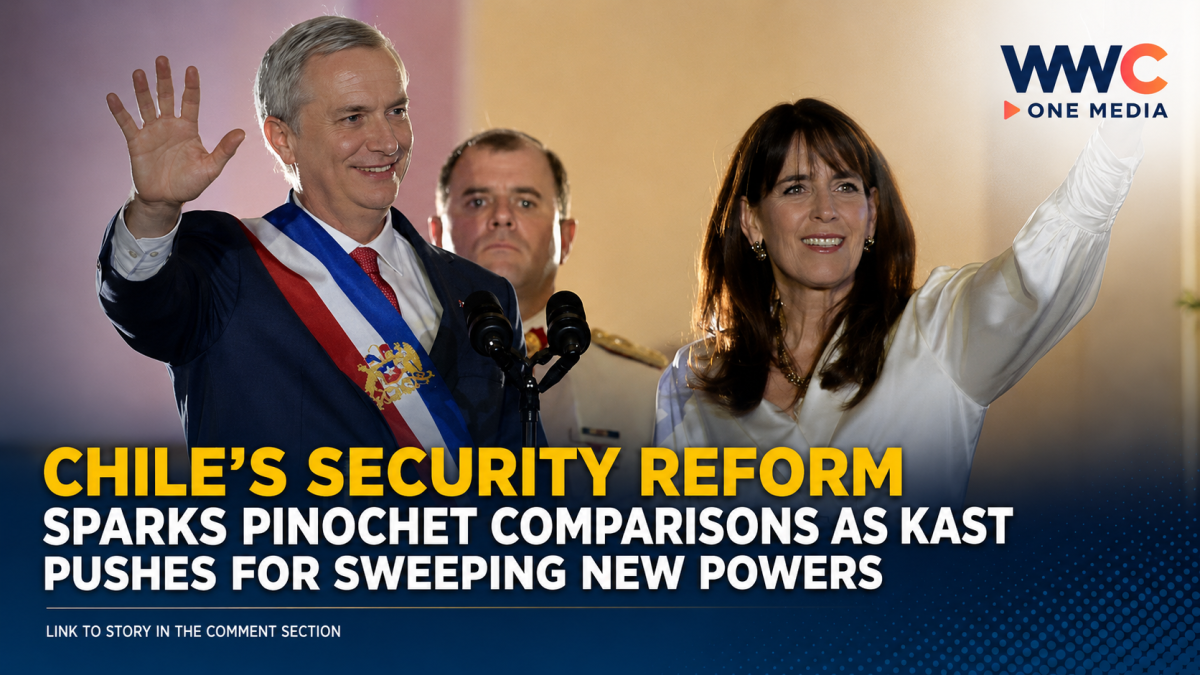
SANTIAGO, Chile — A new security push by Chilean President José Antonio Kast has triggered street protests, clashes with police and renewed debate over one of the country’s most sensitive political memories: the authoritarian rule of Augusto Pinochet.
Hundreds of demonstrators gathered in central Santiago on Thursday, September 3, protesting Kast’s proposed security reforms. Police used tear gas and water cannon to disperse protesters as demonstrators moved through Plaza Italia and chanted comparisons between Kast and Pinochet, according to AFP reporting carried by multiple outlets.
The demonstrations come as Kast, who took office in March 2026, makes public security a central priority of his administration. His government says stronger powers are necessary to confront organized crime, terrorism, illegal immigration and a rise in serious violent crime.
But critics say some of the proposed constitutional changes could give the presidency unusually broad emergency powers and weaken safeguards designed to prevent abuses of state power.
The proposal at the center of the controversy
Kast’s administration submitted an ambitious constitutional security package to Chile’s Senate in August as part of its Agenda Against Organized Crime and Terrorism, known as ACOT.
The package contains eight constitutional amendments. Among the most controversial is a proposal to create a new constitutional state of exception for serious threats to public security.
Under the proposal, the president could declare the emergency measure without obtaining prior congressional authorization. The measure could initially last 120 days and be extended for another 120 days, potentially bringing the total period to 240 days, or roughly eight months.
The proposed powers could include restrictions on freedom of movement and assembly and, under specified circumstances, the interception or examination of communications and other measures affecting property and individual rights.
The proposal has therefore become a major test of how far Chile is willing to expand executive authority in the name of public security.
Why Pinochet’s name is back in the debate
For Chileans, comparisons with Pinochet carry extraordinary historical weight.
Pinochet ruled Chile from 1973 until 1990 after a military coup that overthrew President Salvador Allende. His dictatorship was marked by widespread political repression and serious human-rights abuses.
Kast is a democratically elected president, and the current proposal is being debated through Chile’s constitutional and legislative institutions. That distinction is important.
Nevertheless, opponents argue that granting a president extensive powers to restrict civil liberties without prior congressional approval creates risks that are particularly sensitive in a country with Chile’s history.
Human Rights Watch has urged Chilean lawmakers to reject the proposed constitutional changes, arguing that the measures could undermine human-rights protections and due process.
The government says security is the priority
Kast’s government argues that Chile’s security environment requires stronger tools.
The president’s ACOT agenda includes measures targeting organized crime and terrorism, tougher penalties, changes involving the police and proposals intended to strengthen investigations and the state’s ability to respond to criminal organizations. Chile’s Senate confirms that the constitutional reform seeks to explicitly establish public security as a responsibility of the state.
The security debate is also unfolding against a backdrop of organized criminal activity and concerns about transnational gangs.
Chile remains comparatively safe by Latin American standards, but serious violent crime has become a much larger political issue. AFP reported that Chile’s homicide rate reached 5.4 per 100,000 inhabitants in 2025—about twice the level recorded a decade earlier.
Recent reporting has also highlighted the country’s struggle with organized criminal networks and the spread of groups such as Venezuela’s Tren de Aragua.
The pressure is not limited to street crime. Reuters recently reported that increasingly organized criminal groups have been targeting copper shipments in Chile’s Atacama Desert, underscoring the broader security challenges facing the country.
But the reform has already hit political resistance
The proposed emergency powers have encountered resistance not only from opposition parties but also from politicians within Kast’s broader political camp.
On September 1, the government backed away from giving the constitutional reform its most urgent legislative timetable after it became clear that it lacked the 29 Senate votes needed to advance the measure.
The proposal now has a less urgent timetable, giving lawmakers more time to debate it. Government officials have also signaled openness to modifying the controversial emergency provisions.
That development is significant.
It means the eight-month emergency power is a proposal—not a power currently possessed by the president under the new reform.
The Senate’s own legislative records identify the measure as a constitutional reform intended to strengthen Chile’s national public-security system and create a new state of exception for public security.
A wider security crackdown continues
Even as the constitutional proposal faces political obstacles, Kast’s government is continuing with other elements of its security agenda.
According to El País, the administration is pressing ahead with numerous other ACOT measures, including proposals involving the modernization of the Carabineros police force, stronger penalties for serious offenses, critical infrastructure protection, rules governing police use of force and changes to the criminal justice system.
The government has also emphasized border security and migration controls.
The administration’s broader approach has drawn comparisons with tougher security policies elsewhere in Latin America. The Associated Press recently reported on Kast’s transfer of hundreds of high-risk prisoners to Chile’s newly built La Laguna prison, part of a wider crackdown on organized crime and prison-based criminal networks.
The question now is bigger than crime
Chile’s political argument is increasingly centered on a difficult question:
How much presidential power should a democracy grant its government when public security deteriorates?
Supporters of Kast’s reforms argue that conventional policing and criminal-justice tools may not be enough to confront organized crime.
Opponents counter that extraordinary powers can create new risks if they are not accompanied by strong congressional, judicial and human-rights safeguards.
That tension explains why the debate has become so emotionally charged—and why references to Chile’s authoritarian past have returned to the streets.
For Kast, the challenge is to demonstrate that tougher security policies can produce tangible results without undermining the institutional checks that distinguish today’s democratic Chile from its authoritarian past.
And for Congress, the question is no longer simply whether Chile needs stronger tools against organized crime.
It is how far the state should be allowed to go in using them.




Leave a Reply