
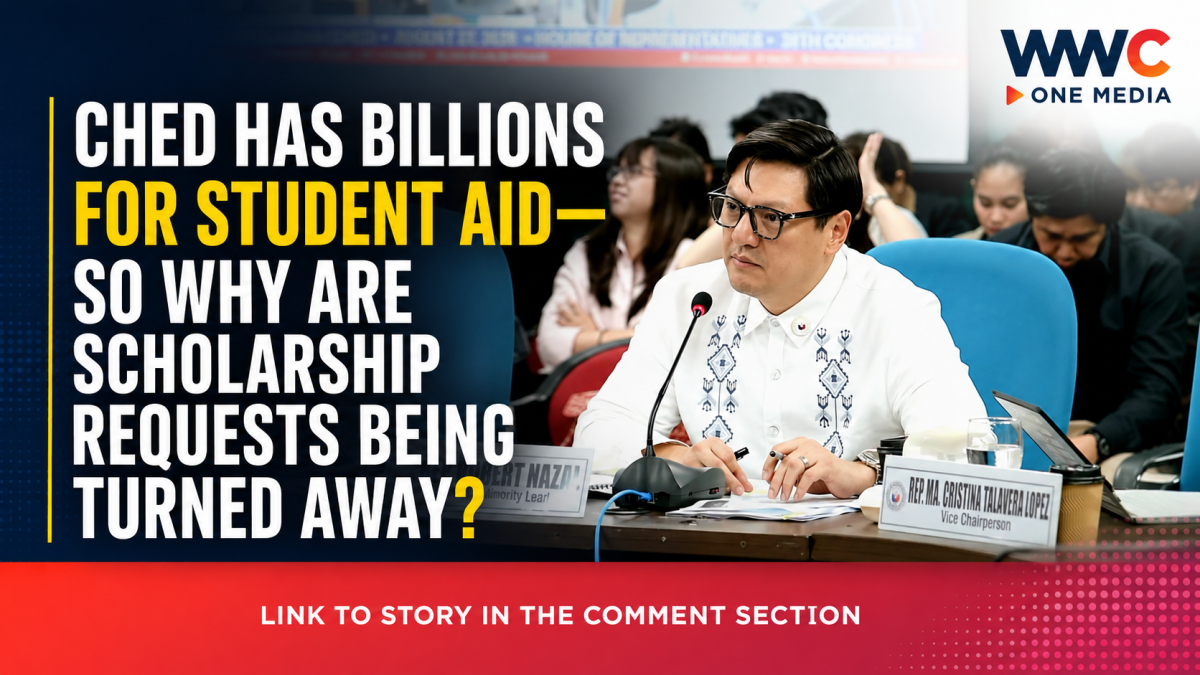
MANILA, Philippines — A lawmaker has called out the Commission on Higher Education (CHED) over allegations that hundreds of students recommended for government assistance were being turned away despite funds allegedly remaining available for scholarships.
Bagong Henerasyon Party-list Rep. Robert Nazal confronted CHED over the issue during congressional budget deliberations, questioning why students seeking assistance could be denied while money intended for educational aid had reportedly not been fully utilized.
“Hindi niyo pera ’yan,” Nazal said, stressing that public funds should be used to support qualified Filipino students rather than remain unused while families struggle to keep their children in college.
The controversy has put renewed attention on the government’s Tulong Dunong Program (TDP) and the broader question of whether billions allocated for higher education are reaching students quickly and fairly.
The P2-Billion Question: Why Are Students Still Being Denied?
The issue gained traction after reports that CHED had around ₱2 billion in unused assistance funds under the Tulong Dunong Program, even as some students were reportedly unable to secure financial aid. Nazal raised concerns over a list of around 400 recommended scholarship beneficiaries, according to the Manila Bulletin report.
The allegation is particularly sensitive because the Tulong Dunong Program is designed to provide financial assistance to deserving and financially disadvantaged students pursuing higher education.
However, the existence of unused or unobligated funds does not automatically mean that every recommended applicant is legally or administratively eligible for immediate approval. Government scholarship programs are subject to qualification requirements, available slots, documentary requirements and rules governing the release and use of public funds.
That distinction is likely to be at the center of the debate as lawmakers press CHED for a clearer explanation.
A Bigger Problem Than Just One Scholarship List
The dispute comes as the government continues to publicly emphasize its commitment to expanding access to college education.
Just days before the controversy, President Ferdinand Marcos Jr. said the government’s Free Higher Education program was benefiting 2.62 million students, while financial assistance programs such as the Tertiary Education Subsidy and Tulong Dunong were also intended to help more Filipinos finish their studies.
At the same time, the government recently released ₱9.753 billion to CHED to address funding deficiencies involving the Free Higher Education Program in 108 state universities and colleges. The funding covered validated obligations from previous academic years, underscoring the financial pressures surrounding the implementation of government higher education programs.
The developments highlight a crucial distinction: government education funding may exist across different programs and accounts, but each allocation can be governed by specific rules and purposes. That makes transparency over exactly which funds are available—and why students are being denied assistance—essential.
CHED Faces Growing Pressure to Explain
The controversy is also unfolding as CHED seeks significantly more funding for 2027. Reports from congressional budget discussions show the commission has warned of a substantial gap between its proposed funding requirements and the amount initially provided in the National Expenditure Program, with scholarship and student assistance programs among the areas affected by funding concerns.
That has created an uncomfortable question for the agency: How can CHED argue for more money while lawmakers are questioning whether existing funds are being fully and efficiently used?
For students and parents, however, the issue is far less about budget jargon.
It is about whether a young Filipino who qualifies for help can actually receive it before financial hardship forces them to delay—or abandon—a college education.
Leave a Reply