
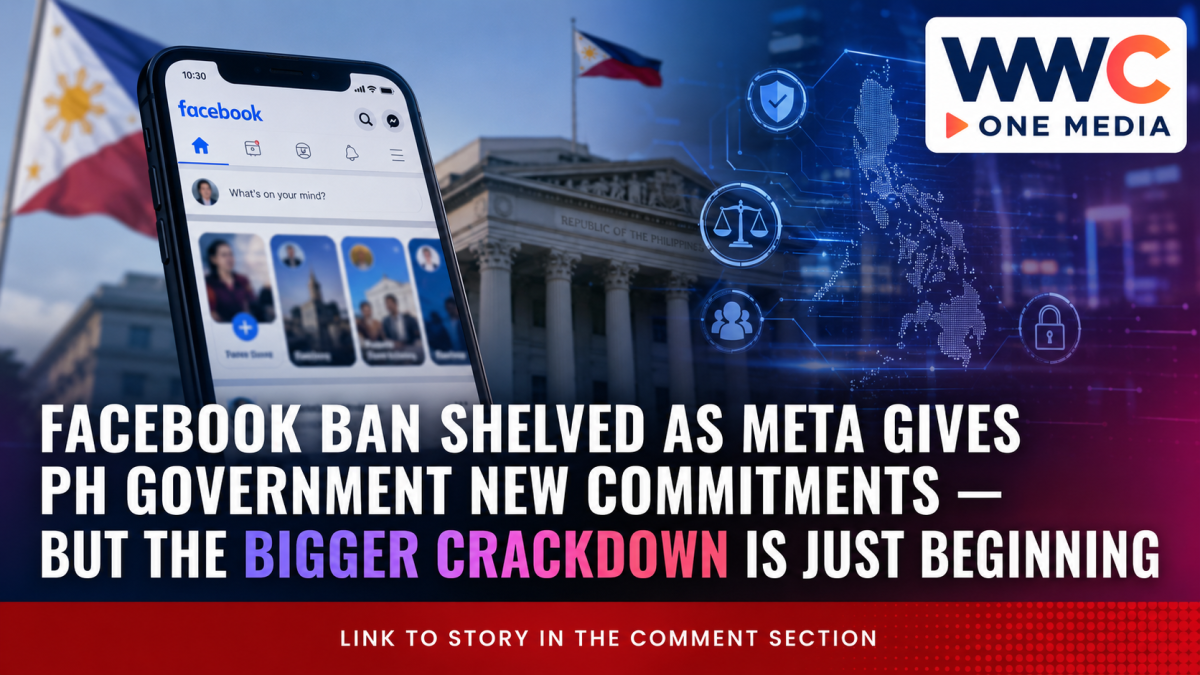
MANILA, Philippines — Facebook is staying online in the Philippines for now. But the threat of tougher government action against social media platforms has not disappeared — it may simply be entering a far more consequential phase.
Malacañang backed away from the immediate prospect of blocking Facebook after officials said its parent company, Meta, had become more responsive to government requests involving misinformation, violent material and other harmful content.
Palace Press Officer Claire Castro said on Aug. 27 that the latest information reaching the administration showed Facebook cooperating with authorities, particularly when problematic posts needed to be removed quickly. The Palace stressed that no platform had actually been banned and that restrictions remained subject to further study.
That is a significant change in tone from just two days earlier.
On Aug. 25, Malacañang said the Marcos administration was open to considering broader restrictions — potentially including Facebook and gaming platforms — if authorities concluded that they posed serious public-safety risks or repeatedly failed to address harmful content.
But the story is no longer simply about whether Facebook will be banned.
It is increasingly about how much responsibility the Philippine government can force the world’s biggest online platforms to accept — and how quickly those companies must respond when lives may be at risk.
The Zamboanga shooting changed the debate
Pressure on Facebook intensified following the deadly shooting at the junior high school campus of Ateneo de Zamboanga University on Aug. 18.
Reports said a Grade 8 student livestreamed the attack on Facebook using a body camera. Two students, including the gunman, died, while several others were injured.
According to the Philippine Daily Inquirer, authorities reported the livestream to Meta approximately five minutes after detecting it. The video nevertheless remained accessible for roughly another nine minutes before it was taken down.
That delay became one of the central arguments behind calls for stronger government leverage over social media platforms.
Importantly, however, policymakers should distinguish between platform accountability and causation. The existence of violent material online, or a livestream of an attack, does not by itself prove that Facebook caused the violence. What the incident clearly exposed was the much narrower but critical issue of how quickly a platform can detect, interrupt and remove dangerous content during an unfolding emergency.
That distinction matters if the government wants regulations that can survive legal, technical and public scrutiny.
DICT says banning Facebook should be the last option
Information and Communications Technology Secretary Henry Aguda subsequently made clear that blocking Facebook would be considered a “last resort.”
Rather than immediately shutting the platform down, the Department of Information and Communications Technology said it intended to exhaust measures aimed at forcing Meta to cooperate with government authorities, particularly on child protection, identification of abusive accounts and faster removal of dangerous content.
Among the problems highlighted by officials were the difficulty of identifying people operating fake or abusive accounts, the speed at which violent material is removed and the lack of a sufficiently strong Meta presence in the Philippines for urgent government coordination.
The government has also demonstrated that its warnings to online platforms are not entirely theoretical.
On Aug. 26, the DICT confirmed that access to the violent sandbox game GoreBox had been blocked after discussions with its developer over concerns about harmful content. Aguda said the action followed notice and discussions rather than an immediate unilateral shutdown.
That precedent sends an unmistakable message to other technology companies: cooperation may increasingly determine whether a platform stays accessible.
Then came the Singapore breakthrough
The turning point for Meta appears to have come during talks between Philippine officials and company executives in Singapore.
Reuters reported that Meta and Roblox agreed to a series of child-safety measures sought by the Philippine government, including stronger age-verification mechanisms, improved parental controls, faster removal of harmful material and closer cooperation with law enforcement.
Meta also agreed to strengthen coordination with Philippine authorities when dealing with serious online threats.
By Aug. 29, the Philippine Daily Inquirer reported an even more significant commitment: Meta had agreed to cooperate in providing subscriber information and traffic data when authorities identify threats involving children, subject to applicable legal processes. Officials also discussed creating a technical working group and designating points of contact to speed up responses to urgent cases.
Meta was also reported to have committed to more aggressively tackling harmful AI-generated deepfakes and responding to lawful government requests connected with cybercrime investigations.
That is considerably more substantial than simply agreeing to delete a few posts.
It could create the framework for a more direct relationship between Philippine law enforcement and one of the world’s most powerful technology companies.
Meta may also strengthen its Philippine presence
Another major issue under discussion is Meta’s presence inside the country.
Reuters reported that Meta planned to send a team to Manila to discuss a timeline for expanding its Philippine presence, while Roblox was aiming to establish a Philippine office as early as October.
Philippine officials have argued that having stronger local representation could dramatically reduce the time required to deal with emergency requests, cybercrime investigations and dangerous online material.
Further talks are expected.
OneNews.PH reported on Aug. 29 that Meta representatives are expected to meet Philippine officials in September to work on information-sharing protocols with law enforcement and measures involving violent and abusive online content.
That meeting could become more important than the original Facebook-ban threat itself.
A shutdown is a blunt instrument. A binding framework that determines how quickly Meta must react, what information it must preserve or disclose under lawful requests, and who Philippine authorities can contact during an emergency could affect millions of users without switching Facebook off.
The confrontation with Meta did not begin this week
The dispute also has a longer history.
Back in April, the Philippine government formally demanded that Meta introduce stronger safeguards against false and panic-inducing content. The DICT and Presidential Communications Office asked the company to submit an implementation plan and warned that failure to address the problem could lead to legal action.
The latest negotiations therefore look less like an isolated response to one violent incident and more like an escalation of months of government frustration with platform accountability.
Congress is now moving too
The executive branch is not acting alone.
The Senate is considering the proposed Child Online Safety and Protection Act, Senate Bill No. 2424, which would set 16 as the minimum age for unrestricted social media use and impose additional obligations on platforms to protect minors from online risks. The measure was endorsed to the Senate floor in late August.
Meta and Roblox have reportedly indicated that they are prepared to cooperate with whatever policy Congress ultimately adopts.
There is, however, an important competing view.
The Council for the Welfare of Children has previously opposed a blanket social media ban, arguing that children should be protected online without simply being cut off from digital technology. The council has emphasized both children’s right to meaningful digital access and their right to protection.
That may ultimately become the central policy battle: regulation versus prohibition.
Facebook survived the first warning. The real test comes next.
For now, the headline is reassuring for millions of Filipino Facebook and Messenger users:
Facebook is not being banned.
But the more important story is what happened after the government threatened tougher action.
Meta entered negotiations. It promised faster responses. It agreed to stronger child-safety measures. Officials say it is prepared to cooperate more closely with law enforcement. Discussions on data-sharing procedures and a stronger Philippine presence are moving forward.
That means Facebook may have avoided the most drastic consequence — but Meta has not escaped scrutiny.
The next question is whether the promises made in Singapore become enforceable procedures in Manila.
Because if another violent livestream, deepfake campaign or serious online threat erupts and authorities again find themselves waiting for a response, the argument over a Facebook ban could return very quickly.
And next time, Malacañang may be under far greater pressure to prove that its warning was more than just a warning.



Leave a Reply