
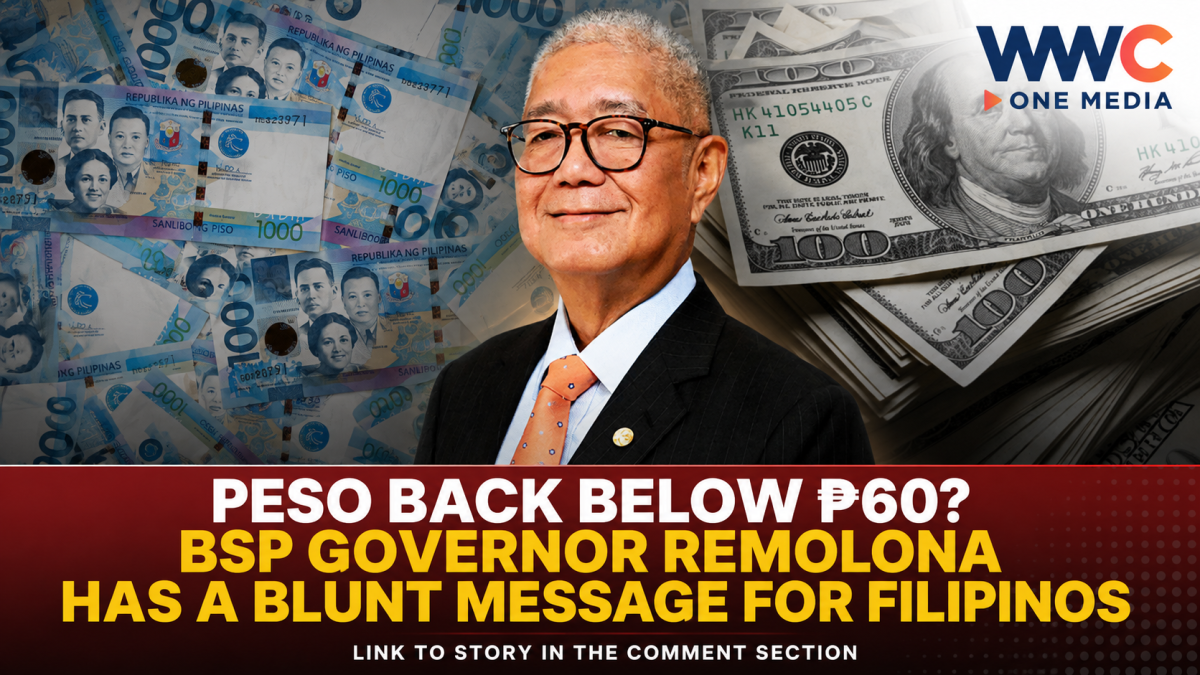
MANILA, Philippines — Filipinos hoping to see the Philippine peso quickly return below the ₱60-per-dollar level may have to temper their expectations.
Bangko Sentral ng Pilipinas (BSP) Governor Eli Remolona Jr. has made it clear that the central bank is not prepared to exhaust the country’s dollar reserves simply to force the peso back to a preferred exchange rate.
The message is straightforward: the BSP can step into the foreign exchange market when conditions become disorderly, but it will not wage an unlimited and costly battle against market forces.
According to the latest BSP exchange-rate data available as of August 28, the central bank’s reference rate stood at ₱61.90 to the US dollar, underscoring how far the currency remains from the psychologically important ₱60 level.
‘Hindi Kaya ’Yun’: Why the BSP Won’t Fight the Market Forever
Remolona’s latest remarks reinforce a position he has consistently taken throughout the peso’s volatile run: foreign exchange intervention has limits.
The BSP can use its reserves to smooth excessive volatility and prevent disorderly market movements, but repeatedly selling large amounts of dollars just to maintain a specific exchange rate could become unsustainable. That is why Remolona has repeatedly stressed that the central bank’s role is not to guarantee a particular peso level.
Earlier this year, the BSP chief said the central bank faced what he described as “tremendous pressure” to defend the peso, while maintaining that economic fundamentals—not public pressure alone—should determine the policy response.
That distinction is crucial for businesses and consumers watching the exchange rate. A central bank may intervene to prevent a market panic, but trying to permanently override global demand for dollars can rapidly drain foreign currency reserves.
The ₱60 Question Is Bigger Than a Number
The peso’s weakness has become a major economic concern because a softer currency can make imported goods—including fuel and other dollar-priced commodities—more expensive.
The currency has repeatedly tested record territory in 2026, with recent reports showing it moving toward and beyond the ₱61-to-₱62 range amid external pressures and market uncertainty.
But Remolona has also cautioned against treating any single exchange-rate level as a make-or-break number. The BSP’s bigger concern is whether peso depreciation begins feeding significantly into inflation and destabilizing broader economic conditions.
Reuters reported earlier this month that Remolona said the BSP remains prepared to take whatever action is necessary to bring inflation back within its target range, even as the central bank expects price pressures to ease gradually over the medium term. At the time, the peso was trading above ₱61 per dollar.
What Could Bring the Peso Back Below ₱60?
A return to stronger levels is still possible—but it will likely depend on a combination of market forces rather than a simple BSP intervention.
Among the factors investors will be watching are:
- Movements in the US dollar and Federal Reserve policy
- Global oil and energy prices
- Inflation trends in the Philippines
- Capital flows and investor confidence
- The country’s trade and external account position
The peso has shown that it can recover sharply when the US dollar weakens. Earlier this month, for example, it strengthened to around ₱60.705 per dollar following softer US jobs data, illustrating how global developments can quickly change the currency’s direction.
BSP’s Message: Stability Matters More Than a Symbolic Exchange Rate
For now, Remolona’s message appears to be one of realism rather than surrender.
The BSP is not abandoning the peso. Rather, it is signaling that defending economic stability is more important than defending a specific number on the currency board. Intervention remains part of the central bank’s toolkit, but the country’s dollar reserves are not meant to be spent indefinitely chasing an artificial exchange-rate target.
For ordinary Filipinos, however, the question remains painfully simple: Will the peso recover before higher import costs hit wallets even harder?
The answer may not come from the BSP alone. It will depend on what happens next in global markets—and whether the economic forces pushing the peso down finally begin to reverse.



Leave a Reply