
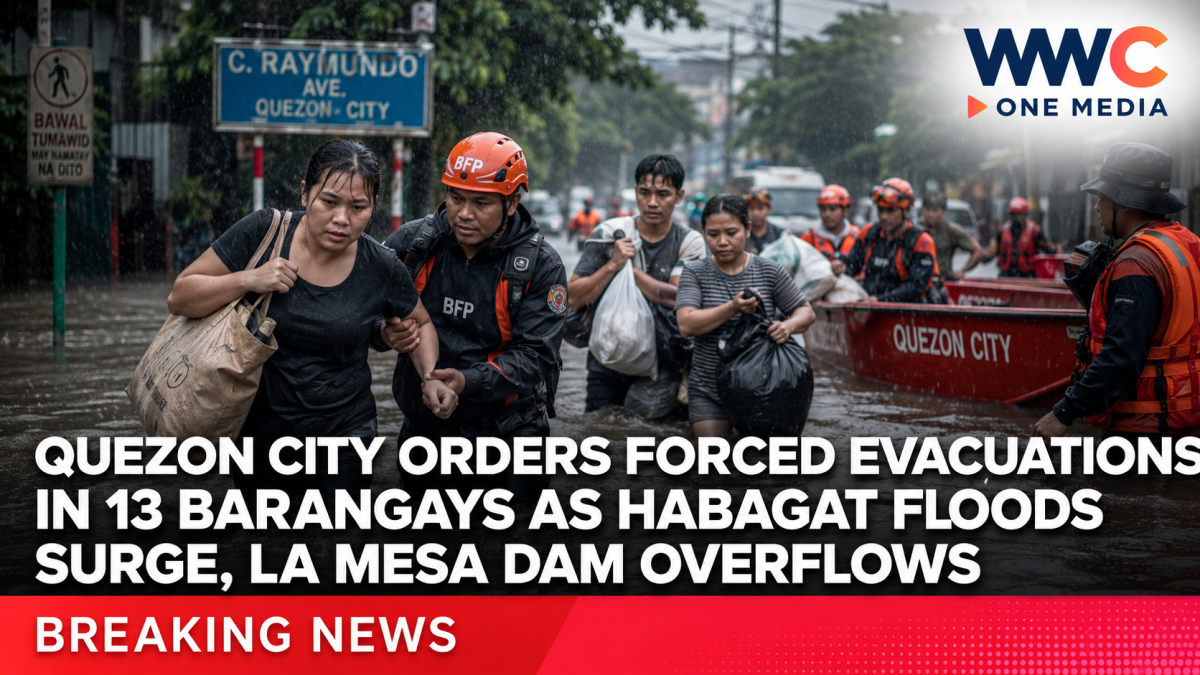
QUEZON CITY, Philippines — What began as another day of relentless Habagat rain escalated into a forced evacuation order Saturday afternoon as Quezon City authorities moved residents out of flood-prone, creek-side and landslide-risk communities while floodwaters continued rising across the city.
The Quezon City government ordered forced evacuations in high-risk portions of 13 barangays as of 3:30 p.m. on Saturday, August 29, as the enhanced southwest monsoon continued to dump heavy rain over Metro Manila.
The distinction is important: the order does not necessarily mean every resident of all 13 barangays must evacuate. It specifically targets people living in areas considered vulnerable to flooding, overflowing waterways, creeks and unstable slopes.
The barangays covered by the order are:
District 1: Del Monte, Talayan, Ramon Magsaysay and Bahay Toro
District 3: Bagumbayan, Escopa 1 and Escopa 3
District 4: Kamuning and Obrero
District 5: North Fairview
District 6: Culiat, Pasong Tamo and Apolonio Samson.
The city government also urged barangays not included in the initial list to carry out preemptive evacuations if they have communities already experiencing flooding or facing possible landslides.
Floodwater Was Already Reaching Dangerous Levels
The evacuation order came after flooding had already become severe in parts of Quezon City.
According to a city flood monitoring update reported by the Inquirer, floodwater along N.S. Amoranto corner Don Jose Street in Barangay Sienna reached as high as 60 inches as of 1:30 p.m.
Other locations were reporting chest-high, waist-high, knee-high and tire-high flooding.
Chest-high flooding was recorded in parts of Barangays Apolonio Samson, Sienna, Damayan, Katipunan and Doña Imelda, while waist-high water was reported in portions of Sienna, Tandang Sora, Doña Imelda and Masambong.
The flooding was not simply the result of isolated afternoon thunderstorms.
PAGASA had placed Metro Manila under a red rainfall warning, its highest rainfall warning category, as the southwest monsoon continued bringing intense rain across the capital and several Luzon provinces.
Under the 2 p.m. warning, serious flooding was possible in flood-prone areas, with more heavy rainfall expected.
Then La Mesa Dam Crossed Its Overflow Level
Adding to the concern was the rapidly rising level of La Mesa Dam in Quezon City.
At around 1:50 p.m., the reservoir reached its 80.15-meter overflow elevation.
By 2 p.m., PAGASA data cited by the Philippine News Agency showed La Mesa Dam at 80.22 meters — seven centimeters above its overflow level.
That matters because excess water from La Mesa Dam flows directly toward the Tullahan River system.
PAGASA warned that potentially affected areas include Fairview, Forest Hills Subdivision, Quirino Highway, Sta. Quiteria and San Bartolome in Quezon City, as well as vulnerable communities in Caloocan, Valenzuela, Malabon and Navotas.
The weather bureau also warned that water overflowing from the reservoir is only part of the danger. Continued rainfall over the La Mesa watershed could cause river levels downstream to climb even further.
That combination — saturated communities, continuing Habagat rainfall, an overflowing reservoir and rising waterways — explains why authorities shifted from merely advising residents to prepare to issuing forced evacuation orders in identified high-risk locations.
This Has Happened Before — Just Weeks Ago
Saturday’s La Mesa Dam overflow is also not an isolated event.
On August 10, another period of intense Habagat rainfall pushed La Mesa Dam past its 80.15-meter spilling level. Residents near the Tullahan River were subsequently evacuated as the river rose.
During that earlier flooding episode, the Quezon City government reported that by the morning of August 11, 2,326 families or 8,209 people had been evacuated and were staying at evacuation sites across the city.
The recurrence less than three weeks later underscores the continuing vulnerability of low-lying communities whenever prolonged monsoon rainfall combines with elevated reservoir and river levels.
Residents Urged to Follow Evacuation Orders
Authorities are urging residents in identified danger zones not to wait for floodwaters to enter their homes before moving to safer ground.
Flood conditions can deteriorate quickly, particularly beside rivers and creeks or in neighborhoods where drainage systems are already overwhelmed.
Residents outside the 13 listed barangays should also remain alert. Quezon City specifically encouraged other barangays with flood-prone communities or areas exposed to landslide threats to begin preemptive evacuation when necessary.
For emergencies, residents can contact the Quezon City Helpline at 122, which operates 24 hours a day for disaster, medical, police, fire and other emergency assistance.
For now, the forced evacuation order marks a clear escalation in Quezon City’s response to Saturday’s Habagat rains.
But with La Mesa Dam already above its overflow elevation and PAGASA warning that continued rainfall could push downstream water levels even higher, the bigger question is no longer simply where flooding has already occurred — but which communities could be next if the rain does not ease.

Leave a Reply