
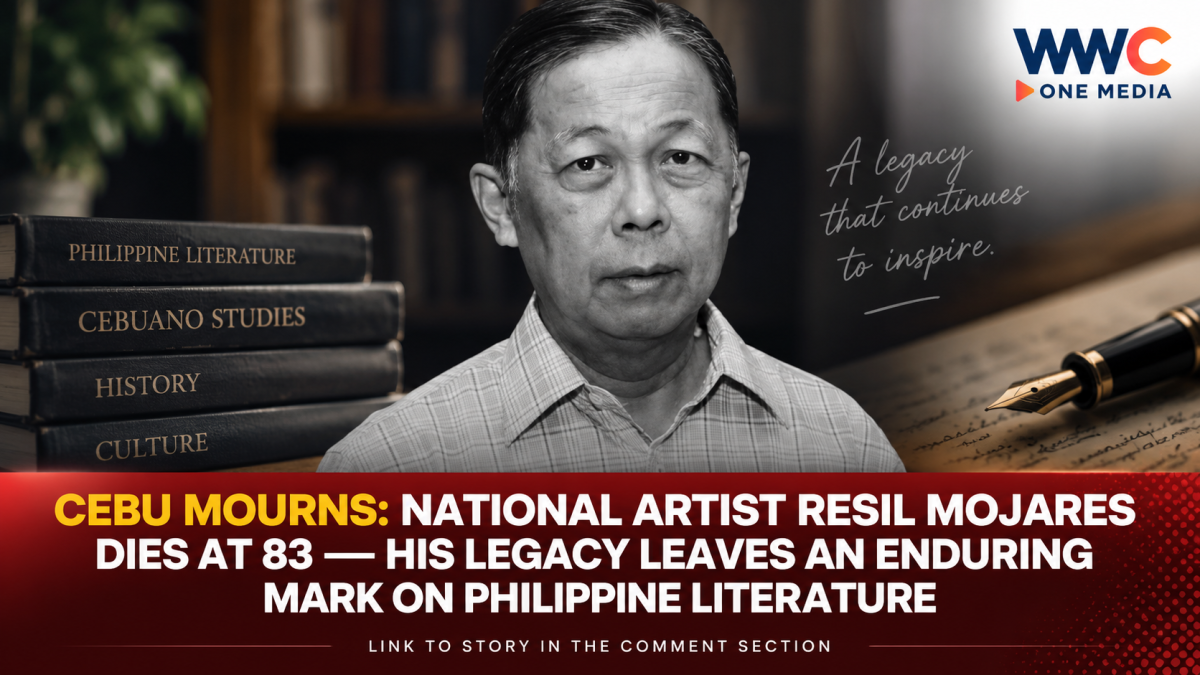
CEBU CITY — The Philippines has lost one of its most influential scholars, writers and cultural historians.
National Artist for Literature Resil B. Mojares, a towering figure in Cebuano and Philippine literature, died in the early hours of Saturday, September 5, 2026, his family confirmed.
He was 83.
The news of Mojares’ death was first reported by Cebu Daily News, which said the National Artist died early Saturday. His passing marks the end of a remarkable intellectual career that helped place Cebuano literature, history and culture at the center of national scholarship.
Mojares was more than a celebrated author. He was a historian, literary critic, essayist, educator and cultural researcher whose work explored the people, stories and historical experiences that shaped Cebu and the Philippines.
A LIFE DEVOTED TO CEBU AND PHILIPPINE LETTERS
For decades, Mojares worked to document and preserve Cebu’s cultural and literary heritage.
The Cebuano Studies Center identifies him as its founding director, a position he held from 1975 to 1996. The institution credits his work with helping establish Cebu as an important center for research into Cebuano culture and history.
His academic training reflected the depth of his literary and historical work. He earned his bachelor’s degree in English and master’s degree in Literature from the University of San Carlos, before completing postgraduate studies and a doctorate in Literature at the University of the Philippines Diliman.
Over the course of his career, Mojares produced works spanning literary criticism, Philippine history, biography, cultural studies and fiction.
The Cultural Center of the Philippines noted that he had published extensively for more than five decades in forms ranging from fiction and essays to journalism, scholarly articles and books.
FROM CEBUANO SCHOLAR TO NATIONAL ARTIST
Mojares’ contribution eventually earned the country’s highest official recognition for artists.
In 2018, he was named National Artist for Literature, joining a distinguished group of Filipino cultural figures honored for their exceptional contributions to the nation’s artistic and cultural heritage. The University of the Philippines lists Mojares among the National Artists for Literature.
The Cultural Center of the Philippines described him as an educator, scholar, essayist, fictionist and cultural/literary historian, emphasizing his role in regional literature and the development of scholarship on Cebuano and Philippine identity.
His National Artist recognition was significant not only because of his individual achievements, but also because it elevated the importance of regional literature and local histories in the broader Filipino narrative.
THE “VISAYAN TITAN OF LETTERS”
Mojares became widely respected for his ability to connect literature, history and society.
His body of work examined how Filipinos understood themselves through stories, historical memory, political experience and culture.
Among the institutions that documented his career, the Cebuano Studies Center notes that he received multiple National Book Awards from the Manila Critics Circle for works involving literary criticism, local and national history, urban and rural history, and political biography. He also received the Carlos Palanca and Free Press awards, as well as international distinctions and fellowships.
His influence extended well beyond Cebu.
He served as a visiting professor or fellow at institutions including the University of Wisconsin, University of Hawaii, University of Michigan, Kyoto University, UCLA and the National University of Singapore, according to the Cebuano Studies Center.
HIS LEGACY GOES BEYOND BOOKS
Perhaps Mojares’ greatest contribution was his insistence that the history and culture of the Visayas deserved to be studied, preserved and understood as an essential part of the Filipino story.
His scholarship helped generations of readers and researchers look more closely at Cebu—not simply as a regional center, but as a place whose literature, people and historical experiences are integral to the country’s identity.
His connection with Cebu’s literary community also remained strong in the years before his death.
In 2025, Mojares delivered the keynote address at the 2nd Dumaguete Literary Festival, demonstrating that even in his later years he continued to engage with literature, cultural history and the country’s intellectual community.
CEBU LOSES ONE OF ITS GREAT CULTURAL VOICES
Mojares’ death closes a remarkable chapter in Philippine intellectual and literary history.
But the questions he spent his life exploring—Who are Filipinos? How do regional cultures shape national identity? How should history be remembered? And whose stories deserve to be heard?—remain as relevant as ever.
His books, essays, research and generations of students and readers will continue to carry those questions forward.
For Cebu, the loss is particularly profound.
The city and the region have lost not simply a National Artist, but one of their most important chroniclers—a scholar who spent much of his life ensuring that Cebuano voices, stories and history would never be pushed to the margins of the Filipino narrative.
Resil B. Mojares is gone. But the literature, history and cultural legacy he helped preserve will continue to speak.
WWC ONE MEDIA J.M.S



Leave a Reply