
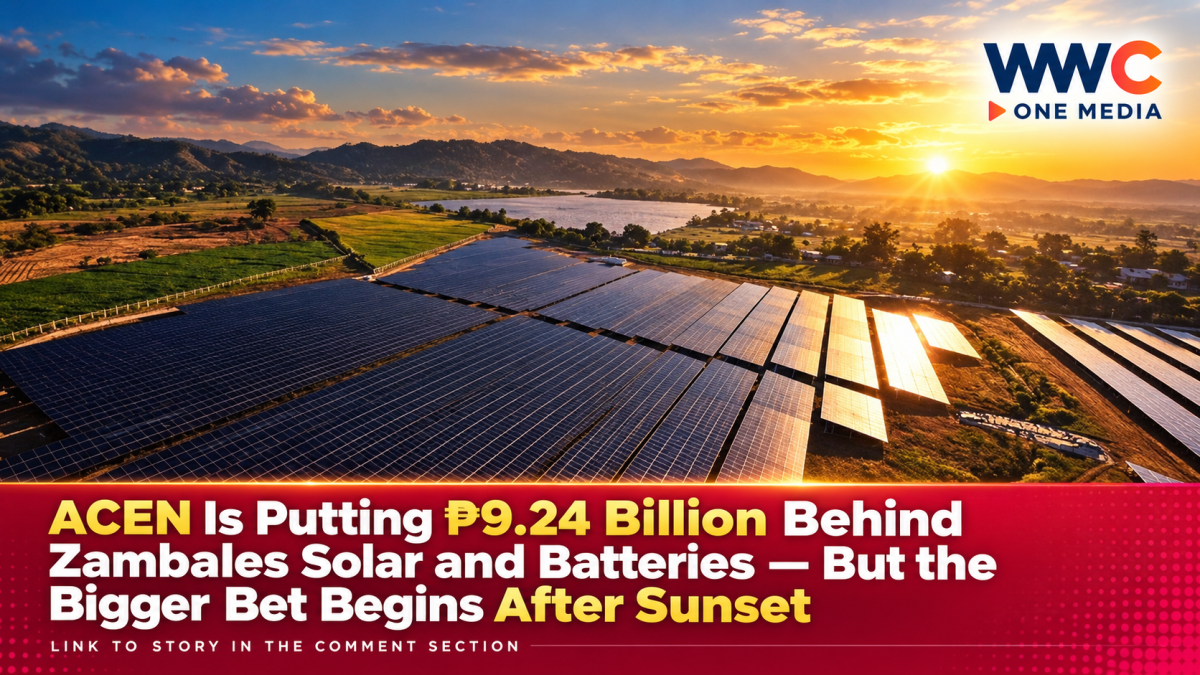
MANILA — ACEN Corp. is putting another ₱9.24 billion of financing behind two major renewable-energy projects in Zambales, accelerating an emerging solar-and-battery complex that could become one of the Philippines’ most important tests of whether massive amounts of daytime solar power can be made useful when the sun is no longer shining.
The Ayala-led energy company has executed loan agreements with two wholly owned subsidiaries: up to ₱6 billion for SanMar Solar Inc. and up to ₱3.24 billion for GIGA ACE 8 Inc.
Both agreements were executed on September 3, according to corporate disclosures filed with the Philippine Stock Exchange.
But the money is funding two very different pieces of the electricity system.
SanMar’s financing will support a giant battery installation designed to store electricity.
GIGA ACE 8’s loan will help complete another major solar farm — plus the transmission infrastructure needed to actually deliver that electricity into the grid.
Taken together, they reveal where ACEN’s Philippine strategy is moving next:
not simply building more renewable generation, but building the infrastructure required to make renewable power available when consumers actually need it.
₱6 Billion Is Going Toward a Giant Battery Project
The larger financing agreement is with SanMar Solar Inc.
ACEN said the subsidiary can borrow up to ₱6 billion to support construction of a 500-megawatt/1,000-megawatt-hour Battery Energy Storage System, or BESS, in Barangay Santa Fe, San Marcelino, Zambales.
The battery will be integrated with SanMar’s existing solar facilities, creating a combined solar-and-storage system.
That distinction is crucial.
Solar panels produce their strongest output during daylight hours.
Electricity demand, however, does not disappear when the sun goes down.
Large batteries allow part of the electricity generated during periods of high solar production to be stored and released later, including during evening demand peaks or when solar output suddenly falls.
ACEN itself says its Zambales storage investments are intended to improve the reliability and dispatchability of renewable generation and help support grid stability.
In other words, the battery is not another power plant.
It is a tool designed to make the power generated by existing renewable assets more flexible.
Another ₱3.24 Billion Is Going Into Palauig 2
ACEN separately signed a short-term loan agreement of up to ₱3.24 billion with GIGA ACE 8 Inc.
The money is intended to support construction of the 300-MWdc Palauig 2 Solar project, including its transmission line and substation in Barangays Salaza and Bulawen in Palauig, Zambales.
Palauig 2 is not a new project.
ACEN announced construction in 2023, estimating the development — including a 1,200-MW transmission line — at roughly ₱16 billion.
The company expects the second phase to produce about 453 gigawatt-hours of renewable electricity annually.
The Philippine Star reported that ACEN had already injected approximately ₱1.15 billion into GIGA ACE 8 earlier this year to support the project.
That means this latest ₱3.24-billion facility should be viewed as another financing step in a project that has been under development for years, rather than the beginning of an entirely new solar farm.
Zambales Is Becoming Much Bigger Than Two Projects
The significance of the loans becomes clearer when viewed against ACEN’s larger plan for the province.
ACEN said in July that its Zambales renewable-energy cluster includes:
585 MW of SanMar Solar capacity in San Marcelino and 363 MW of Palauig Solar capacity, for a combined 948 MW of solar projects.
Around 450 MW was already operational, while the remaining solar capacity was under construction and expected to be finished within 2027.
That is approaching the scale of a one-gigawatt solar hub.
But generation capacity is only half the strategy.
ACEN said it had also begun constructing 1,660 MWh of battery energy storage systems across its Zambales solar facilities.
That combination — solar generation plus utility-scale storage plus dedicated transmission infrastructure — is what makes the development more consequential than a conventional solar project.
There Is an Important Battery-Capacity Detail Publishers Should Know
There is one notable discrepancy across official documents that should not be ignored.
ACEN’s latest financing disclosure identifies the SanMar project being funded as a 500 MW/1,000 MWh BESS.
However, Environmental Management Bureau records for the broader San Marcelino development describe a proposed 500 MW/2,000 MWh battery energy storage system undergoing environmental review.
Those figures should not automatically be treated as contradictory or interchangeable. They could represent different project configurations, development stages or portions of the broader storage buildout.
For this particular ₱6-billion financing story, the safest and most accurate figure is the one in ACEN’s latest corporate disclosure:
500 MW/1,000 MWh.
If discussing the broader environmental application, the proposed 2,000-MWh configuration should be separately attributed to DENR records.
Why Batteries Are Becoming the Real Story
For years, the Philippine renewable-energy debate largely centered on one question:
How many megawatts of solar and wind can the country build?
The next phase is considerably more complicated.
As more variable renewable energy enters the system, electricity must still be available when clouds reduce solar output, when wind production falls or when demand peaks after sunset.
That creates a growing need for:
battery storage,
flexible generating resources,
stronger transmission,
and better connections between generating areas and major demand centers.
The Department of Energy’s current planning framework targets renewables at at least 35% of the country’s power-generation mix by 2030 and 50% by 2040.
DOE projections also show Philippine peak electricity demand rising sharply over the coming decades, requiring enormous additions of both generation and supporting grid infrastructure.
That is why simply building more solar panels is not enough.
The grid must also be capable of absorbing, moving and storing the electricity they produce.
ACEN Says Zambales Could Power Around 340,000 Homes
Once its Zambales solar portfolio is fully operating, ACEN projects the facilities will collectively generate around 1,400 GWh of clean electricity annually.
The company estimates that would be enough electricity for approximately 340,000 households and could avoid about 800,000 tonnes of carbon dioxide emissions per year.
Those household and emissions figures are company estimates and should be presented as such rather than guaranteed outcomes.
ACEN has also built transmission infrastructure specifically to move electricity from the Zambales developments into the Luzon grid.
That investment is easy to overlook.
A huge solar installation has limited value if there is insufficient transmission capacity to move its output to consumers.
ACEN Has the Balance Sheet Growth to Match the Construction
The latest financing comes as ACEN’s renewable portfolio continues expanding.
The company reported ₱3.9 billion in consolidated net income during the first half of 2026, up 411% from the comparable period, while attributable renewable generation increased 21% to 4,024 GWh.
Its attributable renewable-energy portfolio reached 7,517 MW, with 57% operational.
ACEN said the portfolio increase included the groundbreaking of 775 MW/1,660 MWh of battery-storage projects in the Philippines.
Chief Executive Eric Francia has emphasized three priorities: protecting ACEN’s balance sheet, expanding contracted electricity sales and increasing its energy-storage portfolio.
The Zambales loans fit directly into that strategy.
But ₱9.24 Billion Does Not Mean ₱9.24 Billion Has Already Been Spent
This point matters for investors and headline writers.
The two agreements total up to ₱9.24 billion.
That is the maximum financing available under the disclosed facilities.
It does not necessarily mean both subsidiaries immediately received or spent the full ₱9.24 billion.
ACEN’s disclosures also did not provide several details that would be necessary to fully assess the financing, including the interest rates, repayment schedules and exact amounts already drawn.
And because SanMar Solar and GIGA ACE 8 are wholly owned ACEN subsidiaries, these are intra-group loans.
They are different from ACEN securing ₱9.24 billion in fresh external financing from banks or new investors.
That distinction should remain clear in any rewritten headline or social-media card.
The Bigger Bet Starts When Solar Production Falls
The eye-catching number is ₱9.24 billion.
But the more important number may eventually be the amount of electricity ACEN can reliably deliver after the strongest solar-production hours are over.
That is the strategic logic behind combining nearly one gigawatt of solar capacity with increasingly large batteries and dedicated transmission lines in the same province.
If the model works, Zambales could demonstrate how the Philippines can move beyond simply installing renewable capacity and toward building renewable power systems capable of operating more predictably across the day.
If it does not, the country will confront the same problem facing renewable-heavy grids around the world:
plenty of electricity when nature provides it, but not necessarily enough when consumers need it most.
ACEN has already built much of the solar.
Now it is committing billions to solve the harder problem.
How do you make sunlight useful after sunset?
And the answer emerging in Zambales is increasingly measured not only in megawatts of solar panels — but in billions of pesos worth of batteries, substations and transmission lines.
WWC ONE MEDIA M.J.E




Leave a Reply