
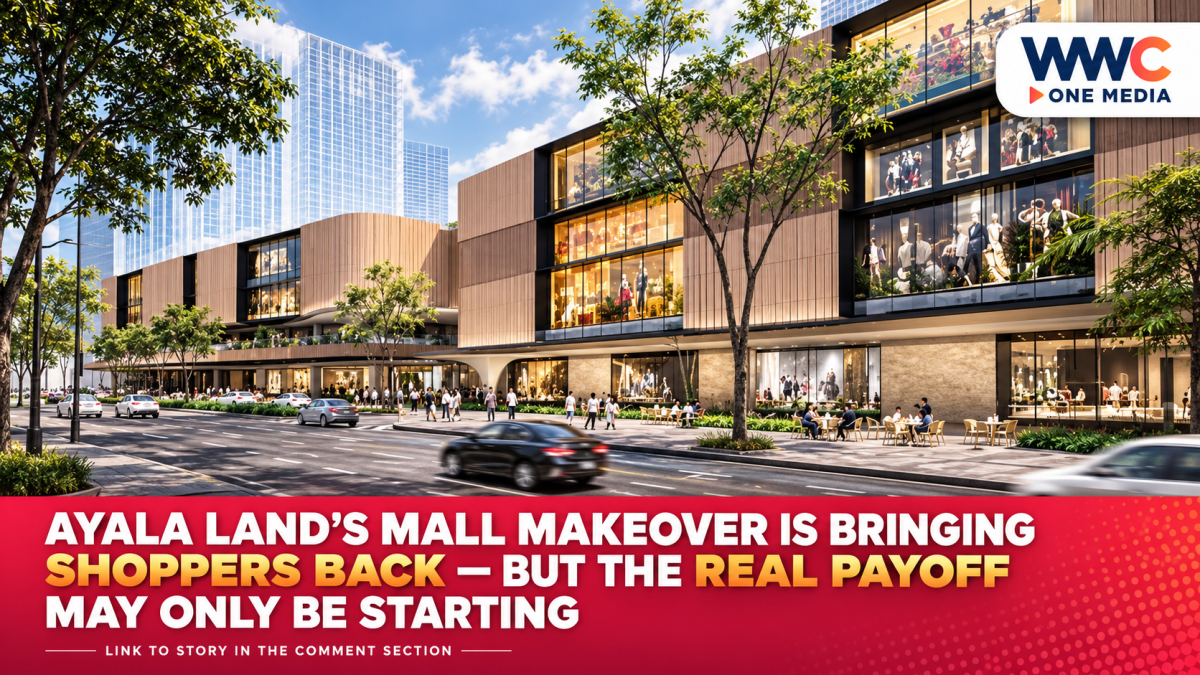
MANILA — Ayala Land spent billions of pesos betting that Filipinos would still go to malls if the malls themselves gave them a better reason to stay.
Early numbers suggest that bet may be working.
The property giant said visitor traffic across its shopping-center portfolio increased 5% in the first half of 2026, while same-mall revenues grew 7% and the lease-out rate reached 90%, up from 87% a year earlier. Mall EBITDA margin remained a robust 61%.
Those numbers are beginning to provide evidence that Ayala Land’s large-scale reinvention of Glorietta, Greenbelt, TriNoma and Ayala Center Cebu is doing more than giving decades-old malls a cosmetic facelift.
It is beginning to change their economics.
And that matters because Ayala Land increasingly needs its malls, hotels and other recurring-income properties to do more heavy lifting at a time when its traditionally dominant residential-development business is facing a much tougher market.
A 5% Foot-Traffic Gain Doesn’t Sound Huge—Until You Look at What Happened to Revenue
Footfall increased 5%.
Same-mall revenues increased 7%.
That difference matters.
If revenue is growing faster than visitor traffic, it can indicate that malls are extracting more economic value from each wave of customers through better tenant mixes, higher spending, improved occupancy or stronger rents.
Ayala Land said higher occupancy, merchant sales and the early benefits of its reinvention program supported the improvement.
Shopping-center revenues reached ₱12 billion in the first six months of 2026, up 4% from a year earlier.
That 4% figure should not be confused with the 7% same-mall revenue increase. The first measures the reported shopping-center business as a whole, while the latter compares the performance of comparable existing malls.
Ayala Land also told investors that excluding the impact of its earlier sale of Alabang Town Center, shopping-center revenue growth would have been approximately 9%.
In other words, the operating momentum inside the existing mall network appears stronger than the headline 4% revenue increase initially suggests.
Ayala Land Has Been Spending Billions to Reinvent the Mall
This turnaround did not happen accidentally.
Ayala Land began the first phase of its major mall-redevelopment program in 2024, initially targeting four flagship properties:
Glorietta in Makati
Greenbelt in Makati
TriNoma in Quezon City
Ayala Center Cebu
The goal was not simply to repaint interiors or replace flooring.
Ayala Land’s own redevelopment plan calls for redesigned facilities, more open spaces, energy-efficient features and, critically, changes to the merchant mix—the combination of restaurants, stores and experiences occupying each property.
The initial program was budgeted at roughly ₱13 billion, but Ayala Land increased the redevelopment budget to ₱17.5 billion in 2025 as it expanded the program and raised design and customer-experience standards.
That makes the current traffic numbers important.
Ayala Land now has tangible evidence that a multibillion-peso reinvestment in older assets can produce measurable improvements in customer activity.
But management says the full financial payoff will take longer.
The Renovations May Be Finished. The Tenant Transformation Isn’t.
Ayala Land President and CEO Anna Ma. Margarita “Meean” Bautista-Dy said in August that the physical reinvention of the four flagship malls was complete and that the company was moving into what it calls the merchant-replacement phase.
That means replacing or relocating tenants, introducing new brands and optimizing the retail mix for each property.
Dy cautioned that the full benefits of the reinvention could take two to three years to become visible.
That is an important distinction.
A newly renovated mall can reopen almost overnight.
A high-performing tenant mix cannot.
Leases expire at different times. New brands need to enter. Existing merchants have to be repositioned. Customers need time to develop new shopping and dining habits.
Ayala Land had earlier estimated that its renovated malls could eventually generate approximately a 15% to 20% uplift in rents once the properties stabilize.
So a 5% traffic increase today may only represent the opening stage of the company’s intended return on investment.
This Isn’t Really About Making Malls Look New
Ayala Land’s strategy reflects a much broader shift in retail.
For years, e-commerce prompted predictions that physical malls would eventually become less relevant.
Instead, leading mall operators have increasingly tried to transform shopping centers from places built mainly around transactions into “third spaces”—destinations where people eat, work, socialize, attend events and spend time even when buying a product is not the primary reason for visiting.
Ayala Malls Chief Operating Officer Paul Birkett described precisely that strategy while discussing TriNoma’s redevelopment earlier this year.
He said malls must evolve beyond the transactional model that dominated when properties such as TriNoma first opened nearly two decades ago.
The redesigned properties are therefore increasingly emphasizing restaurants, cafés, outdoor spaces, event areas and transportation connectivity alongside traditional retail.
The objective is simple:
Get people to come more often.
Then:
Give them reasons to stay longer.
And finally:
Give tenants a better opportunity to convert that time into sales.
TriNoma Shows Where Ayala Is Taking the Strategy Next
TriNoma may be one of the clearest examples.
Ayala Malls is adding The Exchange at TriNoma, a roughly 40,000-square-meter expansion tied directly to the Unified Grand Central Station.
The project includes about 12,000 square meters of retail space, 4,000 square meters of offices and dedicated parking and transport facilities.
Its biggest advantage may not be architectural.
It is transportation.
TriNoma is being positioned to connect with MRT-3, MRT-7 and LRT-1, in addition to buses, UV Express vehicles and point-to-point services. With the Unified Grand Central Station and MRT-7 targeted for completion, Ayala expects the interchange to increase the mall’s commuter catchment.
That represents another evolution in the mall business.
Rather than hoping shoppers deliberately drive to a destination, the property becomes embedded directly into the routes people already use every day.
The commuter becomes the potential shopper.
And Ayala Land Isn’t Stopping With Four Flagship Malls
The first phase is only part of the program.
Ayala Land’s official redevelopment plan lists Ayala Malls Abreeza, Ayala Malls Cloverleaf, Ayala Malls Fairview Terraces and MarQuee Mall in the next phase, with phased reopenings stretching from 2026 through 2028.
That means the performance of Glorietta, Greenbelt, TriNoma and Ayala Center Cebu has implications beyond those four properties.
If higher foot traffic, rents and merchant productivity persist, Ayala has a financial argument for applying the formula to more mature assets.
And it is simultaneously pursuing an even more aggressive strategy:
building new mall space.
2026 Could Be Ayala Land’s Biggest Mall-Expansion Year Ever
Ayala Land plans to open more than 200,000 square meters of additional retail gross leasable area in 2026, the largest single-year mall addition in its history.
The expansion includes projects in locations such as Arca South, Nuvali, Evo City and Gatewalk in Cebu, alongside additional retail space within existing estates.
Ayala Malls Arca South has already opened, while Ayala Malls Gatewalk in Mandaue City is scheduled to open later in the year.
Another roughly 100,000 square meters of mall space is targeted for 2027, according to management’s first-half briefing.
That creates an unusually ambitious combination:
Ayala is renovating old malls and building new ones simultaneously.
The company therefore is not behaving like a developer preparing for the decline of physical retail.
It is betting heavily on its continued relevance.
But Here’s the Bigger Reason Ayala Needs the Mall Strategy to Work
The strongest argument for paying attention to Ayala’s mall numbers comes from somewhere else in its income statement.
Ayala Land’s overall first-half performance was weak.
Net income fell 19% to ₱11.5 billion from ₱14.2 billion a year earlier.
Total revenues declined nearly 10% to ₱75 billion.
And property-development revenues—the segment that includes much of Ayala Land’s residential business—fell 22% to ₱41 billion.
Leasing and hospitality moved in the opposite direction.
Those businesses generated ₱25.2 billion, up 9% year over year.
Shopping centers: ₱12 billion, +4%
Offices: ₱6 billion, +2%
Hospitality: ₱6.3 billion, +28%
Industrial real estate: ₱879 million, +15%.
That changes the meaning of the mall-redevelopment story.
Ayala is not simply trying to make Glorietta or TriNoma nicer.
It is trying to reshape the earnings profile of one of the Philippines’ largest property developers.
Recurring Income Is Becoming Ayala Land’s Shock Absorber
Residential development can produce enormous profits, but it is cyclical.
When consumers become cautious, mortgage rates rise or condominium inventories increase, buyers can postpone purchasing property.
Mall leases behave differently.
Tenants pay rent every month.
Hotels generate recurring room revenue.
Office buildings generate lease income.
Warehouses generate rents.
That recurring cash flow can act as a stabilizer when property sales slow.
Ayala Land CEO Dy has explicitly said the company is trying to create a more balanced portfolio and that leasing is becoming increasingly important to growth.
The numbers indicate why.
While the overall company reported declining first-half profit, its leasing and hospitality business continued growing.
So Ayala’s mall reinvention has become more than a retail experiment.
It is part of a broader earnings-diversification strategy.
The AREIT Deal Adds Another Layer
Ayala Land is also preparing to transfer a new batch of income-producing properties into its listed real estate investment trust, AREIT Inc.
A proposed roughly ₱20-billion transaction includes four malls and three hotels, helping increase AREIT’s assets under management to approximately ₱179 billion.
Among the mall assets involved are Glorietta 4, Ayala Malls Circuit, Ayala Malls Capitol Central and Ayala Malls Cloverleaf.
The strategy allows Ayala Land to recycle capital from mature income-producing properties while maintaining economic exposure through its stake in AREIT.
Those funds can then support new development and redevelopment.
In simplified terms:
Ayala builds or improves a property.
The property matures and generates dependable rents.
Selected mature assets can eventually be transferred to AREIT.
Ayala then redeploys capital into the next generation of projects.
That makes higher mall occupancy and tenant productivity important not only for rental income—but potentially for the valuation and capital-recycling potential of the assets themselves.
The 90% Occupancy Number Needs Perspective
There is one point investors should not overlook.
Ayala Land’s 90% lease-out rate at June 2026 is clearly better than the 87% recorded a year earlier.
But its mall portfolio ended 2025 at 91% leased out, according to the company’s integrated report.
So it would be inaccurate to portray 90% as some unprecedented occupancy breakthrough.
Portfolio composition is changing as new space opens, which can influence occupancy ratios.
The stronger evidence for the reinvention thesis may therefore be the simultaneous improvement in:
visitor traffic,
same-mall revenue,
merchant sales,
and rental potential.
Those measures say more about what is happening inside the malls than occupancy alone.
WWC ONE MEDIA M.J.E




Leave a Reply