
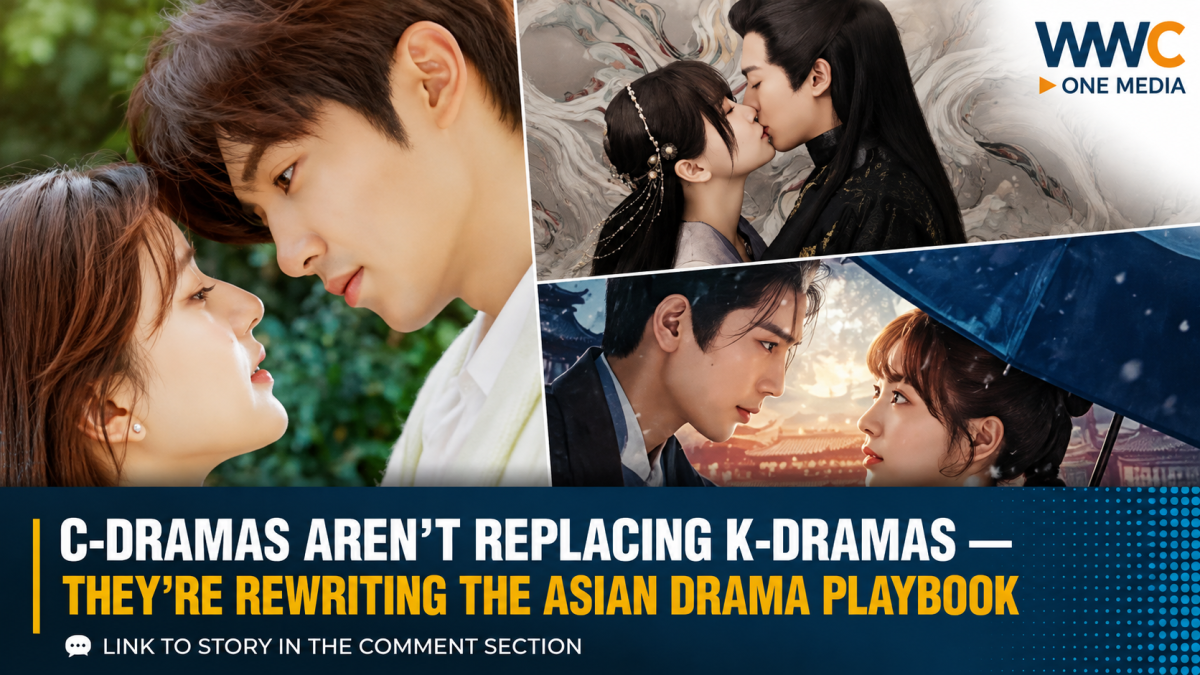
For years, K-dramas were the gold standard of Asian television exports.
From Winter Sonata and Descendants of the Sun to Goblin and Crash Landing on You, Korean dramas helped turn television into a global cultural phenomenon. Their influence reached far beyond entertainment, shaping international interest in Korean fashion, beauty, food, tourism and even the Korean language.
But there is a new development in the Asian drama landscape.
C-dramas are no longer simply following the K-drama formula. They are increasingly expanding it.
That is the central argument of Tatler Asia’s latest examination of the two industries, which points to the increasingly distinctive strengths of Chinese television — particularly its world-building, historical storytelling, political intrigue, fantasy mythology and long-form character development.
And for viewers who have mostly lived inside the K-drama universe, that difference can be surprisingly addictive.
1. C-Dramas Often Build Worlds Instead of Just Settings
One of the biggest differences is scale.
A typical K-drama might revolve around a hospital, law firm, company, family or neighbourhood.
Many C-dramas go much bigger.
Nirvana in Fire, for example, places its revenge story inside an elaborate imperial political system involving military factions, noble families and competing interests. Viki describes the 2015 series as a historical drama centred on a brilliant strategist seeking revenge and restoring his family’s honour.
Other dramas such as Joy of Life, The Untamed and Love Between Fairy and Devil similarly construct extensive political, historical or fantasy environments.
The result is television where the world itself can become part of the story.
2. History Isn’t Just Background Decoration
China’s enormous historical and literary tradition gives C-dramas an unusually large storytelling library.
The Story of Minglan, The Longest Day in Chang’an and The Rise of Phoenixes use historical settings to explore everything from family hierarchy and gender expectations to political power and social structures.
That gives viewers something beyond romance.
You may start a historical C-drama for the costumes — and end up staying for the politics.
3. Political Intrigue Becomes a Chess Game
This is perhaps where C-dramas can feel radically different.
In many Chinese historical dramas, characters rarely say exactly what they mean.
A conversation can simultaneously be about loyalty, succession, military strategy and betrayal.
Nirvana in Fire is a prime example: its protagonist Mei Changsu operates largely through strategy, alliances and manipulation rather than simply fighting his enemies head-on. The series has 54 episodes and is categorized by Viki as historical, war and costume drama.
Newer productions continue that tradition.
Tatler points to The Double, Story of Kunning Palace and the 2026 drama Pursuit of Jade as examples of stories where information, alliances and strategy can be as important as physical strength.
And Pursuit of Jade shows how the formula continues to evolve.
The 2026 series stars Zhang Linghe and Tian Xiwei and combines historical romance with marriage, family and military conflict. Netflix lists it as a 40-episode series in which a woman marries a disgraced noble to protect her family before eventually following him into battle.
4. Romance Doesn’t Always Have to Drive the Entire Story
This is another major distinction.
K-dramas are famous for romance, but C-dramas frequently allow romantic relationships to exist alongside much larger narratives.
A series might simultaneously be a revenge thriller, political drama, mystery, military story and romance.
Mysterious Lotus Casebook, for example, is primarily a martial-arts mystery, while Strange Tales of Tang Dynasty leans into supernatural investigation.
That broader genre mix may help explain why C-dramas increasingly attract viewers who want more than a conventional romantic storyline.
5. Female Characters Are Increasingly Driving the Story
The modern C-drama heroine is often not waiting for someone to save her.
Characters such as Sheng Minglan in The Story of Minglan, Xue Fangfei in The Double, Wei Yingluo in Story of Yanxi Palace and Zhao Pan’er in A Dream of Splendour are defined by intelligence, calculation, resilience and strategic thinking.
The Double is particularly representative of the revenge-driven heroine trend.
The 2024 Youku series follows Xue Li, a woman betrayed by her husband and left for dead who assumes another woman’s identity and seeks revenge.
The appeal is obvious:
These women aren’t simply reacting to the plot. They are creating it.
6. Forty Episodes Can Actually Be an Advantage
For viewers accustomed to 12- or 16-episode K-dramas, a 40-episode C-drama can initially sound intimidating.
But length can also allow something shorter series sometimes struggle to achieve: slow character transformation.
Tatler argues that the strongest long-form C-dramas use additional episodes to develop relationships, rivalries, political alliances and moral changes instead of merely stretching the same story.
That approach is particularly powerful in stories such as Goodbye My Princess, Till the End of the Moon and Princess Agents, where major emotional changes take time to develop.
And Pursuit of Jade is another contemporary example of the format: its 40 episodes give its romance and military storyline considerably more room than a traditional limited series.
7. Even the Villains Can Become the Characters You Remember
Another C-drama strength is its willingness to make antagonists complicated.
Characters such as Runyu in Ashes of Love or Rong Hao in Love Between Fairy and Devil aren’t simply presented as evil for the sake of being evil.
Their histories, trauma, loyalties and motivations are gradually revealed.
That creates an uncomfortable but compelling question:
What if the villain wasn’t born evil — what if they were shaped by what happened to them?
It’s a storytelling device that makes the conflict more emotionally complicated.
8. The Dialogue Can Be Its Own Battle
The best political C-dramas don’t always need explosions or sword fights.
Sometimes, the most dangerous weapon is a sentence.
Tales of imperial politics frequently rely on poetry, historical references, metaphors and carefully chosen words, turning conversations into strategic contests. Tatler highlights Nirvana in Fire and The Rise of Phoenixes as particularly strong examples.
For viewers willing to pay attention, that creates another reason to rewatch a series.
A line that sounded harmless during episode five can suddenly have an entirely different meaning 20 episodes later.
9. Xianxia Gives Chinese Fantasy Its Own Identity
This is where comparisons with K-dramas become particularly limited.
Chinese xianxia fantasy draws heavily from Chinese mythology, Taoist concepts, Buddhist ideas, reincarnation, cultivation traditions and celestial realms.
Shows such as Love Between Fairy and Devil, The Legend of Shen Li and Till the End of the Moon don’t simply create generic fantasy kingdoms.
They build fantasy worlds influenced by a much older cultural tradition.
Love Between Fairy and Devil, for instance, follows a fairy and a powerful demon whose lives become magically intertwined, combining romance with mythology and fantasy.
That’s a major reason the genre can feel distinctly Chinese even when it becomes globally popular.
10. And Then There Is the Emotional Damage
If there is one warning every new C-drama viewer should receive, it is this:
Do not assume a beautiful romance guarantees a happy ending.
Series such as Goodbye My Princess and One and Only are willing to let sacrifice, political duty and tragedy have lasting consequences.
Even stories with more hopeful conclusions often embrace bittersweetness rather than wrapping everything neatly in a fairy-tale ending.
That emotional willingness to let characters suffer — sometimes for dozens of episodes — is part of what makes long-form C-dramas so difficult to quit.
So, Are C-Dramas Better Than K-Dramas?
Not necessarily.
That’s the wrong question.
K-dramas remain exceptionally strong at tightly structured storytelling, character-driven romance, contemporary settings and emotional pacing.
C-dramas bring different advantages: scale, historical depth, elaborate fantasy mythology, political intrigue, long-form storytelling and increasingly complex female protagonists.
Rather than one industry replacing the other, Asian television is becoming more competitive — and more diverse.
The real winner may be the viewer.
Because you no longer have to choose between K-drama and C-drama.
You can watch both.
And once you get used to a 40-episode Chinese political epic, that 16-episode Korean romance might suddenly feel very short.
WWC ONE MEDIA J.M.D




Leave a Reply