
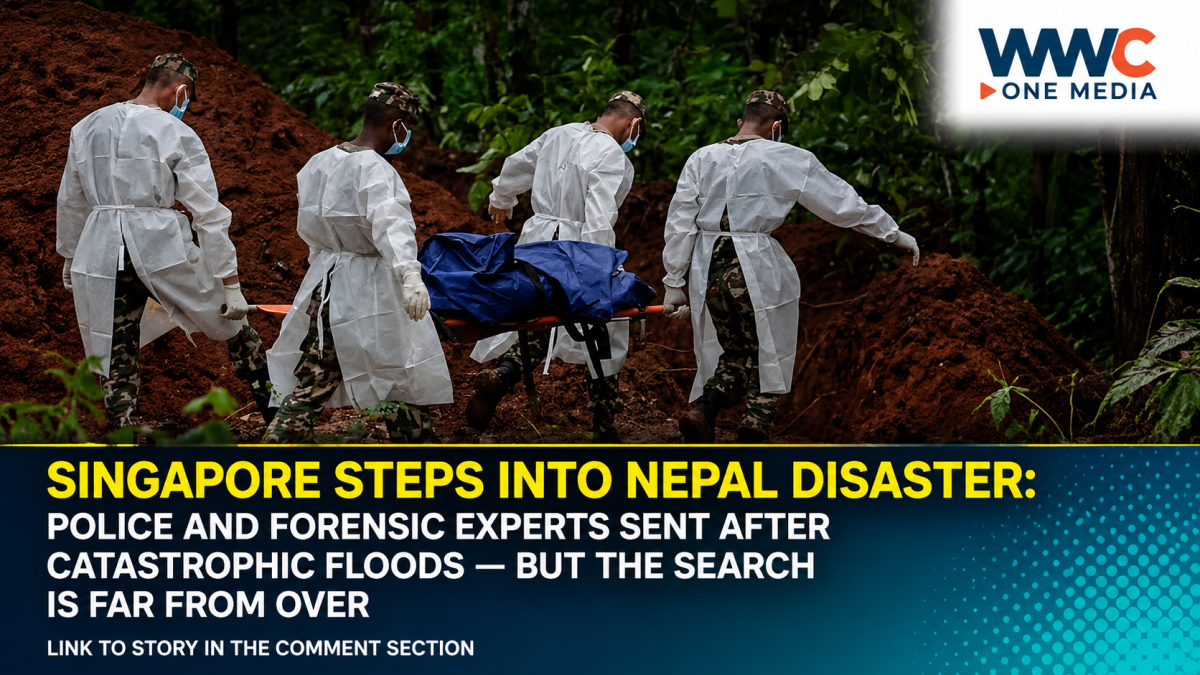
SINGAPORE — Singapore has deployed police officers and forensic specialists to disaster-hit Nepal as the international search for survivors and victims enters a critical stage following catastrophic floods along the Nepal-China border.
The Singapore Police Force (SPF) and the Health Sciences Authority (HSA) are sending personnel to assist Nepali authorities, particularly with Disaster Victim Identification (DVI), forensic work and aerial surveillance.
The deployment follows a formal request from Nepal for specialised assistance as rescue teams struggle across heavily damaged and difficult-to-access areas.
According to Singapore authorities, an initial group of 17 police officers and two HSA officers from the Forensic Medicine Division departed for Nepal on Sept. 1 and 2. Another 14 police officers are expected to join them, bringing the planned contingent to 33 personnel. The team is led by Assistant Commissioner of Police Patrick Tan.
The mission comes as Nepal continues to deal with the devastating aftermath of the Aug. 26 disaster, when a massive surge of water, ice, rock and mud swept through communities near the Nepal-Tibet border.
Singapore expands its humanitarian response
Singapore’s deployment is part of a broader humanitarian response.
The Ministry of Foreign Affairs said Singapore is also providing humanitarian supplies from civilian sources and the Singapore Armed Forces to support relief operations in Nepal.
Singapore previously contributed US$100,000 to the Singapore Red Cross’ fundraising appeal. The Red Cross had raised around S$1 million as of Aug. 31, according to Singapore’s MFA.
The Singapore Red Cross had separately pledged S$50,000 in humanitarian assistance, while Singapore-based disaster relief organisation Mercy Relief announced plans to provide about S$120,000 in emergency aid, including food, water, shelter and hygiene supplies for affected communities in Rasuwa district.
Singapore’s MFA Crisis Response Team has also been in Nepal since Aug. 27, providing consular assistance to Singaporeans affected by the disaster.
Nine Singaporeans remain unaccounted for
The Singapore deployment carries an added significance for Singapore because nine Singaporeans remain missing following the disaster.
Singapore police have begun seeking DNA samples from family members of the missing Singaporeans. Authorities said the samples could help identify victims recovered during the ongoing search and form part of Singapore’s support for Nepal’s victim-identification operations.
The missing Singaporeans include Shubakshi Rawla, Sumit Rawla, Estee Loeh, Ghosh Aditi, Ng Kit Kuen, Rajesvaran Ayyavoo, Rengarajan Prabu, Shalinny Deavy Elan Sozan and Subramaniam Diraviam, according to information reported by CNA.
For families waiting for news, the forensic mission is therefore not simply about documenting the disaster. It could become a crucial part of identifying those who remain unaccounted for.
Nepal’s death toll has surpassed 1,000
The scale of the disaster has continued to grow.
Nepal’s disaster authorities reported 987 bodies recovered and 3,916 people still missing as of Tuesday morning, with 11,814 people rescued. Nine Singaporeans were among those still unaccounted for.
Reuters reported on Sept. 2 that the number of confirmed deaths in Nepal had risen to at least 1,114, while thousands remained missing. China has separately reported deaths and missing people in Tibet.
The differing figures reflect the rapidly changing nature of the rescue and recovery operation, with authorities continuing to recover bodies and reconcile information from remote and badly damaged areas.
Hundreds could still be trapped in hydropower tunnels
One of the most urgent challenges is the search for workers believed to be trapped inside damaged hydropower facilities.
CNA reported that more than 600 hydropower workers were feared trapped in tunnels, while officials believed hundreds more could be trapped across multiple projects in the badly affected Rasuwa and Nuwakot districts.
Reuters reported that rescue teams have increasingly focused on hydropower tunnels because some underground areas may still contain survivors. Heavy machinery, helicopters and specialised rescue equipment are being used as authorities attempt to reach people buried behind flood debris.
The terrain, damaged roads, unstable slopes and continuing weather risks are making the operation exceptionally difficult.
A disaster that devastated the Himalayan border
The disaster began on Aug. 26 after a high-altitude collapse involving glacial ice and rock triggered an enormous surge of water and debris through Himalayan valleys.
CNA’s explainer said the event sent ice, rock, mud and water through communities and infrastructure at extraordinary speed, destroying roads, bridges, buildings and power facilities.
Scientists are still examining exactly what triggered the collapse, although experts have warned that a warming climate is increasing risks associated with unstable glaciers and high-altitude disasters.
Reuters reported that the floods generated an estimated 2.2 million tonnes of debris and damaged multiple hydropower facilities, reducing Nepal’s electricity generation capacity. Nearly 50 suspension bridges and 31 motorable bridges were also reported damaged or destroyed.
International rescue effort intensifies
Singapore is now among several countries providing specialised assistance.
India and China have sent technical and forensic expertise, while other countries have offered rescue and humanitarian support. Reuters reported that South Korea was also preparing a specialised emergency relief team.
China has meanwhile worked to restore access toward the worst-hit Gyirong border area in Tibet. Reuters reported that the reopening of the road has allowed heavier rescue equipment to reach areas that previously had to be supplied by air or accessed through difficult mountain routes.
The international response is increasingly focused not only on finding survivors but also on identifying victims, supporting displaced communities and restoring critical infrastructure.
For Singapore, however, the mission has another deeply personal dimension.
As police, forensic specialists and rescue teams head into some of the disaster’s hardest-hit areas, nine Singaporean families are still waiting for answers.
And with the search continuing underground, across mountains and through enormous fields of debris, the most difficult part of the operation may still be ahead.
WWC ONE MEDIA MJE




Leave a Reply